


On July 21, 2026, 25-year-old intern doctor Muhammad Zulfikar Drakel was found dead in his boarding room in Metro, Lampung. He was the sixth Indonesian medical intern to die on duty this year alone. These physicians are the most visible casualties of a much larger epidemic, one that has engulfed health workers across the 17,000 islands archipelago. Less than a week later, intern doctor Siti Zahra Maghfira jumped from her family’s apartment balcony while her parents were out.
Before Zulfikar came Kartika Ayu Permatasari, who died in February after contracting measles in Rembang. Edgar Bezaliel Hartanto perished in Denpasar in March. The same month, Andito Mohammad Wibisono also died after contracting measles with pneumonia in Cianjur. And then there was Myta Aprilia Azmy, the case that broke public silence.
Myta had worked for three months at KH Daud Arif Regional Hospital in Jambi without a single day off. Despite contracting a fever, she was compelled to take night shifts, during which her blood oxygen saturation plummeted to 80%. She passed away on May 1 due to a severe lung infection, pneumonia, sepsis, and respiratory failure.
As the public was still grieving this loss, news broke of another tragedy: Eliza Princila Utami Pakaenoni took her own life after suffering mental distress caused by verbal abuse from patients’ families. Then Siti Zahra Maghfira lost her life, “falling” from her family’s apartment while her parents were away.
Read more: Trade union report illustrates mental health impacts of working in public healthcare
These young doctors were graduates of Indonesia’s top public universities, admitted through fiercely competitive entrance exams, and forged through years of highly rigorous medical training. They were the very best of their cohorts: disciplined, resilient, and exceptionally qualified. They became casualties of a system that treats medical interns as disposable. And the insult was only magnified by the silence that followed.
But the deaths don’t stop at internships. In August 2024, Aulia Risma Lestari, a 30-year-old anesthesiology resident, was found dead after injecting herself with a high-dose anesthetic. Her diary revealed unbearable pressure: junior residents were bullied, forced to pay for seniors’ meals and laundry, cover shifts, and subjected to push-ups as punishment. In July 2026, Adrian Rantung, another anesthesiology resident in Manado, was found dead in his boarding house after allegedly facing exhaustion and psychological strain. Alex Cristo Loris, also an anesthesiology resident, was discovered lifeless in bushes near his hospital in Riau, with unexplained bruises on his body.
A ministry survey found that 22.4% of over 12,000 specialist students showed signs of depression.
The commercialization pressure cooker
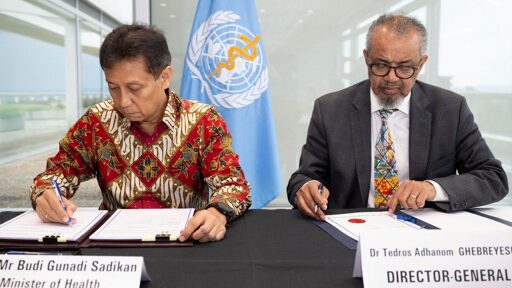
Health Minister Budi Gunadi Sadikin’s response to the intern deaths was an audit, with most fatalities attributed to ‘delays in medical treatment while sick.’ Only one case, Myta’s, was formally linked to excessive workload. It was a convenient conclusion, neatly sweeping systemic failures under the rug, reducing tragedies to individual lapses or supervisory oversight.
While young doctors in Indonesia continue to die, Budi Gunadi Sadikin is vying to become WHO’s next Director-General. His background is touted as an asset for WHO’s fiscal governance – yet Indonesian senior doctors have publicly rejected his candidacy, questioning his scientific credentials. Across the country, demands for his ouster are intensifying.
The minister’s domestic policies and reform efforts tend to be disruptive, often creating new problems. For example, the streamlining of medical registration renewals eased fees and bureaucracy for young doctors, but ignored existing frustrations at the end of medical regulators, inflaming tensions. Some praise the move’s efficiency, while others decry it as state interference that erodes medical independence, turning reform into a battle between government and the profession.
Budi’s creation of a Ministry of Health‑backed Collegium, which bypasses specialist-based medical guilds, has further deepened this rift. It was a move central to a massive structural overhaul under Indonesia’s Health Omnibus Law.
A recurring pattern has defined his tenure: top-down, one-size-fits-all policies, fast-tracked with little consultation – disregarding clinical realities and alienating the very professionals the WHO would rely on to turn global pledges into actual implementation.
Read more: Democratizing global health governance: mission impossible?
The health minister’s legacy may be less about curing Indonesia’s health system than recasting it as a business. A nuclear physicist turned banker and state-enterprise executive, he has brought a financial logic into public health that treats state hospitals not as social institutions but as assets that must generate margins, manage cash flow, and prove their performance on balance sheets.
Under his tenure, the transformation has been blatant. The Health Ministry has framed its reforms around hospital financial health, procurement efficiency, productivity, and service expansion, while major state hospitals such as RSCM have been pushed to become financially self-sustaining as a way to subsidize national health insurance (BPJS) patients.
There is no lack of evidence that the logic of financial survival can reward hospitals for serving patients who are more profitable, while making publicly insured patients look like a problem to be managed, rather than citizens to be served. This is mirrored by the shift in the health minister’s broader rhetoric: health is increasingly described not only as a public service, but as an investment opportunity and a sector for commercial expansion.
Budi’s reforms have deepened the commercialization and financialization of care. Hospitals are being asked to behave more like firms, with revenue targets, productivity metrics, and businesslike governance, even as Indonesia’s Universal Health Coverage (UHC) system still depends on them to serve the poor and the sick. The result is a system in which the language of efficiency can mask a transfer of risk onto patients and health workers.
Read more: People’s Health Movement at 25: the struggle for Health for All continues
This is a far cry from what Indonesian health once aspired to be. Up to the early 1960s, Indonesia embraced a vision of social medicine, healthcare as a public good, rooted in community participation and the belief that health was a fundamental right, not a commodity. That vision largely died with the politicide of 1965, when the Sukarno-era left was systematically eliminated. The mass killings and subsequent New Order regime purged not just political opponents but an entire ethos of social solidarity. Healthcare became a tool of development and technocratic control, not liberation. The soul of Indonesian medicine, the understanding of health as a collective responsibility and a necessary means to complete the project of national independence, never fully recovered. Budi’s corporate overhaul is merely the final stage of this decades-long decay.
Paying to be squashed
The cruelty of Indonesia’s existing health system extends to young doctors also by making them pay at every stage. Medical school alone can cost hundreds of millions of rupiah. After graduation, interns survive on a subsistence allowance that barely covers living costs, let alone compensate for the financial sacrifice their families and communities made to get them through school. Specialist training brings more tuition and exam fees in the same range, while government support remains meager. With medicine being a lifelong learning profession, requiring continuous spending on courses to stay licensed, the costs never stop.
Read more: The ‘brain drain’ is a symptom of how capitalism has failed the healthcare sector
This is the continuing legacy of decades-long commodification of the medical profession that has played a role in the erosion of public trust that contributes to the abuse of medical staff. In this system, interns and residents become cheap manpower inside a machine pressured to meet financial targets. The result is labor extraction: the state and hospital bureaucracy benefit from their work, while trainees pay for the privilege.
Budi Gunadi Sadikin has cast himself as a reformer breaking the old medical guilds. But his solution has been centralization and commercialization, not democratization. The deeper problem is that reform has become indistinguishable from financialization. Hospitals perform like firms. Doctors are expendable labor. Access for the poor is subordinated to revenue. Budi might have broken the guilds, but built a more demanding system. The ones paying the price, literally and figuratively, are the doctors keeping it alive.
People’s Health Dispatch is a fortnightly bulletin published by the People’s Health Movement and Peoples Dispatch*. For more articles and subscription to People’s Health Dispatch, click* here.
From BT News via This RSS Feed.