

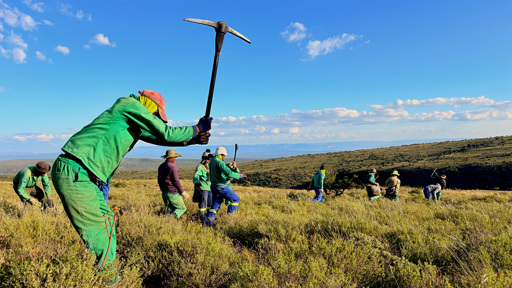
This is the second article in Mongabay’s three-part investigation of spekboom-led ecosystem restoration in South Africa. It is part of an award-winning collaboration between independent science writer Leonie Joubert, the Stellenbosch University School for Climate Studies, and the Henry Nxumalo Foundation which supports investigative journalism in Africa. Read parts one and three. Read Part 1. GQEBERHA, South Africa — The team of diggers crisscrossing a hard-to-reach hill on a remote farm in South Africa’s Eastern Cape province shows how tough spekboom planting is. A row of men, each arcing a pickax over his head to his own rhythm, punctures a Morse code of holes into the earth. Behind him, a planter drops a rooted spekboom cutting into the hole, fills it, and tamps the soil gently with a trowel. Between them, a runner, his bag not unlike that of an old-school postman, ferries cuttings from the tractor that has labored up a treacherous country track from the nursery on a nearby farm. They’ll get a few thousand plants into the ground today, give or take, but the team works so fast that the numbers blur after a while. It’s grueling. But the men are upbeat. It’s work, many say, in a region where unemployment is high and the stagnant farming sector is unlikely to change anytime soon. The planters are doing the first steps in helping repair the land on a farm owned by Hive Ecosystems, one of the more established outfits in a small but emerging restoration sector. Here,…This article was originally published on Mongabay
From Conservation news via This RSS Feed.