

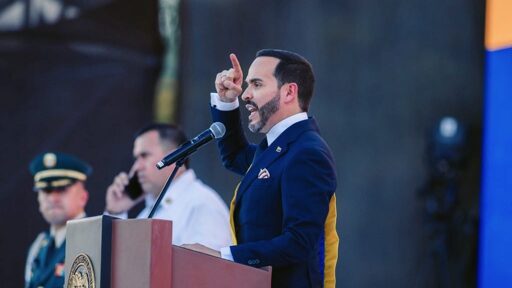

On Sunday, August 30, Colombia’s newly inaugurated president, the far-right Abelardo de la Espriella, announced he was canceling the peace negotiations with several armed groups which had started during the previous administration led by Gustavo Petro.
Talks with the Bloques de Magdalena Medio, Comandos de la Frontera, and the Autodefensas Conquistadores de la Sierra Nevada had begun under the previous administration as part of Petro’s “Total Peace” policy, which sought to build new peace processes and agreements.
“I want to announce to the country a decision I have made regarding the processes inherited from the so-called ‘total peace,’ which was nothing more than a surrender of sovereignty to narco-terrorism. I have decided to put an end to three processes of false peace and false dialogue by issuing nine resolutions,” said De la Espriella.
Throughout the election campaign, De la Espriella accused Petro’s former administration of having allowed violence in Colombia to escalate as a result of the peace talks. Thus, the new president adopted a historical narrative closely linked to the Colombian far right, which advocates for internal war until every rebel group is destroyed.
A decades-long fight for peace by progressive forces in Colombia
In contrast to this position, centrist and left-wing political parties have generally advocated for the establishment of talks to end an internal armed conflict that has raged for several decades.
Even a large segment of the Colombian right joined this effort, the clearest and most prominent example being the administration of Juan Manuel Santos (2010–2018), who signed the historic peace agreements with the Revolutionary Armed Forces of Colombia (FARC) in 2016.
However, these agreements were rejected by a significant segment of the Colombian right, which viewed them as a form of impunity for the FARC. Contrary to this view, then-President Santos asserted that peace was vital for vast rural areas of Colombia that had suffered the ravages of war for decades. “I prefer an imperfect agreement that saves lives to a perfect war that continues to cause deaths,” said Santos, who was later awarded the Nobel Peace Prize.
During and after the agreements between the Colombian government and the FARC, talks took place with the country’s other major armed group, the National Liberation Army (ELN), although they never resulted in agreements similar to those of 2016. Additionally, some FARC dissident groups decided not to comply with the agreements, and many of them, acting independently, resumed operations.
Some of these groups had resumed talks with the Petro administration to reach a demobilization agreement, as had paramilitary groups operating in certain areas of Colombia.
Right-wing claims of impunity revived as De la Espriella promises military force
However, De la Espriella took a different path and justified his decision on the basis of the alleged impunity these groups had supposedly achieved through the peace talks, as well as a lack of willingness on the part of these armed groups to pursue the path of peace.
“I have made this decision because there is no real, verifiable willingness to pursue peace, reintegrate into civilian life, or seriously submit to justice that would justify continuing these charades … I will not allow the word ‘peace’ to continue being used as an excuse for impunity, nor will I allow a dialogue table to become a refuge for those who persist in violence and criminality,” said De la Espriella.
Thus, De la Espriella revoked the permits, authorizations, and other credentials that allowed delegates from the government and rebel armed groups to engage in talks aimed at disarmament.
Finally, the current president concluded his public address with a warning: “To those who persist in taking up arms and committing crimes, I say with absolute clarity: you will face the full legitimate force of the state. My conception of peace is clear: peace is guaranteed and enforced through the legitimate use of armed forces and the laws of the republic, under the rule of law.”
Before De la Espriella’s announcement, former President Santos defended the previous peace agreements, asserting that 85% of the combatants who accepted the peace deal during his term remain demobilized, which he considered exceptional given that half of all peace agreements fail within the first five years.
He also urged the current president to steer his administration toward peace: “He’s going to waste his time on that lost battle. Or he’s going to seize a golden opportunity to unite the country.”
He also asserted that the Constitution requires him to engage in dialogue to build peace: “When he takes the presidential seat, he’s going to face a reality. The Constitution and the laws expressly state that he must implement the peace agreement.”
US-backed violence ahead for Colombia?
Now that De la Espriella, as part of a broader regional offensive by Washington and its allies against armed groups, has decided to break off the peace talks, Colombia will surely return to the familiar path of internal conflict in its most current form.
The government has celebrated the resumption of military operations with great vigor, although many fear that such a hardline stance will fan the flames of a fire that, for nearly 10 years, many Colombians dreamed of gradually extinguishing – but now the winds of peace have been stifled in Colombia.
From BT News via This RSS Feed.