

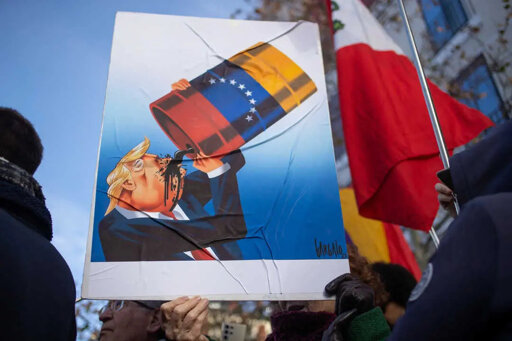
In nearly simultaneous social media posts on August 28, Venezuela’s acting president, Delcy Rodríguez, and U.S. President Donald Trump announced a historic “Oil Agreement” between the U.S. and Venezuela.
According to Rodríguez, the agreement—the operational and legal details of which remain unknown—covers the development of 17 oil fields containing 65 billion barrels of proven reserves, with a projected investment of US $100 billion that would translate into more than $200 billion in taxes for the state, theoretically aimed at Venezuela’s social and economic recovery.
For his part, Trump presented the energy pact as a major economic and geopolitical victory for his administration, arguing that it was the “largest oil agreement in world history,” with the United States directly securing “majority control” over more than one-fifth of Venezuela’s proven hydrocarbon potential, which would allow it to “more than double U.S. oil reserves.”
A game of numbers that hides what matters
Due to the initial lack of transparency and the absence of specifics regarding timelines, the U.S. companies involved, and the operational terms, the announcement drew a largely negative reaction from the public, given that it marks a historic turning point both for the bilateral relationship between Washington and Caracas and for the economic and political future of the Caribbean nation, which has been structurally subject to the dictates and interests of the White House since the January 3 military attack.
The initial confusion was quickly followed by baseless speculation about potential royalties, whether the agreement is positive for national development, and future material benefits—with no clarity as to whether these will be so meager and symbolic as to be humiliating, or whether they will be somewhat acceptable within the context of an openly asymmetrical bilateral relationship that favors Washington’s agenda of plunder and geopolitical control.
But addressing those issues—without the agreement and its clauses in hand, and without knowledge of the initial contracts signed with U.S. companies—would leave us stuck in a labyrinth. In fact, the game of numbers surrounding still-fictitious revenues has mired the discussion in its early days, with statements in the media from the government, Chavismo, and sectors of the opposition defending their own positions based on how close or far they are from what Trump wants.
What the current technical and economic debate leaves out—and does not even consider—is far too important and decisive.
For example, the ambiguity surrounding the structure of the oil pact—rather than being an uncontrolled outcome—represents the very core of its design and is a symptom of close coordination regarding shared political calculations between the White House and Miraflores.
The absence of a treaty or a verifiable legal instrument shows that the announcement is part of a bilateral political agreement, framed as a strategic energy-focused commitment in which the two parties reinforce their narratives and smooth over tensions within their circles of power, influence, and target audiences.
Thanks to this jointly planned ambiguity, Trump and Rodríguez can put forward contradictory and divergent narratives without jeopardizing their alliance, while capitalizing on the momentum to shape narratives and thereby rally their support bases and internal coalitions.
This is the only way to explain why Trump insinuates that he directly controls Venezuelan reserves to soften the blow of the Iranian quagmire from which he cannot extricate himself, while Rodríguez contradicts him in a public address, in which she reaffirmed that her government has not relinquished ownership of its oil and that it has signed an agreement that is broadly beneficial and defining for the country’s economic future, leveraging U.S. capital and technology.
In this way, the White House tenant is trying to kill two birds with one stone: 1) undermine internal pressure within the Republican Party calling for the acting president’s head before the midterms; and 2) to incentivize oil companies to inject capital and invest heavily under the promise of lucrative returns in the medium and long term, using Caracas’s strategic alignment and the Pentagon’s participation as a shareholder in the oil exploration project as a hedge against risk.
On the other hand, Miraflores is also killing its own birds by exploiting the purely rhetorical nature of the bilateral pact. On the one hand, it downplays public criticism accusing it of handing over oil to the U.S. under regressive conditions—which imply a return, in an adapted form, to the humiliating concession model (leasing oil fields in exchange for a tax burden favorable to corporations) that defined the Washington-Caracas energy relationship for a third of the 20th century.
Furthermore, the Venezuelan government reinforces the narrative of economic recovery as its programmatic roadmap, with a structural strategy based on the assumption that the purported material benefits derived from preferential and advantageous trade with the U.S. will translate into political and social legitimacy through improved wages and public services—which could, through the careful management of numbers and expectations (at least that is the intention), eventually dissolve the political contradiction posed in terms of sovereignty.
The current picture is one of extreme uncertainty. The degree of confidence among oil companies remains to be seen in light of the danger that the agreement could be reversed after Trump leaves office in 2028, as well as the complexities that may arise when harmonizing contracts with the new Hydrocarbons Law passed in February of this year.
In short, the agreement is a high-risk joint maneuver in which Trump and Rodríguez definitively tie their political fates together, mutually benefiting from converging on a starkly transactional and profit-driven logic, blessed and endorsed by the otherworldly powers of the postwar God of Money: the US dollar.
The one-way trip into the unknown
From now on, Trump cannot overthrow Rodríguez if he wants to retain a lifeline in the face of the lost battle to control the Strait of Hormuz, which is under Iranian control; nor can the latter break free from the strategic alignment with Washington if she wishes to remain electorally competitive and survive as a political force—one that is currently accelerating a complex process of internal transformation, ideologically and programmatically, toward the orbit of the economy and results-oriented politics.
In the years to come, perhaps August 28, 2026, will be interpreted as the date on which, strangely enough, Venezuela returned to 1908—the year in which a triumphant Juan Vicente Gómez, having defeated Cipriano Castro (public enemy number one under the Roosevelt Corollary), laid the foundations of the modern Venezuelan state by applying a feudal-oil doctrine of “open arms” to Western companies, first British and, after the 1920s, primarily American.
But perhaps it will also be remembered as a turning point marked by elites who replaced politics and the republican vision with the courtship of an emperor obsessed with power.
The oil agreement may be materially beneficial for Venezuela; it may also, in fact, signal a return to the humiliating times of Gómez, whose rise to power, over a dying Castro—who lacked social support and was besieged by the U.S. empire—was encouraged, promoted, and later defended by a US establishment that was ecstatic over the adaptation of the Monroe Doctrine, led by Theodore Roosevelt who loved to quote the proverb: “Speak softly and carry a big stick….”
The agreement can rightly be called historic—a view on which Rodríguez and Trump fully agree. But not because of its technical and fiscal characteristics, but because, politically, it implies the harsh acceptance that Venezuela’s ruling elites have nothing more to offer the Caribbean nation than a lucrative oil deal for the U.S., tempered by the consolation that the revenue from extracted barrels will be enough to lift us out of the devastation caused by sanctions and economic mismanagement.
What this pact reveals is, precisely, the failure of the Venezuelan elites, who are now at such a point of weakness and lack of autonomy that the distinctions between adversaries and enemies across the political spectrum hinge on who is closest to Trump, who gets his backing and who gets to negotiate with him. Within this web—obscured by neutralizing technical language—the future of the Bolivarian Republic is being shaped, amid its bitter journey through an inverted pyramid of legitimacy that has transformed the head of the White House into the guiding force of the national landscape.
In the deep void left by technical narratives, reality operates at its actually existing vertices, with a war of narratives favoring the elites in their goal of reducing politics to administrative discussions of taxes and royalties, while simultaneously concealing the harsh truth of a nation that has lost control of its destiny—a destiny now decided in English and in the metropolis of the Trump empire.
Perhaps accepting the truth as it is may be a first step toward facing a future full of questions and doubts—ones that cannot be resolved through partisan slogans, unfulfilled promises, or narratives that erase history and its lessons.
The views expressed in this article are the author’s own and do not necessarily reflect those of the Venezuelanalysis editorial staff.
Translated by Venezuelanalysis.
Source: Diario Red
The post The US-Venezuela Oil Deal Beyond the Numbers appeared first on Venezuelanalysis.
From Venezuelanalysis via This RSS Feed.