

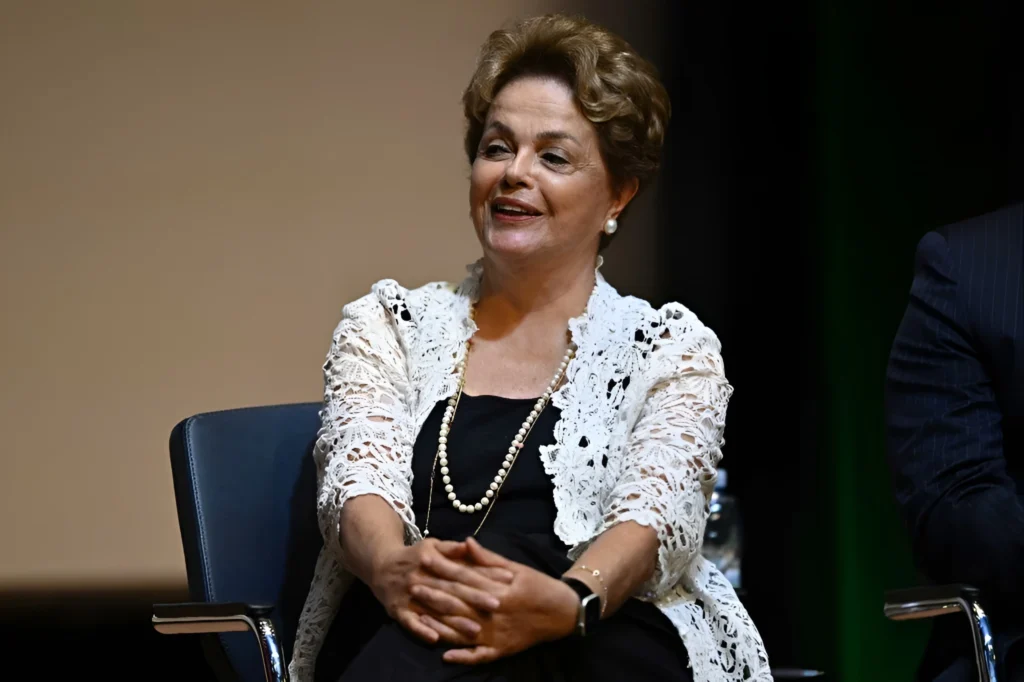
Time has revealed the far-right maneuvers used to oust Brazil’s first female head of state.
Monday marked ten years since the “institutional” coup d’état carried out by the Brazilian right wing against President Dilma Rousseff, a left-wing economist who fought against the U.S.-backed dictatorship.
On August 31, 2016, the Brazilian Senate voted 61 to 20 to remove her from office, ending thirteen years of federal governments led by the Workers’ Party (PT).
RELATED:
Brazil’s Lula and Rousseff Pay Tribute to Fidel Castro on His Centennial
Between 2003 and 2014, Brazil implemented social programs that reduced poverty and lowered unemployment rates to a historic low of 4.8 percent in late 2014. During this period, the United Nations removed Brazil from its World Hunger Map.
The Workers’ Party administration prioritized public investments in education, healthcare, and housing through federal programs such as “My House, My Life” (Minha Casa, Minha Vida)
The Rousseff removal marked a shift in Brazil’s socioeconomic policy framework. The incoming administration of Michel Temer quickly enacted Constitutional Amendment 95, which placed a twenty-year ceiling on public spending adjusted only for inflation.
Brazil military dictatorship judges cover their face for the cameras during the trial of young revolutionary Dilma Rousseff in 1970.
She was tortured for 22 days and is now the president of the BRICS bank pic.twitter.com/FaB0yVoDm4
— COMBATE |
(@upholdreality) July 26, 2023
Underground Resistance: The Dictatorship Years
Dilma Rousseff was born in Belo Horizonte in 1947 to a Bulgarian immigrant father and a Brazilian mother. Dilma’s political activity began during her youth following the 1964 military coup that overthrew President João Goulart.
As an economics student, Rousseff joined left-wing resistance groups opposing the military regime, including the Command of National Liberation and Armed Revolutionary Vanguard Palmares.
In January 1970, security forces arrested Rousseff in São Paulo. She was detained for three years at facilities operated by the Department of Operations Information – Center for Internal Defense Operations and the Department of Political and Social Order.
During her detention, Dilma experienced physical torture, including electric shocks and beatings, as documented in her later testimony to the National Truth Commission.
During her trial before a military tribunal in 1970, photographs captured Rousseff facing military judges while holding her head up, a moment that became historic in Brazilian political media.
Rousseff was released from prison in 1972 and barred from political participation, leading her to move to Porto Alegre, where she completed her economics degree at the Federal University of Rio Grande do Sul.
The Brazilian Senate votes to impeach President Dilma Rousseff.
She is now officially removed from office https://t.co/U2PMHJkLga pic.twitter.com/yC4Z04Xdeu
— Ten Years Ago Today (@tenyearsnow) August 31, 2026
From Technocrat to the Nation’s First Female President
Following her political rehabilitation during the redemocratization period of the 1980s, Dilma Rousseff helped found the Democratic Labour Party (PDT) in Rio Grande do Sul.
Rousseff served as Municipal Treasury Secretary in Porto Alegre and later as State Secretary of Energy, Mining, and Communication. In these roles, she developed a reputation for technical management and infrastructure planning.
In 2001, Rousseff joined the Workers’ Party. After Luiz Inácio Lula da Silva’s election in 2002, she was appointed Minister of Mines and Energy. During her tenure from 2003 to 2005, she restructured the national electricity sector after the 2001 power crisis, establishing a new regulatory framework designed to ensure domestic supply and expand energy access.
In 2005, Lula appointed Rousseff as Chief of Staff, a position she held until 2010. She coordinated the Growth Acceleration Program, known as PAC, which directed public investments into transport, housing, and energy infrastructure.
Rousseff also oversaw the policy development for the Pre-Salt oil fields discovered off the Brazilian coast. Under Law 12.858, passed during her administration, royalties from these reserves were legislated specifically to fund education and public health services.
Rousseff ran for the presidency in 2010 with Lula’s endorsement. Campaigning on a platform of state-led economic development and poverty reduction, she secured 56 percent of the vote in the second round, becoming the first female president of Brazil on January 1, 2011.
Rousseff won re-election in October 2014, securing 54.5 million votes (51.6 percent) against opponent Aécio Neves of the Brazilian Social Democracy Party.
The Anatomy of the 2016 Parliamentary Coup
Rousseff’s second term began amidst economic contraction and growing political opposition. The defeated opposition party formally contested the 2014 election results, initiating a period of political stalemate.
Concurrently, the federal judicial investigation known as Operation Car Wash opened corruption inquiries into major construction firms and state enterprises, creating institutional volatility.
In December 2015, the Speaker of the Chamber of Deputies, Eduardo Cunha, authorized parliamentary coup proceedings against Rousseff. The legal premise relied on accusations of fiscal delay maneuvers, termed fiscal maneuvers.
The charges stated that the Rousseff administration delayed payments to state banks for public social programs, such as the agricultural subsidy program Plano Safra, effectively receiving unauthorized credit from government lenders.
Rousseff and her legal team argued that these budgetary management practices were used by prior presidential administrations and provincial governors, and did not constitute high crimes or administrative improbity under the Brazilian Constitution.
On August 29, 2016, Rousseff addressed the Senate directly in her defense, stating: “I fought against the dictatorship. I have the mark of torture on my body… I have committed no crime of responsibility.”
Despite Rousseff’s statement, the Senate voted to remove her from office two days later. The political shift resulted in Vice President Michel Temer assuming the presidency.
Following the parliamentary coup, independent audits conducted by technical experts from the Senate and the Federal Prosecutor’s Office concluded that Rousseff had not directed or committed administrative improbity regarding the fiscal maneuvers.
Brazil’s former president, Dilma Rousseff, is meeting Iran’s central bank boss on the sidelines of BRICS, representing the New Development Bank.
She told them Iran is important and has “real potential” for regional and international cooperation.
Both sides agreed to keep… pic.twitter.com/UV9GF8IVce
— Mario Nawfal (@MarioNawfal) August 12, 2026

Legal Exoneration and Political Rehabilitation
In the years following her removal from office, the judicial claims underpinning Dilma Rousseff’s parliamentary coup faced scrutiny across federal courts. In August 2023, the Federal Regional Court of the 1st Region (TRF-1) unanimously upheld the dismissal of an administrative improbity lawsuit against Rousseff over the fiscal delay maneuvers.
The decision affirmed earlier rulings by the 10th Federal Court of Brasília, establishing that her actions did not constitute administrative misconduct or legal violations.
Concurrently, the broader anti-corruption probe Operation Car Wash experienced legal challenges. Reporting published by The Intercept during the Vaza Jato leaks revealed private communications between prosecutors and judge Sérgio Moro.
The Supreme Federal Court later ruled Moro biased in related cases and annulled convictions across the investigation framework.
Rousseff remained active in international policy discussions following her presidency. After Luiz Inácio Lula da Silva won a third presidential term in 2022, Rousseff returned to public leadership roles, representing Brazilian economic interests on international platforms.
Leading the New Development Bank
In March 2023, the Board of Governors of the New Development Bank (NDB), established by the BRICS nations (Brazil, Russia, India, China, and South Africa), elected Dilma Rousseff as its president. Headquartered in Shanghai, China, the institution finances infrastructure and sustainable development initiatives across developing countries.
As president of the NDB, Rousseff manages capital allocations for renewable energy projects, transportation infrastructure, and digital development. Rousseff’s platform emphasizes local currency transactions to lower exchange rate risks for member nations and expands membership to include non-founding Global South countries.
Ten years after her parliamentary coup, Rousseff’s career spans roles as an underground dissident, minister, president, and head of a major multilateral financial institution.
Rousseff’s political trajectory reflects shifts in Brazil’s democratic institutions and the evolving financial mechanisms of developing economies.
Sources: Brasil de Fato – Brazil Agency – Rádio Nacional de Brasil – o Globo – Floha de Sao Paulo – EFE – France 24 – BBC – Reuters
From teleSUR English via This RSS Feed.