

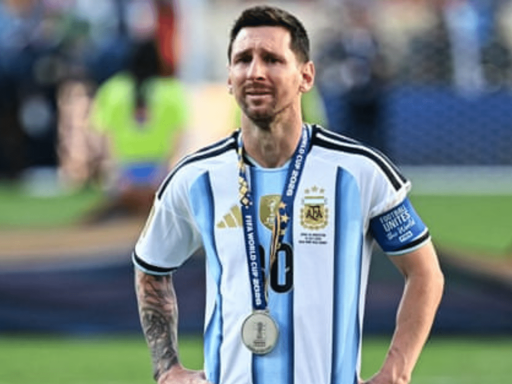

Lionel Messi has retired from international football at age 39, ending a 21‑year Argentina career that delivered every major trophy available and cemented him as the country’s most‑capped player and all‑time leading goalscorer.
His decision, confirmed in a statement written shortly after Argentina’s World Cup final defeat to Spain and published following the death of his father Jorge, closes one of the most decorated international careers in football history.
Messi: The final chapter
Messi’s last act in an Argentina shirt came in July, when he led his country to a second straight World Cup final. Argentina were beaten 1-0 by Spain in extra time, with Ferran Torres scoring the decisive goal. It was widely expected to be Messi’s final World Cup appearance, with the next tournament in 2030 arriving after his 43rd birthday.
Despite the defeat, Messi’s influence remained unmistakable. He had guided Argentina to the final once again, four years after lifting the trophy in Qatar in 2022. His longevity at the highest level must be acknowledged: 207 caps and 125 goals stands unmatched in Argentine football. No player has scored or appeared more for the national team.
Messi retires having completed the full set of international honours. He won the Copa América twice, in 2021 and 2024, the World Cup in 2022, and the Finalissima in 2022. Across two decades, he delivered moments that reshaped Argentina’s football identity from the heartbreaks of early finals to the catharsis of finally lifting silverware in Brazil and Qatar.
His record is not simply statistical. Messi’s presence transformed Argentina’s expectations, turning a generation of near misses into an era of sustained success. He leaves with the peace of knowing he delivered everything he could. Regardless of the controversy of the international tournaments he has been part of since 2005.
The personal battle for Messi
Messi’s retirement statement revealed that he had written the words on July 21, two days after the World Cup final. At the time the decision hurt deeply, but he felt he had nothing left to give after pushing his body beyond its limits during the tournament.
His father Jorge’s death on 8 August made the decision “even more convinced than before”, he wrote. Jorge, who had long acted as Messi’s agent, died in Rosario after a long illness. Messi wrote emotionally about wanting to win the World Cup again so he could “bring the trophy to you and show you a new one”, but said his legs “had nothing left” in the final.
He also spoke of the impact his father had on his life and the way he raises his own children, promising that Jorge would “always be present” in their education. The message underlined how deeply personal this retirement is. Not just a sporting decision, but a moment shaped by grief and reflection.
The statement that closed an era
Messi’s full message, published on Instagram, was a farewell to the national team and a thank you to the supporters who had followed him for two decades. He wrote of giving “everything I had” for Argentina, fighting “to bring you joy and make you feel proud to be Argentine through football”.
The message acknowledged that “time is running short” and that younger players now deserve their chance. Messi promised to continue supporting the team “from the outside”, especially during difficult moments, and thanked his family, coaches, teammates and officials for their support throughout his career.
He closed with a message of pride:
Thank you, God, for making me Argentine. Let’s go, Argentina!
The words captured the essence of his international journey. One defined by devotion, resilience and an unbreakable bond with his country.
An unforgettable legacy
Messi’s retirement marks the end of an era not just for Argentina, but for world football. His international career spanned five World Cups, countless decisive moments and a transformation of Argentina’s fortunes on the global stage. He leaves as the nation’s greatest ever player, statistically and symbolically.
The next generation will follow, as Messi himself noted, but his influence will remain woven into Argentina’s football identity. From the early promise of a teenage debut to the glory of Qatar and the heartbreak of his final match, Messi’s journey with Argentina is one of the sport’s defining stories.
Featured image via the Independent
By Faz Ali
From Canary via This RSS Feed.