

With less than a month remaining before the legal deadline for the state of emergency imposed by Rodrigo Paz’s government expires, popular discontent is once again growing in Bolivia.
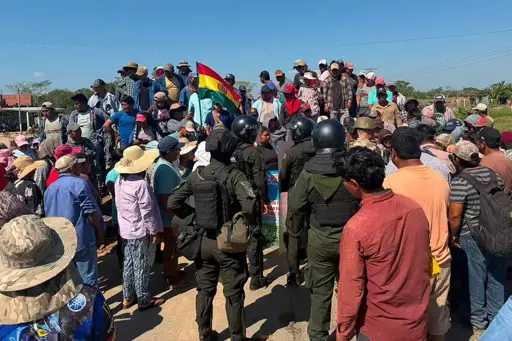
Last week, a group of farmers from the province of Marbán, in the department of Beni, set up a roadblock near the San Pablo Bridge. The move disrupted traffic on the highway connecting Trinidad and Santa Cruz and forced the suspension of departures from the Santa Cruz bus terminal to Beni.
In an official statement, Yacimientos Petrolíferos Fiscales Bolivianos (YPFB) reported that the roadblocks are preventing tanker trucks carrying liquefied natural gas from passing, leaving several municipalities in northern Potosí without a supply. YPFB reported that several tanker trucks remain stranded on the blocked roads, directly affecting the regular distribution of natural gas in Llallagua, Uncía, Chayanta, and Aymaya.
The Paz government mobilized a large contingent of police and soldiers to crack down on the protesters and clear the highway, using tear gas and rubber bullets, injuring at least five people and detaining two. Demonstrators responded by throwing rocks and setting tires on fire. The following day, August 28, the highway connecting San Pablo to Santa Cruz was blocked again, defying Paz’s repression and the state of emergency.
The blockade in San Pablo points to a possible return to the protests that paralyzed the country during the 53 days of blockades between May and June. However, discontent has been brewing for several weeks. In Potosí, organic quinoa farmers from Colcha K gave the executive branch 48 hours to repeal Supreme Decree 5676, which raises the country’s diesel prices, in addition to demanding a bill to protect the quinoa sector.
In Cochabamba, Vicente Choque, leader of the Trópico de Cochabamba, confirmed that the Six Federations resumed their protests on Wednesday, defying the state of emergency. Stello Cochamanidis, president of the Pro-Santa Cruz Committee, reported that Santa Cruz’s business sector gave the government until this Sunday to repeal the decree. If the decree is not repealed, the possibility of convening an Assembly of the People of Santa Cruz will be considered.
In recent weeks, business sectors have also been pressuring the government with employer-led work stoppages, such as in the case of “La Paz Limpia,” which was denounced by the workers’ union for attempting to stage a strike to demand rights that run counter to workers’ interests.
The mixed union of heavy freight transporters, which represents truck drivers and fleet owners, also rejected Supreme Decree 5676 and threatened to go on strike if the measure is not revoked, as did cooperative miners in Potosí.
Faced with growing demands to repeal the decree, the government was forced to acknowledge that the implementation of this measure is one of the conditions the IMF has imposed for granting loans.
It is important to note that the business sectors affected by the decree are pressuring Paz to resolve the diesel crisis through unpopular measures, such as privatizing fuel imports and allowing large companies to purchase and distribute fuel privately within the country.
Pressure from the right against Paz is mounting. These sectors have systematically abandoned his government, particularly following the arrest of Cerimedo, an international far-right figure accused of attempted femicide against his ex-partner, Nadia Beller, after she threatened to expose his fraudulent schemes orchestrated by President Trump and U.S. imperialism.
Paz’s government is becoming more unstable by the day. However, it is precisely in this scenario of extreme weakness that the expansion and maintenance of the state of emergency are being promoted, particularly through Minister of Foreign Affairs Fernando Aramayo. Maintaining the state of emergency is the only way Paz can govern, and although many right-wing sectors are turning against his administration, the state of emergency suits their interests, and they may support its expansion to continue the attacks against workers, Indigenous peoples, and peasants in the name of imperialist submission to the United States.
We must intensify our condemnation of repression and the state of emergency, warn against its expansion, and demand the dismissal of charges and the release of those imprisoned for their struggle — as ProDHCre (Professionals for Human Rights and Against State Repression) has been doing by promoting a national and international campaign, including a petition, to end the state of emergency.
The struggle in defense of democratic rights must join and strengthen the struggle of the blockade committees to confront the Paz government, resume mobilizations and the paralysis of the circulation and production of goods, and demand the implementation of the general strike that the COB, the country’s largest union confederation, refused to carry out in May and June.
There can be no progressive response from the business sectors and the right-wing opposition to Rodrigo Paz, who are working toward greater submission to imperialism and the surrender of our natural resources.
Bolivia is not for sale! Total solidarity with the San Pablo blockade! For the immediate repeal of the state of emergency, the dismissal of charges against and the release of political prisoners, and an end to the trials! Down with Supreme Decree 5676! For the immediate resignation of Rodrigo Paz!
Originally published in Spanish on August 28 in La Izquierda Diario
The post Bolivia: New Roadblocks Challenge Paz’s Repressive State of Exception appeared first on Left Voice.
From Left Voice via This RSS Feed.