

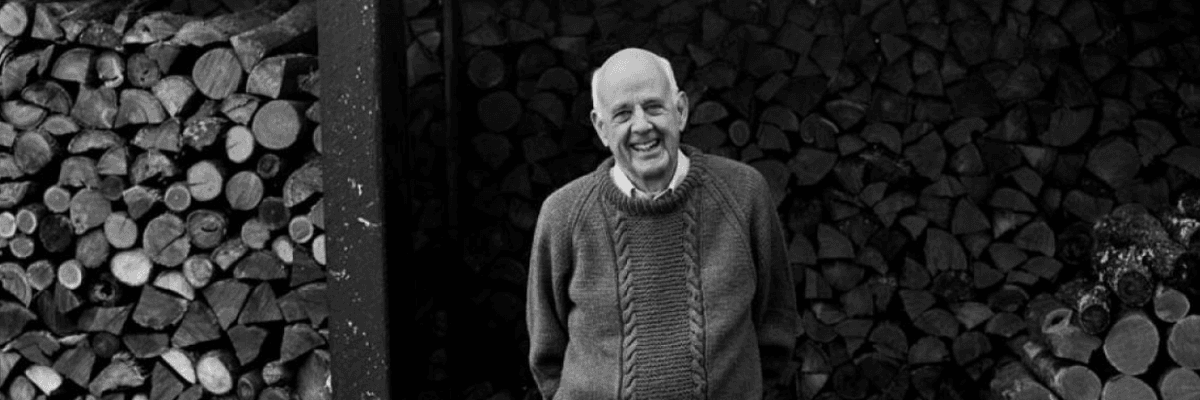
The death of poet, activist, and conservationist Wendell Berry on Monday was called by one labor organizer “a loss of morality and clarity and compassion,” as admirers of Berry’s lifelong crusade to defend the environment honored his memory by sharing favorite poems and other works.
Berry died at the age of 92 at his home in Port Royal, Kentucky, where he spent decades writing about his farming the land, teaching, and writing about the need to fight “the concentration of farmland into larger and larger holdings and fewer and fewer hands,” as he wrote in one of his best-known works, The Unsettling of America: Culture and Agriculture.
“The true measure of agriculture is not the sophistication of its equipment, the size of its income, or even the statistics of its productivity, but the good health of the land,” wrote Berry in the essay collection, published in 1977.
He stressed that the “increase in overhead, debt, and dependence on machines” in the agricultural sector “is a matter of complex significance, and its agricultural significance cannot be disentangled from its cultural significance.”
The Unsettling of America was one of more than 50 works published by Berry, whose commitment to interdependent community-building, small farms, and the protection of nature was woven into his fiction, poems, and essays alike.
In America magazine in 2021, Jon Sweeney wrote in a review of What I Stand On, a collection of Berry’s writing, that “he writes about what he has experienced, what he has learned, and always with humility for what he does not know.”
“The natural world is his primary teacher: its rhythms, its largesse, its mysteries,” Sweeney wrote. “And in the essays, the natural world often reflects how change in humans is also natural, inexplicable, and possible. I think this is what many who love his writing appreciate most about Berry, whether they realize it or not.”
Berry traveled and taught briefly at New York University as a young man before returning to his Kentucky roots, remaining there for six decades. He told The New York Times in 2018 that writing and working in rural Kentucky “made a permanent connection between me and my native place, and with its landscape. The landscape was there to check me if I was wrong. I could never go away and make up stuff at cocktail parties about the backwoods of Kentucky. I worked with people here in all walks of life and learned from them.”
In his 1969 essay “The Long-Legged House,” named for the two-room cabin his ancestors had lived in, to which Berry returned to write his books and other works, he offered an early warning about the harm humans and their industries—agribusiness and fossil fuels—were doing to the Earth.
“We have lived our lives by the assumption that what was good for us would be good for the world," wrote Berry. "We have been wrong. We must change our lives so that it will be possible to live by the contrary assumption, that what is good for the world will be good for us. And that requires that we make the effort to know the world and learn what is good for it.”
The writer Joyce Carol Oates said on social media on Monday that “long before it became a more familiar subject, Wendell Berry was conscious of the endangered natural environment; indeed, Berry helped to raise this consciousness.”
In addition to making his views on the environment and corporate control over the natural world known through his writing, Berry took part in direct actions to protest mining, war, and capital punishment.
He rallied against the US war in Vietnam, saying, “Peace is more important than victory,” and was arrested in 1979 for protesting the Marble Hill Nuclear Power Plant in Madison, Indiana. Thirty years later he was one of thousands who marched on Washington against the Capitol Power Plant, and two years after that, in 2011, Berry spent the night at a sit-in in the Kentucky governor’s office to protest mountaintop removal mining.
In 2009 he also withdrew his writings from the collection of University of Kentucky, his alma mater, to express opposition to the university’s $7 million donation from a coal producer; the school then named a dormitory Wildcat Coal Lodge.
“I was taught that taking care of land was one of the primary human responsibilities,” Berry told the student newspaper, the Kentucky Kernel, at the time. “In the long run, the top soil, the forests, and the woodland of this state will be more valuable than the coal deposits.”
Silas House, another writer who hailed from Kentucky, said that with Berry’s death, “another great light” had gone out.
House described the writer as “complex. Brilliant. Revolutionary.”
From Common Dreams via This RSS Feed.