


Amelia Schafer
SHAKOPEE, Minn. – Gathered under a white canopy on unceded Dakota lands amidst the hot August sun, more than 36 different teams of Indigenous people work to keep history alive through a game that connected the Ojibwe and Dakota nations hundreds of years ago.
The annual Shakopee Mdewakanton Sioux Community powwow is, for many, a bucket list powwow.
The three-day celebration is known across Turtle Island for its wide array of Indigenous food stands, incredible vendors and highly competitive powwow dance competition and overall hospitality.
While the powwow dance competition may be the main event, it’s not the only event with thousands of dollars on the line.
Just outside of the dance arena, away from the lights, bells and jingles, another annual competition brings together Indigenous people of all ages for a friendly-traditional competition that ties directly into Minnesota’s unique Indigenous history: the moccasin games.

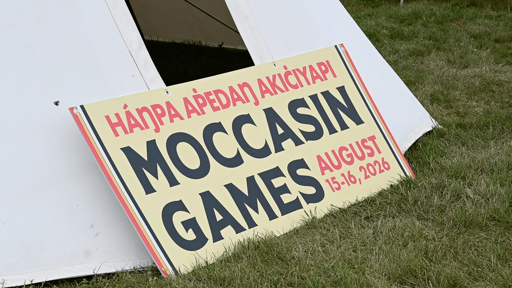
Over 100 Indigenous people competed in the sixth annual Moccasin Games tournament during the annual Shakopee Mdewakanton Sioux Community powwow in Shakopee, Minn. The game has existed for centuries and was first played between the Dakota and Ojibwe people in what is now Minnesota. (Photo by: Amelia Schafer, ICT)
Moccasin games began hundreds of years ago to settle a dispute between a group of Dakota and Ojibwe hunters competing for limited resources in what is now Minnesota.
The two nations share a centuries long relationship, something that attendees poked fun at, with one organizer taking to the mic to point out that Mni Sota is Dakota homelands, not Ojibwe, a statement which was followed by laughter.
This year’s tournament drew in more than 140 participants from as far as Alberta, Canada, a 16-hour drive, organizers said.

A man uses a striped black and orange stick to smack the opposing team’s moccasin during the sixth annual Shakopee Mdewakanton Sioux Community’s powwow. The goal of the game is to correctly guess which moccasin the opposing team has hidden a bead under. Each correct guess earns an arrow, once a team has all 20 arrows they receive one point. (Photo by Amelia Schafer, ICT)
Teams of at least four competed all day Saturday, Aug. 15, for the chance to win up to $4,000 for an adult team or $1,200 for youth teams.
While neither the Dakota nation or Ojibwe nations can agree on who won the first moccasin game, the 2026 tournament the winner is a bit more clear, with the Red Lake Nation’s team taking home first place for their third consecutive year in a row.
“What we often say is that not everyone is a dancer, not everyone may be a singer, and so at our gatherings here at the Wacipi, this provides an opportunity for anyone, both youth and adults, to be a part of our culture and carry on our traditional ways,” said said Sunka Ska, whose English name is William Crawford. Sunka Ska is from the Sisseton Wahpeton Oyate and serves as the moccasin games coordinator.
Indigenous people were once banned by the federal government from participating in traditional games like the moccasin games.
Indian Agents called the game gambling, outlawing it and leading to a massive decrease in its popularity across the country.
Despite this pressure, the games never fully stopped, instead participants played in secret where they could, keeping the tradition alive.
Decades later, the games have reemerged to the public as a form of entertainment, bonding and a way to promote cultural connection.
“There was a time where this game went underground and a time when this game wasn’t widely played across our Dakota tribes,” Sunka Ska said. “To see all of our youth now interested and engaged and wanting to play, that makes us feel good.”
In 2021, members of Shakopee’s cultural resources team wanted to bring the game back into modern Dakota life.
The game promotes use of Dakota language, traditions and provides the perfect setting for inter-generational bonding.
“This is primarily a male-played game to help strengthen this warrior and hunting spirit, but also the camaraderie to bring purpose with males’ lives and through generations with your uncles, your grandparents, your grandfather and your father,” said Andy Vig, whose Dakota name is Hehaka Zote, meaning Whistling Elk. Vig is a member of the Shakopee Mdewakanton Sioux Community and previously worked for the cultural resources department for five years.
It’s not uncommon to see a grandfather, father and son together on a team, Vig said. Sometimes even four generations are represented.
“You’re hearing the language spoken not only through these conversations but through song,” Vig said. “Just being together is so important so we say kawitayapi, being together, that’s culture in itself.”
Between 200 to 400 years ago, a group of Dakota hunters and Anishinaabe hunters were in what is now Minnesota competing over elk herds.
As the fur trade industry expanded across the Great Lakes region, the Anishinaabe had begun to move further west seeking more resources.
“What we think is that the Dakota and Ojibwe were going after the same herd,” said Andy Vig, Mdewakanton Dakota and the director of the tribe’s cultural center, Hoċokata Ṫi. “They didn’t want to hurt each other, so they came up with this game to settle who got ownership of the elk herd.”
Indigenous hunters often traveled with a spare pair of moccasins in addition to the pair they were using.
So hunters from the two different tribes created a competitive game using those moccasins to settle their dispute.
One man would hide a bead or small piece of stone underneath a moccasin, working carefully to distract the opposing team or throw them off in guessing which moccasin hid the bead.
Then, the opposing team would use their bows to strike the moccasin they believed the bead was hidden under.
At the same time, the opposing team tests the hiders by hovering their bow over the moccasins, trying to see if the hider’s face will give away the beads location.
For every correct guess, the hiding team handed an arrow to the opposing team. But if the opposing team guessed wrong, they gave one of their arrows to the hiding team.
The game continued until one team possessed all of the arrows.
“And the Ojibwe say they won the first original game, [but] the Dakota also say that we won the first original game,” Vig said. “But it’s nice to see even today that we see both Dakota and Ojibwe Anishinaabe teams represented. So it keeps that history alive.”
Today, the game is played similarly.
Instead of moccasins, fabric mitts with fringe edges work to hide the bead.
Instead of bows, the guessing team uses long sticks, often decorated, to strike their guess.
In place of arrows, the teams trade decorated sticks much like those used for traditional stickgames further west on the Great Plains.
For the Shakopee tournament, each team has 10 sticks given as a reward for a correct guess or as a penalty for an incorrect guess.
When a team has all twenty sticks, they’re awarded one point.
Adult teams play until one team has five points, while youth teams only play to four points.
“[One of my favorite parts is] seeing all of our Dakota relatives coming and gathering in one place,” Sunka Ska said. “Sometimes you don’t see them throughout the year and sometimes just a couple [times]. Being able to see all of our relatives work together, come together and be together for the weekend, that’s what I like about it most.”
Growing up, youth participation wasn’t commonly encouraged in moccasin games tournaments, Sunka Ska said.
But that didn’t stop youth from being interested in the game.
“We would play at home with pot holders and spatulas just for fun,” Sunka Ska said. “Eeventually, as a teenager, a young teenager, I played in my first tournament and that’s when I got more involved with this tournament style of play.”
The 2026 powwow marked the second annual youth moccasin games tournament, Sunka Ska said.
A record 13 youth teams entered the tournament, which was held simultaneously with the adult tournament between 23 different teams, Sunka Ska said.
“Every year we see a continued growth and interest with our youth,” Sunka Ska said.
The post Moccasin games: A rivalry dispute turned friendly game appeared first on ICT.
From ICT via This RSS Feed.