

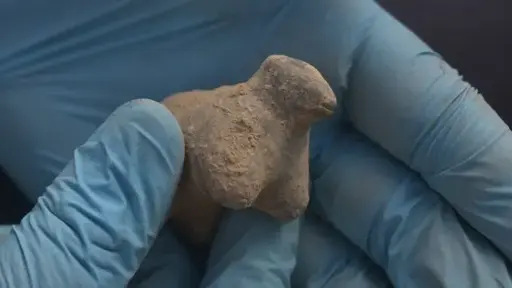
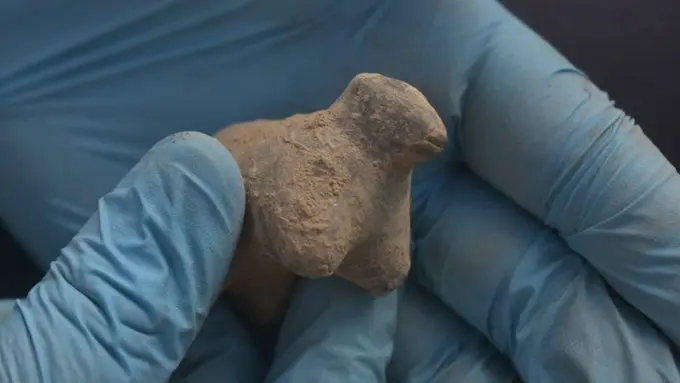
On Monday, a group of stone figurines with shapes representing animals with female sexual characteristics were found during recent archaeological excavations at the Kuélap Monumental Archaeological Complex, the great fortress of the pre-Inca Chachapoya civilization. This culture flourished in the northern Peruvian Andes between 800 and 1570.
RELATED:
China and Peru to Launch Archaeological Research On the Caral Civilization
These sculptures, called ‘illas’, “constitute an important contribution to the study of ritual practices linked to fertility,” reported the Peruvian Ministry of Culture through its Decentralized Directorate of the Amazonas region.
The pieces exhibit characteristics that allow them to be related to the so-called ‘conopas’. These are small sculptures, generally made of stone and representing camelid forms, widely documented for the Inca period. They were associated with ritual practices intended to promote fertility, abundance, and the protection of herds, crops, and the well-being of the household.
According to archaeological research, they also formed part of the political-religious dynamics developed during the Inca state to strengthen relationships between families, sacred sites (huacas), and state power. Therefore, these objects expressed relationships of reciprocity, balance, fertility, and protection.
El Ministerio de Cultura continúa con los trabajos de conservación y restauración en el Acceso 2 y la muralla perimetral oeste del Complejo Arqueológico Monumental Kuélap, en la provincia de Luya, región Amazonas.
https://t.co/sExBHSJpRb pic.twitter.com/NsWFQw3Zu2
— Diario El Peruano (@DiarioElPeruano) August 23, 2026
The text reads, “The Ministry of Culture continues with the conservation and restoration work on Access 2 and the western perimeter wall of the Monumental Archaeological Complex of Kuélap, in Luya province, Amazonas region.”
In the case of Kuélap, the discovery of ‘illas’ (small figurines) representing animals with female sexual characteristics opens new lines of research. These figures may be evidence of the Inca Empire’s relationship with the Chachapoya, also known as the “warriors of the clouds” for inhabiting the cloud-covered peaks of the Andes and for being one of the peoples who most fiercely resisted the arrival of the Incas to their territory.
The Peruvian Ministry of Culture noted that Kuélap shows evidence of occupation corresponding to the Late Horizon period, linked to the presence and expansion of the Inca state in the region. This allows us to consider this evidence within the framework of the interactions between local ritual traditions and those linked to the Andean region.
Kuelap, which has been nicknamed the Machu Picchu of northern Peru, is notable for its walls up to 12 meters high. These structures protect some 500 circular dwellings on the summit, within a perimeter of about seven hectares, high atop a mountain some 3,000 meters above sea level.
China’s Archaeology Institute, Peru’s Culture Ministry, and the Archaeology Faculty at the National University of San Marcos signed an agreement to expand their cultural cooperation through a joint archaeological research project on the Caral civilization.https://t.co/CUO67xbMgY
— teleSUR English (@telesurenglish) August 27, 2026
From teleSUR English via This RSS Feed.