

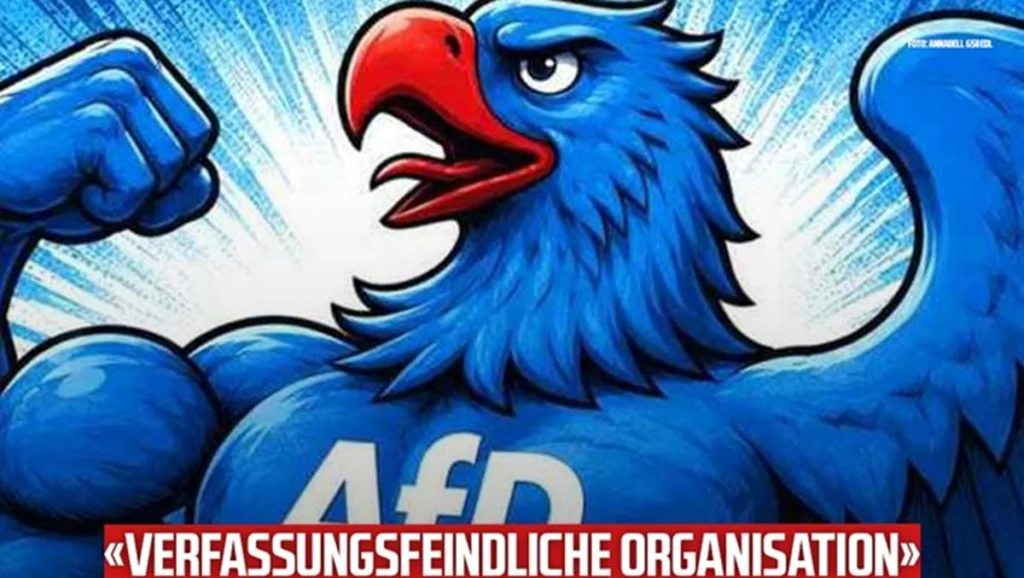
Berlin Institute Finds Far-Right Party Gains Support in Aging Regions, While Its Appeal Also Expands in Western Germany.
This week, the Berlin Institute for Economic Research (DIW) published a study showing that demographics are a key factor in explaining the momentum currently enjoyed by the far-right Alternative for Germany (AfD), especially in the east of the country, where three regional elections will be held in September.
RELATED:
Germany’s Far-Right AfD Files Constitutional Appeal Against Extremism Classification
In regions with a high percentage of people over 60 and where well-educated young people are emigrating, the AfD receives more votes, a factor that is key ahead of the elections in Saxony-Anhalt on Sept. 6 and in Berlin and Mecklenburg-Western Pomerania on Sept. 20.
Some strictly economic factors, such as income levels or unemployment rates, although relevant play a secondary role. The DIW had already shown in previous studies that the AfD is not the party of the unemployed or low-income earners and now reiterates that single-cause explanations fall short.
Although the AfD’s main electoral asset is opposition to immigration, the study finds that the percentage of foreigners or asylum seekers in a given region is either irrelevant or even shows a negative correlation with the AfD’s success.
“The AfD was particularly successful in the 2025 elections where the percentage of foreigners was very low,” according to the DIW.
WOW: This is the support on the ground for the AfD party in Saxony-Anhalt ahead of the State Election
These scenes are unprecedented.
Germany is going to be rocked on 6th September. It could be the trigger.
pic.twitter.com/doVVKMYp0h
— Inevitable West (@Inevitablewest) August 23, 2026
Historical Factors Also Matter
Despite the importance of demographics in explaining the AfD’s success in the east, the study finds that structural differences between the east and west are not enough to explain the party’s differing levels of support in the two parts of Germany and points to historical factors as well.
In this regard, there is a phenomenon in Germany known as “Östalgie,” a word that combines “Ost” (“east”) and “Nostalgie” (“nostalgia”) and describes the tendency among some residents of the so-called new federal states to idealize life in the former communist East Germany, the GDR.
In its campaigns in the east, the AfD frequently organizes caravans featuring Simson motorcycles, a GDR brand that has become emblematic, to express the nostalgia some people feel for times past.
Der Spiegel magazine, in a report on a recent caravan in Saxony-Anhalt led by the AfD’s regional leader, Ulrich Siegmund, quoted one of the demonstrators as saying that he had owned his motorcycle since 1975 and had lived through good times until “the Mercedes people came from the West to ruin everything with their incompetence.”
Without a doubt, the lives of people in the territory of the former GDR are better today than they were in 1989, but the entire process left many with the feeling that all decisions are made from Berlin and Brussels, creating an atmosphere of rebellion in some sectors that has been capitalized on by the AfD.
This is Alice Weidel, leader of Germany’s far right AfD party.
She just promised “the largest deportation operation in German history”, sounds familiar?
Listen to her speech. Close your eyes and just listen, she sounds like Hitler. Open them and listen/read to what she is… pic.twitter.com/MRaHyhgcFD
— Mario (@PawlowskiMario) August 31, 2026

Far Right Consolidates Its Support Beyond the East
In Germany, the far right is gaining supporters not only in the eastern regions but also in the west of the country.
“When people talk about the difference between the two parts of Germany, many hope that in the west the threat posed by the AfD will not be as great,” said Eva von Angern, The Left party’s lead candidate in Saxony-Anhalt.
“But if you look at the percentages the AfD received in Baden-Württemberg or Rhineland-Palatinate, two states in southwestern Germany, you can see that this is not just an eastern problem,” she added.
In the March 8 elections, the AfD won 18.8% of the vote in Baden-Württemberg. Fourteen days later, the AfD received 19.5% of the vote at the polls in Rhineland-Palatinate.
teleSUR/ JF
Source: EFE
From teleSUR English via This RSS Feed.