

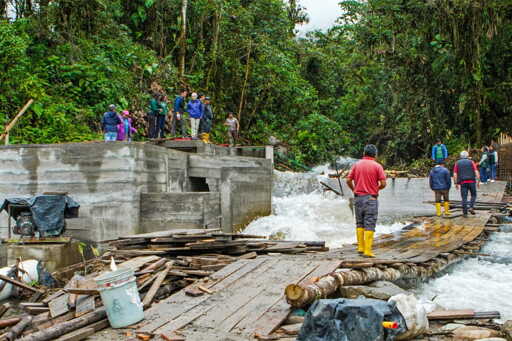
In Ecuador’s Intag Valley, one of the major watersheds that supply the country’s Imbabura province in the north, 19 families from four communities are developing a 300-kilowatt (kW) run-of-river hydropower plant — a project that generates electricity by capturing the Aguagrún River’s natural flows without the construction of a large dam or water storage reservoir. Engineers say this makes them less environmentally impactful. The families, which are from the communities of Cerro Pelado, Chinipamba, Nangulvi Bajo and Barcelona, own 90% of the HidroAguagrún project. Registered as a business since 2022, half of the revenue raised from selling electricity to the national grid will go directly into a trust for conservation activities, such as the protection of cloud forests. The idea to create a small hydropower plant came from a general concern among the families about water availability in the region and the impact of the climate crisis, said Jorge Guachagmira, the president of the Río Aguagrún Renewable Energy Production Association, which represents the 19 families of the micro-basin and surrounding areas. “We live in a remnant of the natural world, and our daily activities are affected by the expansion of the exploitation frontier, such as agriculture, livestock farming, logging or deforestation of natural ecosystems,” he told Mongabay in a video call. “By expanding the agricultural frontier, we are generating greater water insecurity, water instability and climate instability.” The community of Barcelona, which depends on the Aguagrún River micro-basin within the Cotacachi canton, Imbabura province, Ecuador. Image by Denis Laporta. Ecuador,…This article was originally published on Mongabay
From Conservation news via This RSS Feed.