

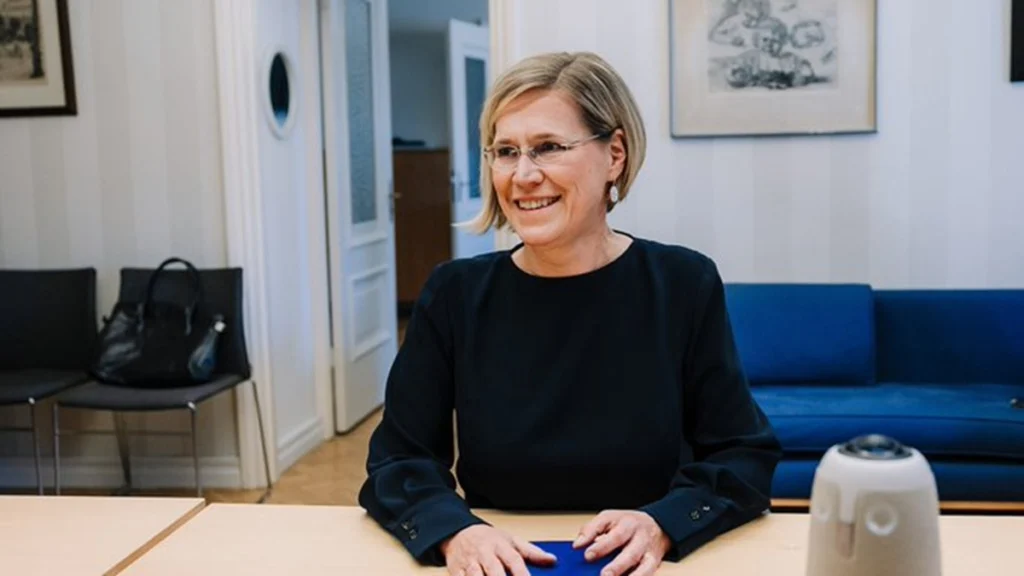
Broad Political Support Secures Enough Votes for the Sole Candidate, While Critics Question Lack of a Competitive Election.
On Wednesday, Parliament is expected to elect Ülle Madise as President of Estonia. She, the only candidate for the position, is a former law professor with no political affiliation who is currently serving her second term as Justice Minister.
RELATED:
Sweden Sends First Four Prisoners to Estonia Under Prison-Leasing Agreement
With 75 lawmakers from various political parties — from the left-wing Social Democrats to the national conservative Isamaa party, as well as the governing centrist liberal Reform Party and several independent lawmakers — having signed Madise’s nomination, she is guaranteed at least the 68 votes needed to be elected, with a margin of seven votes.
According to political scientist Martin Mölder, the diversity of politicians supporting Madise, who would normally disagree on many issues, is a sign that Estonians will have a president who enjoys broad support.
“It seems that the Estonian electorate, on average, is now getting the president it knows best. If direct presidential elections were held with the same candidates who made it to the final selection, the result would probably be that Ülle Madise would also become president,” Mölder stated after describing how parties in the Riigikogu and other candidates competed for the position before settling on Madise.
According to POLITICO, the CIA Director John Ratcliffe used his rare, unannounced trip to Moscow this week to warn Russian officials against escalating tensions with NATO allies, particularly Estonia, Latvia, and Lithuania.
Ratcliffe also urged Moscow to reduce its military… pic.twitter.com/qcs4VrfjbM
— Mega Geopolitics (@MegaGeopolitics) August 26, 2026

The political analyst cited a public opinion poll conducted by Norstat between Aug. 19 and 20 showing that 70% of Estonians would prefer the direct election of the president, while another survey indicated that 59% of the population was dissatisfied with the current method of choosing the president.
“When decisions are made in party offices and the president is practically elected before the Riigikogu even votes, this dissatisfaction is not surprising,” Mölder commented.
Opposition Center Party leader Mihail Kõlvart said he does not consider a single candidate to constitute an election, but rather the confirmation of an appointment.
“The Center Party’s position has not changed. In our opinion, there should be elections, not appointments. Given that there are no elections in the Riigikogu, we do not wish to participate in appointments,” he said.
Hannes Hanso, Estonia’s current ambassador to the United States and briefly considered a possible presidential candidate earlier this summer, said the fact that only lawmakers elect the president reflects negatively on Estonia’s otherwise democratic political culture.
“We are an extremely democratic country by any international standard. But the fact that the presidential election process largely takes place through shadow theater and various political maneuvers, in my opinion, clashes with the rest of our political system. Ultimately, if the president is elected in the Riigikogu, frankly, where were the debates and prior discussions?” Hanso pointed out.
teleSUR/ JF
Source: EFE
From teleSUR English via This RSS Feed.