

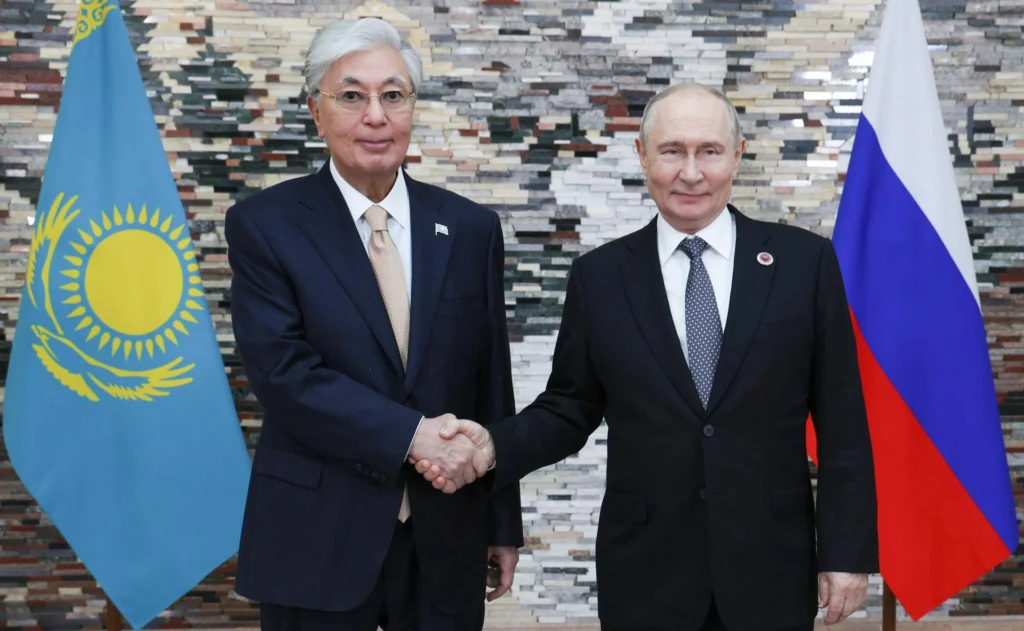
Russian President Vladimir Putin met Kazakh President Kassym-Jomart Tokayev on the sidelines of the Shanghai Cooperation Organization (SCO) anniversary summit, where both leaders highlighted accelerating trade growth and deepening bilateral cooperation.
Both heads of state noted the dynamic development of multifaceted cooperation between Kazakhstan and Russia, which continues in a spirit of friendship, good-neighborliness and allied relations.
Putin congratulated Tokayev on the successful Qurultay elections. He said the results confirmed broad public support for the Kazakh President’s strategic course aimed at further developing the country, strengthening domestic political stability, growing the economy and addressing issues related to improving people’s living standards.
RELATED: Putin Calls for New Investment Cycle to Boost Russian Economy
For his part, Tokayev spoke about the ongoing constitutional reform process, stressing that modernization will continue in accordance with national interests.
“Reforms for the sake of reforms must under no circumstances be undertaken; we understand this very well. Above all, we must proceed from the interests of our citizens,” Tokayev said.
Ver esta publicación en Instagram
Una publicación compartida de teleSUR English (@telesurenglish)
The Kazakh President described Putin’s state visit to Astana in May as a complete success, calling it historic in both scope and significance, assuring that his government is now working to implement all the agreements signed during that visit.
Trade is growing at an accelerated pace, Tokayev noted, pointing to an increase compared with last year. He expressed confidence that Russia will remain Kazakhstan’s key investment and trade partner and said he fully supports that process.
‘We have never had conflicts throughout history’ — President Tokayev on Russia-Kazakhstan relations
‘We will continue to work, to cooperate with the great state of Russia’ https://t.co/Xe72QTVSWj pic.twitter.com/2Ojx1rPB5X
— RT Intl (@RT_on_X) August 31, 2026
President Putin, for his part, praised the dynamic development of bilateral relations across virtually all areas. He recalled solid trade turnover last year and said this year the figure has increased further.
“We are working on a wide range of issues. Our agenda includes both major projects and current issues,” the Russian President said, meanwhile he thanked the colleagues in the Intergovernmental Commission for their efforts and for implementing all the agreements reached between the two leaders.
Around 60,000 students from Kazakhstan are studying at Russian universities, Putin noted. A branch of one of Kazakhstan’s leading higher education institutions was recently opened in the Russian city of Omsk. “Our cooperation is a two-way street in virtually all areas,” Putin said. “Today, we have an opportunity to discuss this entire range of issues,” he affirmed.
The heads of State discussed prospects for strengthening trade, economic and investment cooperation, as well as the implementation of joint projects in areas of mutual interest. They also exchanged views on current issues on the international and regional agenda.
Earlier, Tokayev met with his Azerbaijani counterpart, Ilham Aliyev, on the sidelines of the same summit. The meeting with Putin comes as Kazakhstan pursues a foreign policy that balances its ties with Russia, China and Western partners while advancing domestic political reforms.
The SCO bloc was founded in 2001 by Russia and China to counter Western influence across Eurasia. The 10-member organization also includes India, Iran, Pakistan, Belarus and four Central Asian republics, making it one of the largest regional groupings by population and territory.
The summit comes at a moment of heightened geopolitical tension, with the conflict in Ukraine and the Middle East, meanwhile Central Asia has gained strategic importance as a transit route and a zone of competition between Moscow, Beijing and Western powers.
In this sense, the SCO anniversary summit provides a platform for regional leaders to coordinate positions on trade, security and connectivity across Eurasia, with Central Asia emerging as a key transit corridor in global supply chains.
From teleSUR English via This RSS Feed.