

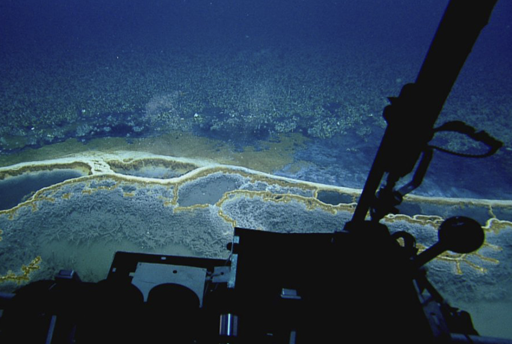
It’s 3 a.m. and I am standing on the deck of a research vessel, staring into water so dark it looks solid. I feel what I felt standing at the rim of the Grand Canyon, watching the sun set: there are places in this world deserving of our reverence, our protection, and our humility. The Orca Basin is one of those places. I have spent years working in the deep Gulf of Mexico, lowering instruments into the dark, pulling up sediment cores that smell of sulfur, watching remotely operated vehicle (ROV) footage of a seafloor that most people will never see, and few even know exists. Lying roughly 168 miles (270 kilometers) off the Louisiana coast, beneath more than a mile (2.2 km) of water, the Orca Basin is one of the most extraordinary environments on the planet. It is a lake on the seafloor, where the water is so salty and so dense that it resists mixing with the overlying seawater, and has occupied a vast depression on the gulf floor for thousands of years. Spanning roughly 154 square miles (nearly 400 km2), its salinity runs nearly 10 times that of normal seawater. No oxygen, no multicellular animals venture below its the ghostly boundary, where normal ocean gives way to something ancient and strange. When descending ROV cameras near the surface of the Orca Basin’s salty water, the interface shimmers like heat rising from sunbaked asphalt — a mirage a mile underwater. Map of the Orca Basin in the…This article was originally published on Mongabay
From Conservation news via This RSS Feed.