

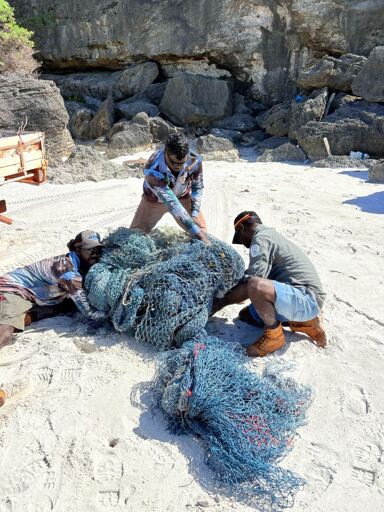
On a remote beach on Groote Eylandt, a large island in Australia’s Gulf of Carpentaria, Kirsten Eden and her colleagues found a fishing net that someone had tried to make disappear. It had been burned and melted into a lump while at sea, and thrown overboard. It didn’t sink, but floated to shore as a wheel of hard plastic — once a net perhaps 60 meters (about 197 feet) long, now breaking into the microplastics that will outlast us all. “So, the entire Groote Eylandt is Aboriginal freehold land,” Eden, who manages the Anindilyakwa Land and Sea rangers, told Mongabay. “It’s spoken for by Indigenous Australians. So, they’re not beaches that anyone can just go to. There’s so much cultural value to these beaches. There’s so much significance. There are songlines, there are art sites … And I guess that’s the drive to try and protect it and move this debris. And it’s such an eyesore.” Aside from general cleanup, the team has its eyes on ghost nets: Discarded fishing nets that end up floating adrift, entangling sea life and gathering trash along their paths. Across northern Australia, Indigenous rangers are the working to retrieve the lost and abandoned fishing gear that keeps killing long after it is retired. Removing a ghost net on Australian beach. Photo courtesy of Timothy Hillier/Agency Project. Getting a net off a beach is slow, physical work. Some have sat for years, buried deep or wound around driftwood and rock. One net can take hours,…This article was originally published on Mongabay
From Conservation news via This RSS Feed.