


Approximately 17,000 New York City homeowners were notified on July 22 that their properties may be subject to a new pied-à-terre tax, a surcharge on secondary residences valued at $5 million or more, should owners be unable to prove exemption by late August. (This deadline has since been extended to October 6.)
The modest tax targets single- and multi-family homes valued between $5 million and $15 million at 0.8% of market value, between $15 million and $25 million at 1.05%, and above $25 million at 1.3%. (Secondary co-op and condo units are taxed a bit higher, compliant with state tax laws that dictate that these properties should be valued and taxed similarly to rentals of comparable size and age with similar amenities.)
Designed as a straightforward levy on wealthy part-time city residents whose luxury units sit empty for more than half of the year, a spokesperson for New York State Gov. Kathy Hochul has also signaled that the pied-à-terre tax will discourage rich New Yorkers from registering as nonresidents to evade taxes (Fortune, 8/6/26).
But instead of accurately reporting on a modest wealth tax and fraud prevention measure, some corporate media took the opportunity to fabricate a reality in which the number of New Yorkers subjected to the tax was vastly overestimated, conjuring up a large mass of working- and middle-class New Yorkers who would have to deal with an opaque, complex exemption process.
‘A Kafkaesque situation’

Politico (7/29/26) presents the fact that the city didn’t send tax letters to some 14,000 homeowners it didn’t expect to be subject to the pied-à-terre tax as “a potential problem” for the Mamdani administration.
As the only criteria for exemption is proving that the unit is the primary residence of an owner, owner’s family member, tenant or majority owner of a business (if the unit is owned by a business entity), filing is actually extraordinarily simple.
To prove primary residence, owners can upload to the NYC Department of Finance website a recent tax return, a driver’s license or non-driver ID card, or voter registration. (The latter requires some additional proof of address, such as a bill or pay stub.) The documentation required for units occupied by an owner’s family member, tenant or the majority owner of a business is almost equally painless.
But a reader would hardly get this impression from Politico’s afternoon New York Playbook PM reporting (7/29/26).
Instead, journalists Chris Sommerfeldt, Leah Clark and Nick Reisman reported that “Mamdani’s pied-à-terrible mess” has put New Yorkers in a “Kafkaesque situation,” in which homeowners have to prove
to the city that they are, in fact, permanent residents not subject to the pied-à-terre surcharge. If they fail to do so, the administration’s letters warn that they’ll face tax bills ranging in the tens of thousands of dollars. And those residents only have until August 21 to prove the city wrong.
Put differently, New Yorkers had nearly a month from the day that this newsletter was published to upload pictures of their driver’s licenses to an e-file site. No transformation into a giant cockroach was necessary.
‘Ridiculously complicated’
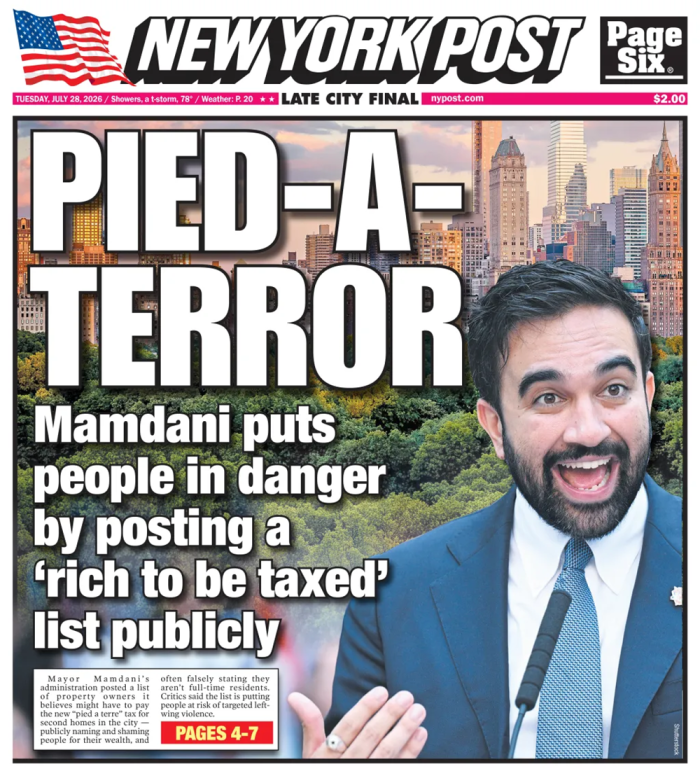
The New York Post (7/28/26) would not pass up a chance to put Mamdani’s face and the word “terror” on the same front page.
The Murdoch-owned New York Post tabloid used similarly dramatic language, describing filing for an exemption from the tax as a “cumbersome,” “insulting,” “painful” “witch hunt” (7/28/26) that is “ridiculously complicated” (7/29/26).
The Post’s July 28 and July 30 coverage particularly focused on the experience of Karen Young, the president of a New York– and Paris-based marketing firm, who, despite living in her Upper West Side brownstone for 30 years, apparently cannot produce New York State ID, tax documentation or voter registration to be uploaded to the city website.
Young claims that she does pay taxes from her New York City home, but does not explain why she cannot submit any documentation, or why she was “forced” to pay an estate lawyer to assemble “a lot” of documents, including the ownership deed to her brownstone.
In their followup reporting on the tax roll-out, Politico’s Sommerfeldt and Reisman (7/30/26) referenced the Post’s July 28 article, though not by name, to explain that some New York City residents are in the “unenviable position” of having to “prove their Big Apple bonafides,” and that they “only” have until August 21 to do it.
Politico neglected to mention what the “unenviable” five-minute process actually entails, assuming that residents have basic documentation of their New York City residence.
‘A cache of documents’
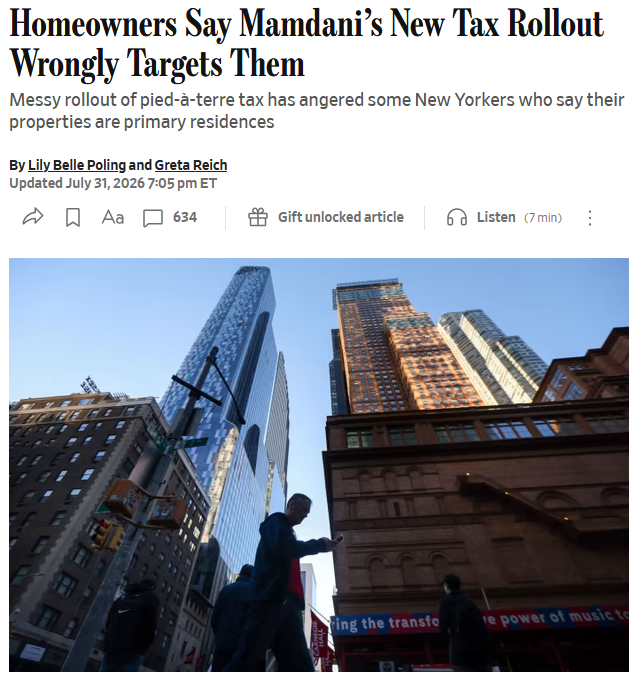
“The process for proving that a property shouldn’t be subject to the tax is difficult,” the Wall Street Journal (7/31/26) reports. The story later cites a source from the real estate industry saying that “submitting the documents to apply for exemption isn’t particularly difficult.”
The New York Post’s Zachary Kussin (7/29/26) also penned an op-ed detailing his own pied-à-terre exemption filing process—explaining that the process involved “a number of micro-managed directions spread across multiple websites that doesn’t answer many questions at all.”
His account of navigating the Department of Finance website is deeply misleading, describing two discrete exemption processes as if they were one confusing procedure, and posing several questions already answered by the FAQ section linked in the article. He concludes with a warning: Those filing for an exemption will “have to create an account—with a username and a password—to proceed,” a process not dissimilar from any other tax-filing website.
Reporting on two other New Yorkers’ experiences trying to file for exemption, Murdoch’s Wall Street Journal (7/31/26) reported that in the “messy” tax roll-out, some New Yorkers “say they are being falsely targeted, and that the process for proving that a property shouldn’t be subject to the tax is difficult.”
But despite reporting that “some New Yorkers” are finding it “difficult” to produce a “cache of documents” before the “fast-approaching deadline,” neither exempted taxpayer complained that the process was very difficult, nor did any of the four other sources quoted or paraphrased. The two sources that described the process, prospective payer Bob Ohlerking and real-estate agent Claire Groome, said filing is “just annoying” and “isn’t particularly difficult,” respectively.
The Journal also neglected to mention that the “cache of documents” expected are an applicant’s choice of a recently filed tax return, a driver’s license, or voter registration accompanied by some mail. (In case you’re wondering, Rupert Murdoch does own an expensive piece of property in New York City: a $35 million condo on Central Park South. But he is apparently registered to vote in the city, so the pied-à-terre tax likely will not apply to him—assuming he can find his paperwork.)
‘Many middle-class and blue-collar homeowners’
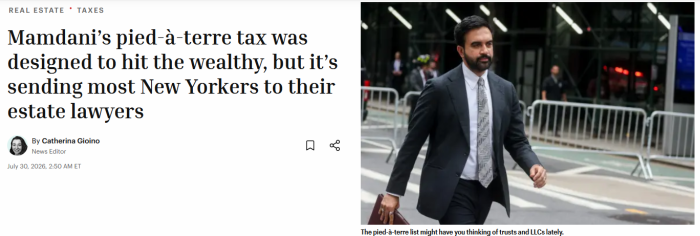
Readers of Fortune (7/30/26) might be surprised to learn that “most New Yorkers” don’t have estate lawyers.
Presenting the pied-à-terre tax as a burden on working- and middle-class New Yorkers, Fortune’s Catherina Gioino (7/30/26) reported that the tax was “designed to hit the wealthy, but it’s sending most New Yorkers to their estate lawyers.”
It should be noted that “most New Yorkers,” far from rushing to “their estate lawyers,” do not even own their own homes. Per the 2023 New York City Housing and Vacancy Survey (NYCHVS), a study of New York City’s cost of living and housing stock conducted every three years to comply with New York City law, of 3,705,000 housing units, 1,109,000 were owner-occupied as of 2023. More than double this number—2,324,000—were renter-occupied.
Nonetheless, Gioino reported that the tax is
pushing middle-class and working homeowners, people who already live in their houses, into estate-planning conversations they’ve never had before, at hourly rates they’ve never had to pay, for advice the wealthy have had access to for generations.
But unless these “many middle-class and blue-collar homeowners” actually own a secondary luxury property in New York City that sits empty for more than half of the year, the process for filing for an exemption is exceedingly simple, and shouldn’t require expensive services from an estate lawyer—unless, like Karen Young, who was profiled by the New York Post, they don’t have basic documentation proving that they live, pay taxes or vote in New York City.
‘Most’ New York City homeowners
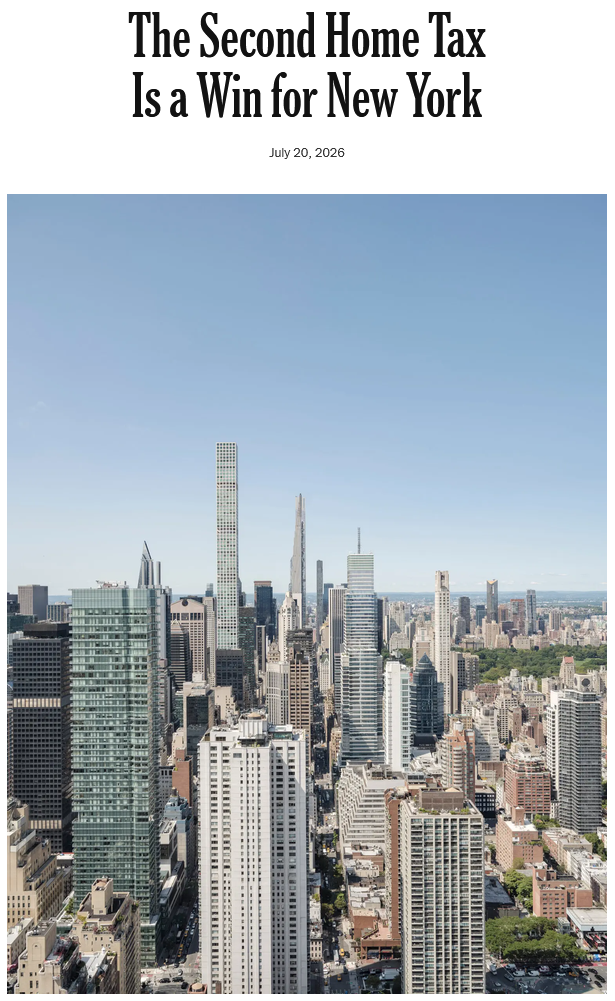
The New York Times (7/20/26) was one of the few establishment news outlets to come out in favor of the pied-a-terre tax, accurately noting that “any attempt to raise taxes on the wealthy inevitably inspires political pushback from the wealthy.”
Even when compared strictly against the number of owner-occupied units, describing the tax as sending “most” New Yorkers to their estate lawyers is a major stretch.
There are roughly 3.8 million New York City housing units in 2026. Assuming similar occupancy and ownership statistics to 2023, about 1.14 million of these are owner-occupied. So even if every single unit that received a pied-à-terre letter was actually an erroneously selected owner-occupied unit, then just 1.49% of New York City homeowners would have received a letter, and would need to undertake the five-minute appeal process.
But obviously every letter from the city is not a mistake, as the pied-à-terre tax actually seeks to capture units classified as “usual residence elsewhere,” or URE, which according to the 2023 NYCHVS classification criteria are classified as vacant and documented as unavailable for rent or sale,
comprising those [units] maintained as pieds-a-terre, units held for investment purposes, and those used as short-term rentals where the entire unit is occupied on a temporary basis.
The 2023 NYCHVS estimated that around 102,900 units were held exclusively for the purposes mentioned above, and fewer than 13,000 would be subject to the new tax (New York Times, 7/20/26).
As of August 18, 2,318 exemptions have been granted of 5,001 completed exemption applications—so the true number of those still on the hook for the tax is 14,682—much closer to the estimate posed by the 2023 NYCHVS.
‘Naming and shaming’
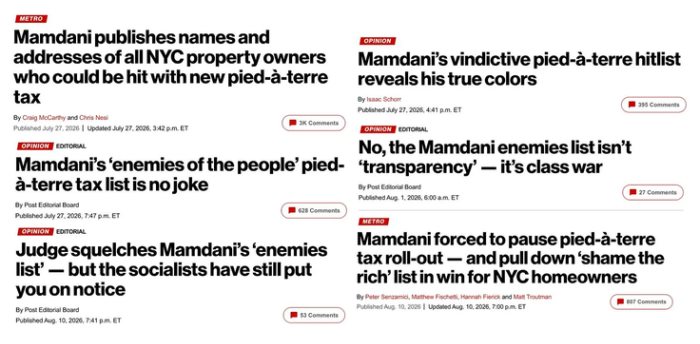
New York Post headlines depict the legally required posting of property tax information as “class war” against “enemies of the people” (Popular Information, 8/26/26).
But rather than present this data to readers, or accurately represent the tax appeal process, corporate outlets have deliberately misrepresented who the pied-à-terre tax primarily impacts, while expecting readers to empathize with “middle-class and working homeowners” who somehow own multimillion-dollar buildings and have suddenly misplaced every form of ID that verifies that their luxury home is their primary residence.
As reported by progressive newsletter Popular Information (8/26/26), some outlets have misrepresented the city’s routine publication of public property tax rolls as an effort to shame and intimidate New York City homeowners. Editorial coverage described the rollout as a “Mao-style” “mass doxxing” effort (New York Post, 8/10/26), “publicly stigmatizing” New York City Mayor Zohran Mamdani’s “class enemies” (Wall Street Journal, 7/29/26) by “naming and shaming nearly a million homeowners” (Washington Post, 8/15/26).
As Popular Information noted, the city is required by law to publish who owns which properties–and for good reason: “Without a public record, there would be no way to resolve competing claims over the same property.”
Nearly a year after New Yorkers granted Mayor Mamdani a mandate to tax the rich, corporate media are intent on framing this as infeasible and dangerous, more trouble than the estimated $500 million of annual tax revenue to fund “parks, schools and libraries” is worth.
Wilson Korik is a field researcher for the 2026 New York City Housing and Vacancy Survey (NYCHVS). The views and opinions expressed are his own, not those of the New York City Department of Housing Preservation and Development, or the University of Michigan’s Institute for Social Research.
From FAIR via This RSS Feed.
So here’s a process that really highlights the disconnect wealthy people have from our reality. Complaints like: “now I need to go to my estate lawyer” would never be mentioned from anyone who would be except from this tax.
Hello fellow blue collar people… Aren’t you also upset about your second luxury home getting taxed!?! Who’s your estate lawyer?
