

The following crosspost was sent in by retired UE Political Action Director Chris Townsend.
We are now well into the sixth year of the Starbucks Coffee organizing drive, certainly a remarkable movement by any measure. Many decades ago, a number of unions did maintain a solid presence in the coffee shop and retail restaurant industry – in a few big cities at least. But in the modern era, huge deep-pocketed chain companies like Starbucks seem impenetrable, designed to be anti-union and impossible to organize. In the early 2000’s the IWW managed to heroically dig in and organize several Starbucks stores across a few cities, but were ultimately incinerated by massive company union-busting and lawbreaking.
Trying to build a union in a giant far-flung company with thousands of locations – by running and somehow winning one-by-one NLRB elections – seems an implausible strategy, even for hardy can-do union organizers. In the minds of most business union leaders — who know nothing about new organizing and prefer only to occupy comfortable administrative roles in their unions – trying to unionize difficult targets like Starbucks just seems “crazy”. Earlier generations of these same conservative, unimaginative leaders and critics deemed the mass production industries as “impossible” to organize, just as they had once written off any chance of organizing health care workers, nurses, public workers, higher education workers, high tech workers, and tens of millions forced to labor in a “new” economy.
2021 STARBUCKS DRIVE
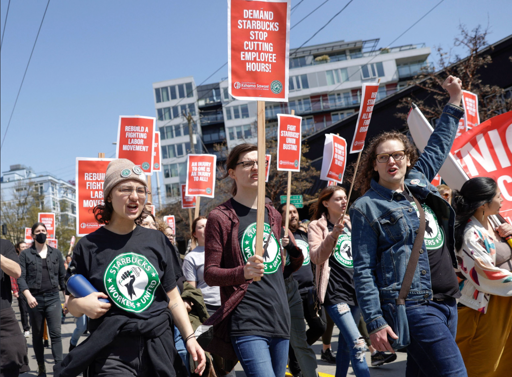
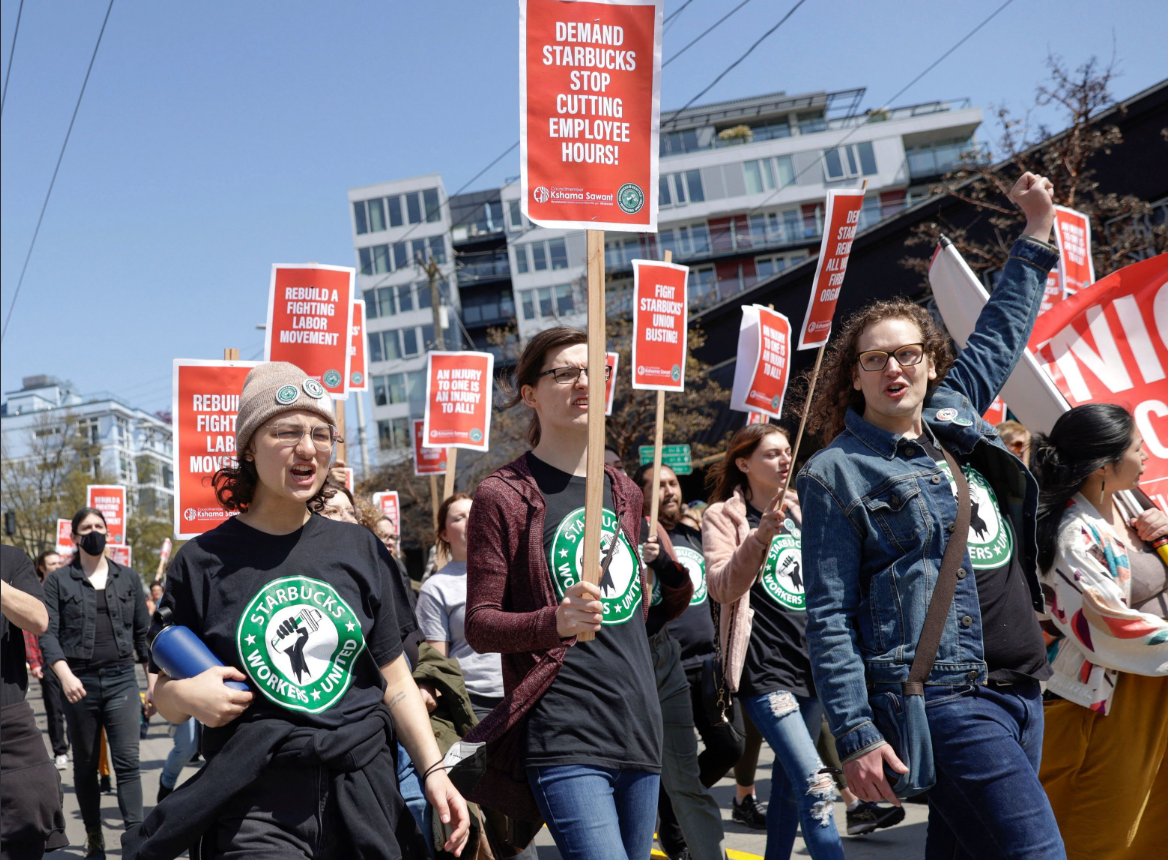
The first group to organize were the Starbucks workers at the Elmwood Avenue store in Buffalo, New York, in December 2021. Two more stores in that city followed shortly after. Since that take-off, more than 700 other stores nationwide have voted for the union in hard-fought NLRB elections. Read that again: more than 700 stores have voted for the unionsince 2021! Several hundred NLRB elections have also been lost, thanks to company firings and anti-union repression of every imaginable type.
In response to the initial Buffalo election victories the company unleashed a nationwide union-smashing campaign, spending vast sums – hundreds of millions – to try to stop the union contagion. Several hundreds more elections might have been conducted were it not for this massive anti-union company counter-attack. Given the unlimited and unstoppable internet reach of the Starbucks Workers United movement few, if any company employees have not heard of the union drive and its successes.
STUDY THIS CAMPAIGN – MANY LESSONS TO LEARN
The Starbucks union movement has relentlessly chugged forward facing constant and withering fire from the company. There has been some press reporting, less as the campaign has grown and become “old news”. But the greatest proportion of the reporting has missed key aspects of this truly historic union eruption. Elmwood Avenue store barista, and one of the first union leaders, Jaz Brisack, has written a very worthwhile book, which explains much about the planning and launch of the drive. It includes valuable context which gave rise to the drive, its otherwise hidden details, as well as a glimpse into some other union organizing campaigns in upstate New York. This book has received very little recognition, likely on account of the fact that the author is not a member of the left writer influencer set who dominate the tiny labor journalism scene.
“Get On the Job and Organize” by Jaz Brisack, published in 2025 by Simon & Schuster, tells the Starbucks story from Jaz’s perspective, documenting much of the real story. The unfortunate big-corporate-publisher-fingerprint is noticeable, but that’s not the fault of the author and is probably the price of getting the book into print. With first-person union organizing literature almost nonexistent, this book is required reading for all students of new union organizing. Two articles in 2022 by this writer are also helpful in understanding the Starbucks battle ; “Young Workers Confront Union Busting” and “The Starbucks Insurrection”. Both offer analysis and background to the Starbucks starting moment, led overwhelmingly by young workers often dismissed by most unions.
HISTORIC MOVEMENT BY ANY MEASURE
Whatever the Starbucks union organizing uprising has been – and continues to be – it has always defied convention. This organizing push was also forced to defy convention, since from its inception it was a member-driven project, largely detached from the middle class ideologists who dominate labor organizing “thinking” today. ***And it has truly been an “historic” labor drive by any definition.***No union organizing push in the United States in more than 75 years has spread as fast to at least 45 states and the District of Columbia. More than 15,000 workers have been organized under severe union-busting conditions, including in places remote from very much trade union presence.
Each week sees new stores added to the union “yes” column, the latest as of this writing being the August 24th win by the 17 workers at an Amarillo, Texas, store. The winning 14 to 2 NLRB election margin for the Workers United union – in spite of the massive and terroristic anti-union onslaught of the company for the past five+ years – truly qualifies as “historic”. Since I track the Starbucks drive closely, I’m not surprised one bit. When word got out that the small Starbucks in Scottsboro, Alabama, had voted “yes” for the union in October 2022 – the town made forever infamous in the 1930s when an international campaign saved a group of nine young Black workers from the gallows after a sordid frame-up case – there was no doubt in my mind that this campaign was here to stay. Organizing has also spread slowly to Canada, with 14 Starbucks locations having now been organized.
STILL AN UNTOLD STORY
Labor union members and leaders have all heard of the Starbucks drive, and will reflexively and eagerly cheer it on. But since only a minuscule number of unionists have any real concept of “union organizing”, they possess little ability to translate the Starbucks energy into the work and organizing of their own union. While it has also become common knowledge – across wide layers and majorities of the population – that unions and the concepts of unionism are wildly popular, this lack of basic organizing familiarity prevents that fact from bolstering real organizing. The frequently timid and inert leaderships of many unions are also incapable of infusing their own work with this aggressive organizing spirit. Some might give lip-service to the cause of new organizing, but quietly downplay, undermine, and reject it within “their” unions.
WHAT’S THE REAL STORY?
There are, however, a number of facts and situations within the Starbucks campaign that have been unreported, or left out of the narratives being generated – out of either ignorance, or hidden agendas. Among them are:
- The original launch location in Buffalo was the result of previous independent coffee shop organizing wins by the Workers United union in upstate New York, including Buffalo. The previous drives proved that workers in this industry would organize – if given the chance. The Workers United Rochester Regional Joint Board – an embattled but scrappy union led by Gary Bonadonna Jr. – is one of the very few unions willing to experiment with organizing groups like coffee shops.
- Veteran union organizer Richard Bensinger and barista-organizer Jaz Brisack assembled volunteer salts in the first 3 stores won in Buffalo. They adapted to the pandemic conditions which ultimately helped propel the campaign. There were also no crowds of inexperienced paid “organizers” milling about with fantastic theories of organizing to get in the way. Sound basic and aggressive trade union tactics were the key to the success – along with lots and lots of educated and motivated rank-and-file members.
- The informal Inside Organizer School – started under the Amalgamated Transit Union (ATU) umbrella in late 2017 – provided some key support for the initial drive. Pulled together by this author Chris Townsend, Richard Bensinger, and then ATU President Larry Hanley, this unlikely union ended up playing a decisive supporting role. The untimely death of Larry Hanley in May of 2019 meant that he unfortunately never lived to witness the unrolling of the Starbucks drives.
- Less than a year into the amazing run-up of initial NLRB election wins, the union – Workers United – and their parent the Service Employees (SEIU) – both moved-in their “expert” staffers to take complete control from Bensinger, Brisack, and the other rank-and-file volunteers. Remarkably, the members kept pouring in, right up until this writing. Despite the best efforts of the highly paid union know-it-alls to derail the trajectory of success – Starbucks workers were not to be stopped. The most expensive anti-union campaign in history waged against the workers by Starbucks has also failed to stop the workers from continuing to organize. Top union “experts” with little actual experience but with all sorts of “new ideas” couldn’t corral the drive. Neither could a giant company wildly flailing away at the workers find a means to destroy it.
The Inside Organizer School played an early role in supporting other union drives in chain companies, but for a number of reasons none was able to achieve critical mass and spread quickly to other locations. Some of these drives have held on, grown a bit, while others have been liquidated by aggressive anti-union employers. The established unions, with their too-few and mostly inexperienced staff, and their inability to act decisively were often a big part of the explanation why these drives faltered.
Some of the thinking which guided the early Starbucks leaders and workers were the writings of legendary labor organizer William Z. Foster. This writer was able to get Foster’s collected works, American Trade Unionism put back into print just prior to the launch of Starbucks. The Inside Organizer School used this book as its defacto text. Simultaneously, this Foster book found its way into the ultimately successful Amazon union win at Staten Island in April of 2022. Available at: American Trade Unionism – International Publishers
BIG UNION ORGANIZING DRIVES ARE POSSIBLE
All union organizing drives follow one of several generally similar paths. A few succeed and win, always against overwhelming odds. A small number triumph somehow against unbelievable employer counterattacks. Most, a vast majority in fact, are killed off in their infancy, destroyed and liquidated long before any union election is even possible. Today the number of NLRB elections hovers at historic low levels, involving only small numbers of workers; public union organizing has dramatically fallen in recent years, with federal union organizing nearly stopped; railroad and airline organizing does move along slowly but with erratic results.
Overall, we find ourselves enmeshed in a decades-long crisis where the bulk of the labor movement long-ago withdrew from the organizing field of battle. Ongoing and ghastly union membership losses continue across many sectors. With only a few bright spots, the unions largely play like the turtle – when confronted by the Coyote. The problem is, while the Coyote moves on for easier prey, while the turtle waits it out, the employers follow no such course. Instead, they devise the formula to profitably weaken and ultimately destroy the union one way or the other. The hideout strategy has never sustained the labor movement, and in fact has hastened our destruction in many sectors already.
UNIONS AND ACADEMICS IGNORE STARBUCKS EXAMPLE
For all its interesting and amazing qualities, the Starbucks drive remains un-examined by the so-called “expert” union thinkers. And it is certainly not yet being imitated. Despite my role in starting the Inside Organizing School, as well as being a close observer of the evolving Starbucks movement from its beginnings, my many efforts over the past five years to stimulate curiosity about the Starbucks movement within unions and among labor academics has found little interest. With only a few exceptions at the local union level, most unions as well as college and university labor programs have ignored the Starbucks example. It’s preposterous, but true.
One might imagine that the founders of the Starbucks movement, as well as the Inside Organizer School would be much sought after by the “thinkers” and “strategists” of the labor movement. But there is no such curiosity. Despite the huge Starbucks success that is obvious to all, the forces occupying the top organizing positions in the unions and “thinking” positions in the academic world sit in failed paralysis. With no force readily available to jerk them out of their self-absorbed stupor, there is little reason to believe that at this late date they will suddenly awake and develop a basic curiosity about one of the most successful union organizing examples in decades. .
LEFT DOES LITTLE TO PROMOTE STARBUCKS EXAMPLE
Given the refusal of the unions and the academic world to seriously consider the Starbucks example, one might think that the left media, or at least the left media that covers labor, would show a useful interest. But that has generally not been the case. Some good incidental reporting has been done, but little else. Writers and authors have abundantly offered their own opinions about the “meaning” of the Starbucks movement or offered the obvious facts and little more. Since virtually none of the writers possess significant labor organizing experience themselves, the writing has been of little use for actual on-the-ground organizers. Consequently, the literature covering Starbucks from the labor perspective is scant, lacking in useful detail, and has largely avoided speaking to the real leaders of the campaigns.
The SEIU union – a self-styled “progressive” union and the inheritor of the Starbucks Workers United movement by virtue of its subsidiary union Workers United – has spent no discernible time figuring out the origins of the remarkable campaign. Or showing any curiosity regarding the ATU-sponsored school which influenced the early drive. With SEIU having banished the actual architects of the drive shortly after the breakout from the Buffalo stores, they have shown zero interest in familiarizing themselves with the detailed history. In a bitterly ironic current twist, the Starbucks boycott recently announced by SEIU is in fact the suggested tactic that led that union to banish Bensinger and Brisack 4 years ago!
While I would not lump the AFL-CIO with “the left”, it is worth mentioning that the labor federation comprising 65 unions and 70% of the organized workers in the country has likewise exhibited virtually no curiosity about the origins of the Starbucks movement. Perhaps this is because Workers United at the time of the 2021 Starbucks launch was not an affiliate of the Federation. But a serious organizer might imagine at least some private curiosity under these circumstances, but none developed. With the Federation having abandoned new organizing anyway, there is little to be surprised about.
NO CURIOSITY EQUALS NO HOPE
The Starbucks organizing example is hardly an example to follow in all situations. No organizing methodology can apply universally. But the near total lack of serious interest in the actual mechanics of how the Starbucks movement was engineered and launched shown by the labor movement and its close “thinkers” is a damming indictment of them. For those serious about organizing on a wider scale, maybe even a mass scale, examination of the Starbucks example is required. Sterilized labor thinking and university hot-house over-thinking models will not get things moving again. Anyone interested in doing this homework should contact me. I may be reached at cwtownsend52@gmail.com
The following op-ed is crossposted from MLToday.
-Chris Townsend is a 47-year union member and leader. He is the retired Political Action Director and International Representative for the United Electrical Workers Union (UE). Townsend was also the Organizing and Field Director for the Amalgamated Transit Union (ATU), as well as being a salt for UFCW and a local organizer for an SEIU local union. He holds an elected seat on the Executive Committee of the International Workers Institute (IWI), the research, strategy, and publishing arm of the WFTU.
From Payday Report via This RSS Feed.