

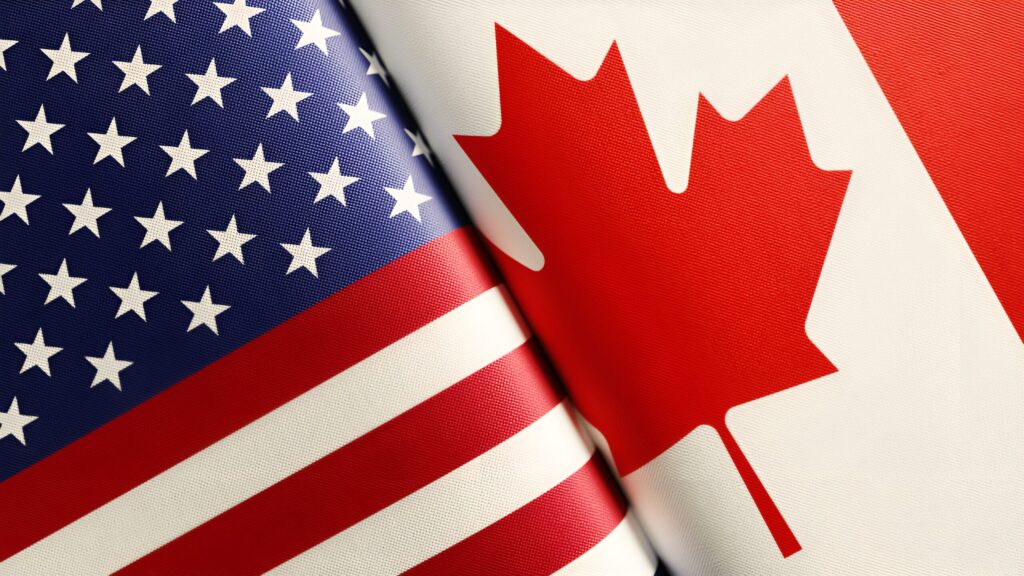
The renegotiation of trade terms lays bare how the U.S. market’s asymmetric weight strains Canada’s economic sovereignty.
The mainstream political narrative about Canada and the United States often portrays the two nations as equal partners, linked by shared democratic values and an open border.
RELATED:
Canada Imposes Tariffs of Up to 50% on U.S. Products in Response to Trump’s Levies
However, economic data show an asymmetric dependency. The U.S. accounts for roughly 75% of all Canadian merchandise exports, whereas Canada accounts for less than 18% of U.S. exports.
During Donald Trump’s non-consecutive presidential terms (2017–2021 and 2025–present), this underlying power dynamic shifted from quiet institutional integration to explicit economic pressure.
Trump’s “America First” platform treated continental supply chains not as mutually beneficial networks, but as zero-sum arrangements where Canadian gains were viewed as U.S. losses.
Across both administrations, Trump used executive trade authority, national security designations, and public rhetoric to demand concessions from Ottawa.
The Restructuring of Continental Trade (2017–2021)
President Trump initiated a shift in bilateral trade during his first term by forcing the renegotiation of the 1994 North American Free Trade Agreement (NAFTA).
In May 2018, the U.S. Department of Commerce applied Section 232 of the Trade Expansion Act of 1962 to impose a 25 percent tariff on Canadian steel imports and a 10 percent tariff on Canadian aluminum imports.
Trump’s administration justified these punitive measures by classifying foreign metal imports as a threat to U.S. national security, a designation that directly challenged Canada’s status as a defense partner.
Canada, under Prime Minister Justin Trudeau, responded by applying retaliatory duties on 12.8 billion dollars’ worth of U.S. goods. Ottawa strategically targeted products manufactured in key U.S. congressional districts, including U.S. whiskey, orange juice, and steel products, to apply targeted political pressure on Washington lawmakers.
The ensuing negotiations resulted in the United States-Mexico-Canada Agreement (USMCA), signed in November 2018 and implemented in July 2020. The final text included significant structural concessions Washington required to protect its market dominance.
Canada agreed to dismantle key protections in its agricultural sector, opening its supply-managed dairy market to allow duty-free access for U.S. producers up to 3.6 percent of domestic production.
The agreement also established stricter automotive rules of origin for the three countries, raising the required regional value content for duty-free vehicles from 62.5 percent to 75 percent, while mandating that 40 to 45 percent of vehicle components be produced by workers earning at least 16 dollars per hour.
Furthermore, Washington inserted Article 32.10, a provision requiring any member state to notify the others before entering free trade talks with a non-market economy.
Trump’s “Bulldozer” Tactics Against Canada Failed
Trump’s “bulldozer” tactics aimed at reshaping the country’s trade relations have once again failed. The United States and Canada were unable to reach a trade agreement, according to The Washington Post. Ottawa refused to make… pic.twitter.com/mklT3G8ezV
— 𝕊𝕡𝕣𝕚𝕟𝕥𝕖𝕣 𝕻𝕣𝕖𝕤𝕤 (@SprinterPress) August 24, 2026
Imperial Rhetoric, Sovereignty, and Political Disputes
Beyond policy renegotiations, President Trump frequently characterized the bilateral trade dynamic as an exploitation of U.S. economic power.
Trump publicly stated that the U.S. trade deficit with Canada amounted to an artificial subsidy granted by Washington, framing cross-border economic integration as an unfair burden borne by U.S. taxpayers.
In multiple discussions with administration officials and media representatives, Trump raised the idea of Canada becoming the 51st state of the United States, suggesting that removing the border would simplify continental security and economic governance.
While Canadian leaders across political lines dismissed these remarks as politically unacceptable, the rhetoric illustrated Washington’s willingness to use its geographic and economic dominance to posture publicly against its northern neighbor.
Political friction also emerged over border management and domestic policy autonomy. Washington repeatedly criticized Ottawa on issues ranging from military spending under North Atlantic Treaty Organization (NATO) commitments to Canadian border enforcement mechanisms.
The U.S. executive branch pressured Canadian lawmakers to alter domestic regulations, including intellectual property rules, digital service taxes, and agricultural policies.
Universal Tariffs, Energy Coercion, and Border Militarization (2025–Present)
Donald Trump’s return to the U.S. presidency in 2025 brought economic pressure against Ottawa again. In early February 2025, the U.S. executive branch announced executive orders imposing a universal 25 percent tariff on most Canadian imports, along with a targeted 10 percent duty on Canadian oil, gas, and energy products.
Unlike previous sector-specific measures, Trump’s administration explicitly linked these trade penalties to non-trade issues, citing concerns over border security, migration flows, and cross-border drug trafficking.
The tariff imposition on crude oil, natural gas, and critical minerals targeted a vulnerable sector of the Canadian economy. Canada exports approximately 4 million barrels of crude oil per day to the United States, representing over 90 percent of its total petroleum exports.
By penalizing Canadian energy, Washington demonstrated that integrated regional supply chains would not shield Ottawa from unilateral executive actions.
The trade conflict escalated further through 2025 and into 2026 as Washington imposed additional 25 percent tariffs on automobiles, steel, and aluminum imports.
Despite legal challenges in U.S. courts regarding the broad application of executive emergency powers, executive orders continued to maintain sector-specific duties and elevated tariffs on Canadian resources.
In mid-2026, Washington instituted 50 percent tariffs on selected Canadian manufacturing and agricultural categories, reinforcing a prolonged economic uncertainty for Canadian exporters.
These actions transformed continental commercial dynamics. Ottawa was forced to allocate emergency financial support to domestic industries while adjusting law enforcement resources along the southern border to address Washington’s political demands.
Trump second-term measures established a precedent where the U.S. market scale is routinely deployed as an instrument of political leverage to dictate domestic policy decisions in neighboring states.
Canada announced retaliatory tariffs against the United States as relations further deteriorate. @GeoffRBennett speaks to Canadian trade representative @DLeBlancNB for more. pic.twitter.com/GLoGr04MBC
— PBS News (@NewsHour) August 25, 2026
Ottawa’s Counter-Measures: Strategic Retaliation and Economic Adjustments
In response to trade penalties imposed by Washington, Canadian governments across both presidential terms deployed targeted retaliatory measures.
During the 2018 trade dispute, Ottawa introduced dollar-for-dollar surtaxes on 16.6 billion Canadian dollars’ worth of imports from the United States.
The Canadian federal government curated the list of affected goods to maximize economic pressure on districts represented by influential U.S. lawmakers, placing duties on products such as steel, aluminum, agricultural goods, and manufactured consumer items.
A similar framework was activated during the escalation of trade measures in 2025 and 2026. The Canadian government implemented countervailing duties aimed at equivalent values of U.S. exports while offering targeted financial relief to domestic industries affected by U.S. tariffs.
To minimize economic disruption for domestic manufacturers, Ottawa created tariff relief programs designed to lower input costs for Canadian firms reliant on cross-border supply networks.
Alongside official state responses, non-governmental and civic sectors engaged in economic adjustments. Canadian consumer groups organized targeted boycotts of U.S. goods, encouraging domestic spending to support local producers.
Labor unions advocated for comprehensive state industrial policies, urging Ottawa to invest in domestic processing capacity for raw materials, critical minerals, and energy.
These Canadian popular initiatives aimed to insulate domestic workers from supply chain shocks stemming from changes in U.S. executive trade policy.
The Crisis of Dependency and the Path Forward
The diplomatic and trade friction observed across both administrations of President Donald Trump highlighted the structural vulnerabilities inherent in Canada’s economic relationship with the United States.
The repeated application of unilateral tariffs, national security designations, and political demands exposed how continental economic integration leaves the smaller trading partner susceptible to shifts in U.S. domestic policy.
For decades, Canadian economic strategy relied on preferential access to the U.S. market under regional free trade agreements.
However, the events from 2017 to 2026 showed that institutional agreements provide limited protection when Washington chooses to deploy its economic scale as leverage.
The enforcement of stricter rules of origin, market access demands, and extra-trade conditions demonstrated the asymmetric nature of bilateral U.S.-Canada governance.
Policy analysts and labor organizations argue that reducing Canada’s dependency on the U.S. market will require expanding trade partnerships with international trading blocs, building domestic processing infrastructure for natural resources, and establishing public sector investments in key industries.
Sources: teleSUR – Al Jazeera – The Guardian – BBC – Reuters – The Globe and Mail – CNN – Global Affairs Canada – Statistics Canada – U.S. Bureau of Economic Analysis (BEA)
From teleSUR English via This RSS Feed.