

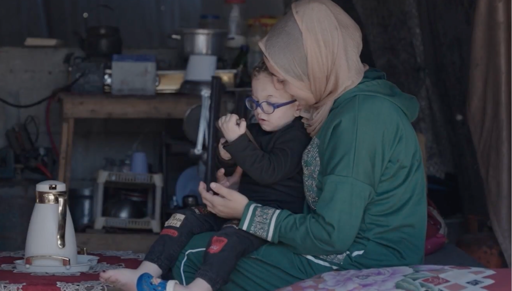
When Israeli forces besieged Al-Shifa Hospital in November 2023, eight premature babies in incubators were evacuated to Egypt under fire. One of them was Joud. His mother, Fatima Dakkeh, spent the next two years and eight months searching for him and fighting to bring him home.
Fatima tells the story of giving birth just months before October 7, losing contact with her son during the first Israeli raid on Al-Shifa, learning a year later that he was alive in Egypt, and a bittersweet reunion with a child who no longer recognized her.
According to the International Rescue Committee, at least 17,000 children in Gaza are unaccompanied or separated from their parents. For many families, there will be no reunion.
Credits:
Producers: Belal Awad, Leo Erhardt
Videographers: Ruwaida Amer, Mahmoud Al Mashharawi
Video Editor: Leo Erhardt
Transcript
Narrator:
Al-Shifa hospital is the largest medical complex in Gaza. Since October 7, it’s been repeatedly raided, occupied and targeted by Israeli forces. Over the course of the Genocide, hundreds were killed in and around the building and the hospital itself was completely destroyed.
In November 2023, under Israeli fire, 8 premature babies in incubators were hurriedly evacuated to Egypt. Joud was one of those babies.
Fatima Dakkeh:
I gave birth to my son, Joud, in July. Joud needed neonatal care at Al-Shifa Hospital. We placed him in the neonatal unit, but then the war started and Joud was there in the hospital. We couldn’t get in touch with Joud because of the shelling and the war.
Narrator:
Fatima Dakkeh and her son Joud have been unable to have a regular mother-son relationship. Joud was born in Gaza just a few months before October 7th 2023 and so, their story has been shaped by war, displacement and separation. Shaped that is, by Israel’s war on Gaza.
Fatima Dakkeh:
When we tried to get to the hospital to get Joud, we weren’t able to get to him and take him out, because of the situation—things had gotten really bad. There was a lot of shelling and there were airstrikes and quadcopters. We planned to go back another day to get Joud, once the situation calms down. But the situation just kept getting worse. The Israelis entered Al-Shifa Hospital and occupied it— that was the first invasion of Al-Shifa Hospital, and my son was inside.
About a year later, I found out my son was in Egypt. I mean, I didn’t give up; I kept going to hospitals, I went to the Red Cross and places like that to search for news about my son, no one could help me. I went to a doctor I know. I told him my story, he said, “I’ll try to get in touch with your son and see where he is.” Thank God, he was the one who discovered my son was in Egypt. After a few days, they sent us pictures of my son, and we found out he was OK. Thank God. They knew he was our son through my name—they had my name on file. We started communicating with him more through my sister-in-law—my sister-in-law in Egypt. We told her the story, and of course she didn’t hesitate; she visited him in hospital, sent us pictures and reassured us about him, thank God.
Honestly, I was happy and upset at the same time because my son was in Egypt, if he would have been here in Gaza he would have suffered a lot. We were starved, even nappies were cut off. Most children were using scraps of cloth as nappies. And milk too, was cut off—we had no milk at all in northern Gaza. I said to myself thank God my son is in a better place than Gaza. But at the same time, I was upset that my son was far from me. I would see mothers playing with their kids, dressing them, carrying them—and I would feel these feelings. I would miss my son. I wished my son was with me. At the same time, I’d look at my situation—how we’re living, in tents, in all this difficulty. I’d say to myself, hopefully he will return to us in a better situation, there will be a ceasefire and we will make up for the days we lost.
I had lost hope that he would return. With the crossing closed and the Israelis were not letting people return. When they first told us he was returning, I was shocked. My husband and I both. We were surprised—how could he come back just like that, overnight? He’s just going to come back, all of a sudden, after we’d lost hope all these years. I was overjoyed with the news that I would see my son again, it was the best news. When we went to the hospital to collect him, it took a really long time for them to bring him to us—many hours. With each passing hour, I would get more and more excited: about seeing him and about how I would greet him. I mean it was really hard, but at the same time, the moment when I saw him was really beautiful.
Yeh, honestly, when I first saw my son, he wouldn’t come to me; he’d cry and avoid me. He would go to his dad before me. he didn’t want to come to me, so I was afraid that he’d stay that way uncomfortable around us And afraid of living with us, and afraid of the situation we’re in— that he wouldn’t accept us Thank God, little by little, he started to accept us.
Narrator:
According to estimates by the International Rescue Committee, 20,000 children are still living separated from their parents in Gaza. Fatima was reunited with Joud and though their separation which lasted 2 years and 8 months impacted both mother and child, they are now reunited. As for the thousands of other survivors in Gaza, for many there will be no reunion.
From The Real News Network via This RSS Feed.