

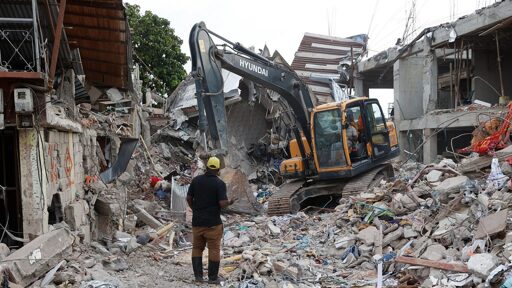
The Colombian department of Chocó is experiencing a complex humanitarian crisis caused by the convergence of armed violence, forced displacement, confinements, environmental damage, and the ravages of the 7.4-magnitude earthquake that occurred on August 10.
This crisis was declared in a public statement by the Ombudsman’s Office, urging national and local authorities to activate emergency response protocols immediately.
The entity warned that the emergencies distinctly and severely impact Afro-descendants, indigenous peoples, and rural communities in the region.
According to the statement, there has been a deterioration of security, especially in the San Juan subregion, since the earthquake with an epicenter in San José del Palmar.
The office documented the prolonged presence and incursion of members of the Clan del Golfo in communities such as San Agustín (Sipí), where they prevented traditional production activities, and their advance towards Puerto Murillo, in Medio San Juan.
At the same time, fierce clashes have been verified between the Clan del Golfo and the National Liberation Army (ELN) in the General Community Council of San Juan (Acadesan) territories and rural areas of Nóvita and Sipí.
“On August 23, clashes and drone attacks reported in Charco Hondo, Sipí, left three civilians wounded and forcibly displaced 65 families to Barrancón. Preliminarily, 652 families (approximately 3,000 people) remain confined,” the official report stated.
During a humanitarian mission carried out on August 25 in the Nóvita–Sipí corridor, the Ombudsman’s Office found serious damage to homes and collective property caused by gunfire and explosive material, in addition to severe psychological effects on the population.
The office accompanied the evacuation of 40 displaced people to Nóvita and Istmina and verified damage caused by the earthquake in the Acadesan ethnic shelter.
Uncertainty in the river basins and active confinements
The mobility crisis extends to other parts of Chocó. On the Quibdó–Medellín road, indigenous communities have been forced to displace due to increased armed activities.
In the lower part of the Tamaná River, pressure from the Clan del Golfo generates uncertainty and mobility restrictions that directly affect 129 families (301 people) in localities such as Paimadó, San Gerónimo, and El Tigre.
The office also reported that confinements remain active in the Alto Baudó and Bajo Baudó subregions. Meanwhile, an imminent risk of displacement and isolation persists for the ethnic communities of Juradó, Nuquí, and Bojayá.
Devastation from illegal mining
In addition to the armed conflict, the unrestricted advance of illegal mining with heavy machinery and mining operations in sectors of Lloró, Bagadó, and the Noanamá–Cucurrupí corridor is taking place.
This activity directly affects 18 communities (11 Afro-descendant and 7 indigenous), totaling about 3,800 people (about 920 families). In addition to generating serious and irreversible ecological damage to local ecosystems, mining expansion has created a new and lucrative scenario of territorial dispute between armed groups.
No definitive census after the earthquake and institutional demands
The consequences of the August 10 earthquake worsen the situation. To date, authorities’ lack of a definitive census prevents an accurate assessment of material damage and keeps numerous rural areas incommunicado, making it impossible to send and deliver basic humanitarian aid.
Colombian Quake Survivors Denounce Government Aid Failure in Chocó and Pereira
Given this multiple emergency scenario, the Ombudsman’s Office urged the armed groups (Clan del Golfo and ELN) to strictly comply with International Humanitarian Law (IHL) and the principles of distinction and precaution, demanding a cessation of actions that endanger the life, integrity, mobility, and property of the civilian population.
Meanwhile, the Ombudsman’s Office requested the Venezuelan National Government, the Chocó Governorate, and the National Unit for Disaster Risk Management (UNGRD) to activate humanitarian assistance routes immediately; guarantee security conditions for mobility; provide food, health, and temporary shelter to victims; and urgently complete the census of those affected by the earthquake in isolated rural areas.
(Telesur)
Translation: Orinoco Tribune
OT/JRE/SF
From Orinoco Tribune via This RSS Feed.