

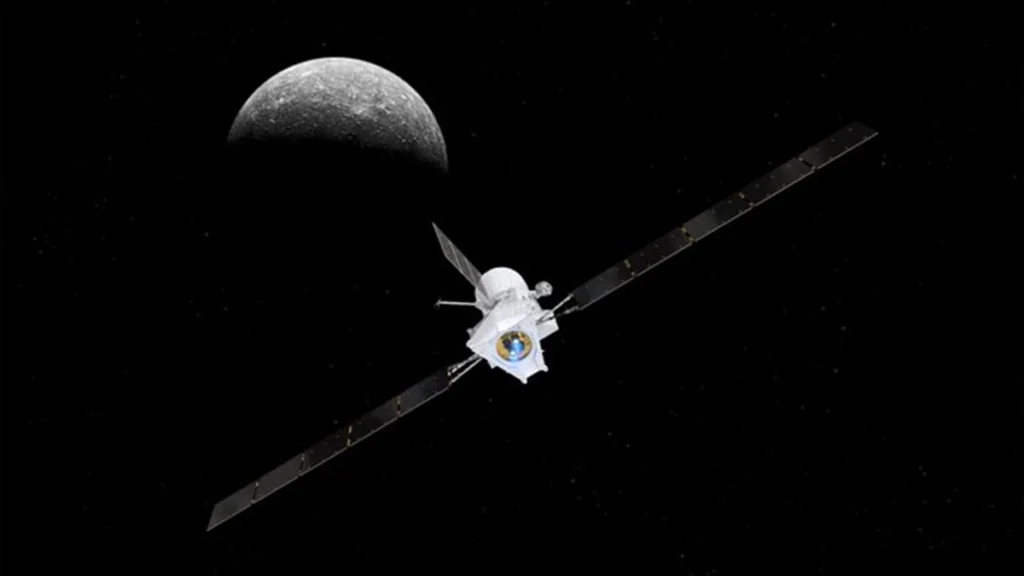
The European-Japanese mission will place two scientific orbiters around the solar system’s innermost planet.
Eight years after liftoff, the BepiColombo spacecraft is about to face the first major step in its approach to Mercury, when the Mercury Transfer Module (MTM), which has propelled the spacecraft during its journey, separates from the two scientific orbiters.
RELATED:
NASA Researchers Set Up in Spanish Village to Observe Total Solar Eclipse
“BepiColombo will not arrive at Mercury at a specific moment, but rather over several months of intense, high-risk operations” that, if successful, will leave two independent satellites orbiting the planet closest to the sun in the solar system, said Ignacio Tanco, head of Inner Solar System Mission Operations at the European Space Agency (ESA).
The first stage of the arrival phase will take place Thursday, Sept. 3, when the MTM propulsion module separates from the two scientific satellites: ESA’s Mercury Planetary Orbiter (MPO) and the Japanese space agency JAXA’s Mercury Magnetospheric Orbiter (Mio), which were designed to operate in a complementary manner.
After separation, the satellites — stacked one on top of the other — will be propelled by the MPO’s thrusters and continue their journey until November, when, “if all goes well,” they will enter Mercury’s orbit. The moment will be crucial for the mission because “there are many subsystems, such as the MPO’s propulsion system, that we have never tested under flight conditions,” Tanco said.
The mission’s final highly complex maneuver will take place in December, when the orbiters separate. The MPO will release Mio into its elliptical polar orbit around Mercury, then eject Mio’s sunshield (MOSIF) and continue until reaching its final orbit in March 2027. The two satellites will begin their scientific mission in April.
BepiColombo is a highly ambitious mission, but the ESA and JAXA teams are prepared to respond to any setbacks that may arise. “We have the ability to react,” mission director Santa Martinez stressed.
The mission will take place just 63 million kilometers from the sun, where solar intensity is about 10 times greater than on Earth, meaning the spacecraft will withstand temperatures exceeding 450 degrees Celsius.
Mercury, here we go!
Watch @esa /@JAXA_en @BepiColombo MTM separation live on 3 September and witness the first critical step in a never-before-seen planetary arrival.
Click here for more info
https://t.co/G2B4eR9ka2@esascience #BepiColombo #Mercury pic.twitter.com/P9zmqBYUku
— ESA Operations (@esaoperations) August 27, 2026


Why Go to Mercury?
The mission’s science lead, Geraint Jones, explained that the trips to Mercury by NASA’s Mariner 10 spacecraft, launched in 1973, and Messenger, launched in 2004, provided a great deal of information about the planet, but there is still “a huge number of things we do not know and that BepiColombo will allow us to discover.”
BepiColombo will study essential aspects of Mercury, including the planet’s origin and evolution, as well as its internal structure and composition, which is “incredibly dense, at least for its size, and we do not know why,” he said.
The mission, equipped with extremely powerful instruments, will study its magnetic field and “the large invisible bubble that forms when the planet’s magnetic field slows and deflects the solar wind, and which is called the magnetosphere,” Jones said, adding that the mission will seek to solve “surface mysteries,” such as confirming whether craters at the planet’s poles contain ice or whether the planet is an active, living place or a dead one, like the moon.
At the same time, the instruments aboard MPO and Mio will also analyze the gases in the planet’s exosphere — an extremely thin gaseous layer surrounding it — and seek to identify which gases are present and how they change.
In addition, the mission aims to test Einstein’s theory of general relativity by making precise measurements of the spacecraft’s orbit and position. As the planet closest to the sun, Mercury lies in an extremely intense gravitational field, making it an ideal setting for studying the effects of gravity.
To reach Mercury’s orbit, the mission — launched in October 2018 — has required nine planetary flybys: one of Earth, two of Venus and six of Mercury.
teleSUR/ JF
Source: EFE
From teleSUR English via This RSS Feed.