

In Donald Trump’s world, “Operation Epic Fury” — the code name for the war of aggression against Iran that he launched alongside Israel — was supposed to be a swift and relatively low-cost military intervention, an opportunity to flex his muscles and thus counteract the undeniable decline of American power.
The precedent set by the military operation in Venezuela — which, in just three hours, resulted in the kidnapping of Nicolás Maduro and the transformation of the Chavista regime into a mere administrator of a U.S. protectorate — fueled the desire for easy victories that characterizes the most narcissistic occupant the White House has ever seen.
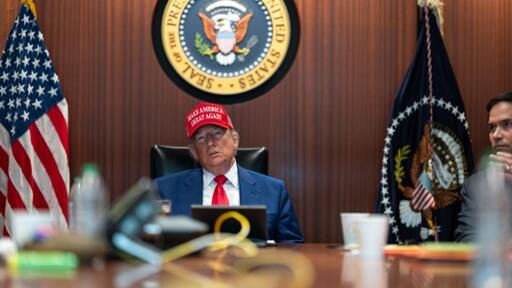
In the early morning hours of February 28, Trump appeared in a pre-recorded video, wearing his ever-present MAGA hat, to announce that, together with Israel, he was once again leading the United States into war in the Middle East. In the absence of an indisputable casus belli — such as an Iranian attack on U.S. forces — Trump offered vague justifications, citing an imminent threat and reviving the disastrous strategy of “preemptive wars” that led to nothing less than the quagmires in Iraq and Afghanistan.
According to Trump, the “greatest attack of all time” (any resemblance to Argentinian president Javier Milei’s rhetoric is purely coincidental) was supposedly going to bring about the collapse of the Islamic Republic of Iran (regime change) within hours, along with the destruction of its missile arsenal and nuclear program. On paper, the plan was to proclaim the famous mission accomplished and withdraw, thus avoiding another endless war in the Middle East. At most, Operation Epic Fury would last four weeks. No casualties, no troops on the ground — only upsides.
For Israeli president Benjamin Netanyahu, it meant realizing his long-standing political-military ambition: that the United States would finally go to war directly against Iran, its main regional enemy — one that the Zionist state cannot defeat on its own, as had already become clear during the so-called “12-day war” of June 2025. Bibi’s interest is more prosaic; it has to do with his precarious domestic situation on the eve of the crucial October 27 election, in which both his position and his freedom are at stake.
At the start of the war, there was a sort of division of labor between the Trump-Netanyahu partners: Israel set out to wipe out Iran’s political, military, and religious leadership, starting with Ayatollah Ali Khamenei, the first head of state assassinated by the Zionist state. The Pentagon bombed military and strategic infrastructure, as well as other “soft” targets such as a girls’ school — a case of “collateral damage” attributed to inaccurate intelligence.
All that remained was to wait for the collapse of the Iranian regime — a promise from Israeli intelligence based on a simplistic view that, as was later leaked, virtually no one shared, not the White House, the Pentagon, or the CIA. Even several advisors and officials pointed out the obvious: that Iran could close the Strait of Hormuz. But Trump dismissed the warning because he bought into the fantasy that the initial blitzkrieg wouldn’t even give the ruling theocracy time to react.
Politically, the main opponent was none other than Vice President JD Vance, who warned that the war would end up fracturing the pro-Trump electoral coalition, pitting the so-called “America Firsters” against the MAGA wing of the Republican right. This is exactly what ended up happening, with a high-profile split involving figures such as Congresswoman Marjory Taylor Greene and former Fox News host Tucker Carlson, who criticized himself for having campaigned for Trump and, after breaking with the GOP, is now calling for the creation of a third party.
The highly unorthodox process by which Trump decided to lead the United States into a losing war against the will of virtually the entire state establishment is recounted in detail in the final chapter of the book Regime Change: Inside the Imperial Presidency of Donald Trump, by Maggie Haberman and Jonathan Swan. Both New York Times journalists had previously reported in that publication on the details of the meetings in the Situation Room, where, according to their account, Netanyahu and the head of the Mossad “sold” a reality deemed “farcical” by the CIA and outright “bullshit” by Secretary of State Marco Rubio.
Without strategic clarity or precise political objectives — the ABCs of waging war — it was to be expected that nothing would go according to plan. After 40 days of air warfare, Trump’s sole priority became reopening the Strait of Hormuz, a problem that did not exist before the war and that affects the global economy.
The objective is no longer the “unconditional surrender” of the Iranian regime — something that clearly isn’t going to happen — nor, likely, the elimination of the nuclear program, but rather to roll back the situation to February 27, which at this point seems like an impossible mission.
Trump proclaimed the United States the victor in the war against Iran some 39 times, the first time in the early days, and the last around the halfway point of the conflict’s first anniversary, when Treasury Secretary Scott Bessent announced “Operation Economic Outcast” — an admission that imperialism has no viable military options and has reverted to the traditional policy of extreme economic pressure to improve the terms of the negotiations, which so far remain favorable to Iran.
This plan, which the White House compares to “D-Day,” will likely not allow the United States to achieve what it failed to achieve on the battlefield either. This pessimistic view is shared by several analysts, including Nate Swanson — a former Biden administration official and Iran negotiator on the Trump team — who, in Foreign Affairs, argues that failure is inherent in the very dynamics of the war, which weakened the ability to exert pressure on Iran for a historical period far exceeding Trump’s presidency.
The success of the “outcast operation” rests on the far-fetched idea that the entire world, including resentful allies and emboldened rivals, would be willing to help the United States strangle the Iranian economy under the threat of a sanctions regime that is as draconian as it is unsustainable, given that Washington lacks the capacity to impose these secondary sanctions on China, Iran’s main economic partner, which has already flatly rejected this alleged interference in its affairs.
Furthermore, Trump is not indifferent to the impact these sanctions could have on the global and domestic economies. As he said at the time of signing the Memorandum of Understanding with Iran, his “red line” is becoming the Herbert Hoover of the 21st century.
Six months later, with the consequences now clear, there is no longer any doubt that the war against Iran is an “epic disaster” for the United States and for the Trump administration, which has seen its popularity in tatters along the way. With exceptions among journalist friends and a few other outdated hawks, the assessment of “strategic defeat” is shared by mainstream analysts, whether they are neoconservatives like Robert Kagan, traditional establishment figures like Richard Haass, or leading figures from various strands of the realist school, such as John J. Mearsheimer.
A brief review of data compiled by Al Jazeera helps put this defeat into concrete terms. Some highlights of this report are: 1) The United States and Israel launched some 3,580 attacks against Iran since February 28. But during that same period, Iran responded with 2,053 attacks, mainly against U.S. allies in the Persian Gulf and the Middle East. It is worth noting that as part of Iran’s defensive strategy of “horizontal escalation,” U.S. bases in Kuwait, Qatar, Saudi Arabia, Bahrain, and Jordan were rendered inoperable. 2) The number of commercial ships passing through the Strait of Hormuz dropped from an average of 100 to 5 per day. 3) According to Pete Hegseth, the Secretary of Defense (or “Secretary of War,” as Trump likes to call him), the cost of the war through July totaled $37.5 billion, but the actual figure is significantly higher: some media outlets report that the Pentagon’s internal estimate ranges from $80 billion to $100 billion. 4) The price of oil rose 22 percent compared to pre-war levels, with peaks exceeding $120 per barrel in a highly volatile market. 5) U.S. strategic oil reserves fell by more than 40 percent, to their lowest level since 1982. The trend is repeated in other countries, including China.
The war in Iran exposed a vulnerability that had remained relatively hidden until now, although the dual pressure of the wars in Ukraine and Gaza had already raised the risk of overextending U.S. capabilities. Despite its formidable military budget and war machine, the United States faces a crisis of ammunition and high-precision weapon shortages that places it in an unprecedented position of vulnerability should it have to confront other crises — let alone one involving China. According to an August military analysis by the Council on Foreign Relations, Operation Epic Fury decimated the Pentagon’s stockpiles.
A few examples illustrate the critical situation: the number of Patriot interceptors dropped from 1,500 to 830, 40 percent of the ballistic missile interceptors were depleted, and the stockpile of tactical missiles was virtually exhausted. Replenishing this arsenal would take between two and six years. The U.S. also lost 25 percent of its MQ-9 Reaper drones — at a cost exceeding $30 million per unit — most of which were shot down by cheap, easily produced Iranian drones. Added to this are other misfortunes, such as the deplorable conditions on the aircraft carrier USS Abraham Lincoln.
Due to this critical situation, the White House had to transfer resources from Asia and Europe to the Middle East. Among other things, this is a key reason why Trump backed away from military escalation following the collapse of the Memorandum of Understanding.
Iran’s war is changing the Middle East, but not in the way Trump and Netanyahu intended. It is doubtful that the United States will be able to rebuild its military presence, or that its allies will consider it desirable to host U.S. bases on their territories — bases that, rather than guaranteeing their security, have ended up turning them into targets of Iranian attacks.
Iran’s war and the State of Israel’s genocide in Gaza have rendered the Abraham Accords unviable — the strategy through which the United States sought to normalize relations between Arab states and the State of Israel as the foundation for a regional order that would counterbalance Iran. Emerging alliances, such as the defense pact between Saudi Arabia, Pakistan, and Turkey, demonstrate a desire for a certain degree of autonomy — to avoid relying exclusively on the United States and to diversify partners, including China.
Trump’s bluster, his vacillation, and his “TACO” style (making threats, only to back down) undoubtedly contribute to eroding the credibility of U.S. imperialism, but the material basis for its decline lies in this degradation of its capacity for coercion. This is something recognized not only by the Iranian regime but also by far more significant adversaries such as Russia and China. And even a number of the so-called “middle powers” are significant enough to pursue relatively autonomous policies that, in some cases, run counter to Washington’s interests.
While on the international stage the war in Iran has deepened imperialist decline and accelerated trends already present in the international situation, domestically it is causing Trump’s popularity to plummet. In the latest Reuters/Ipsos poll, he barely reached a 30-percent approval rating. Amid this widespread rejection — in addition to the war’s unpopularity — the full brunt of inflation is being felt, as is deep skepticism regarding the strategic alliance with Israel. This skepticism is manifesting on the left through the victories of candidates with a clear anti-Zionist and pro-Palestinian platform, particularly those associated with the DSA political movement.
Everything suggests that on the night of Tuesday, November 3, when the results of the midterm elections are announced, Trump will find himself reduced to a lame duck, with the remaining two years of his term marked by political instability and polarization. Trump leads a weak Bonapartist government, with a social base increasingly restricted to the hard core of his far-right supporters. That weakness — not strength — lies at the root of his warmongering and aggressive imperialist policies, as we see in Latin America, where, with the collaboration of allied and subservient governments, he seeks to implement the so-called “Donroe Doctrine.” It also underlies his authoritarian and anti-worker domestic policies, such as the persecution and deportation of immigrants, through which he seeks to overcome the defeat he suffered in Minneapolis.
The profound significance of the United States’ strategic defeat in Iran and its consequences — both geopolitical and for class struggle — have not yet been fully realized. In the long run, it weakens the country’s far-right allies, such as most Latin American governments, starting with Milei’s in Argentina. The question is whether new phenomena — the growing popularity of “socialism” (still largely social-democratic in character) among U.S. youth, the international movement in solidarity with the Palestinian people, and, in another vein, the enormous sympathy for Myriam Bregman as a leading figure of Argentina’s revolutionary Left — are signs that we are entering a “Vietnam moment”: a period of confrontation with imperialism and political radicalization that once again raises the prospect of social revolution.
Originally published in Spanish on August 30 in La Izquierda Diario
The post Epic Fury, Epic Failure: Seven Months of War Against Iran appeared first on Left Voice.
From Left Voice via This RSS Feed.