


Nika Bartoo-Smith
Underscore Native News + ICT
As a young kid, Lluvia Merello remembers many long days spent in marketplaces with her parents, who both made jewelry. They vended at markets in Peru, where Merello was born, and then eventually up and down the West Coast once they immigrated to the United States.
Following in her parents’ footsteps, Merello began to make jewelry as well, looking for opportunities to sell at marketplaces in Portland.
“I’ve always grew up in these kind of settings, and then in 2017, I started my own jewelry business called Indigenous Come Up,” said Merello, Quechua, Andean/Inca. “Through that process here in Portland, I realized how I just would always have so much of a better experience at marketplaces that were culturally respectful, either powwows or BIPOC markets.”
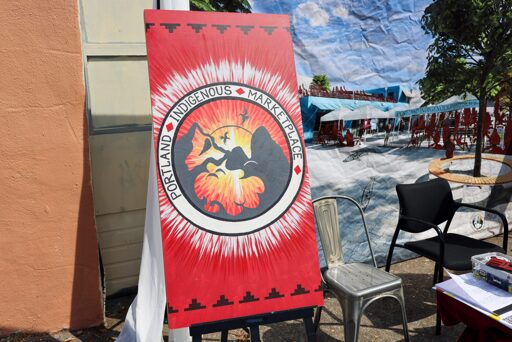
Realizing the need for culturally centered marketplaces, Merello founded Portland Indigenous Marketplace in 2018. It quickly became a staple in the Portland community for Indigenous vendors and events for the public to support local artisans. Currently, the organization hosts dozens of marketplace events annually at various locations.
Portland Indigenous Marketplace will soon be starting renovations on a permanent home with a target for opening by 2028. The space, at 737 Southeast Sandy Boulevard in southeast Portland, was provided by an anonymous donor in 2024. The organization is still looking for funding to complete what they have dubbed “Project 737.” The first step, starting this fall, will be a new roof.
Once completed, the space will include an indoor area for makers and events and an outdoor plaza.
”We’re going to transform this empty, abandoned lot into a beautiful cultural center, vibrant with Indigenous art from all over the world all year round,” said Merello, beaming as she stood in front of the future home of the marketplace during a press conference on Aug. 19.
The start of Portland Indigenous Marketplace
When Merello first started her jewelry business in 2017, she quickly found that there were only around a dozen or so culturally specific vending opportunities in the Portland area each year.
“I just realized there’s all these amazing artists out there, and that’s just not enough opportunity, and it’s infrequent,” Merello said.
So she sought out a way to create more opportunities.
In 2018, Merello and her business, Indigenous Come Up, got a contract with the Portland Bureau of Transportation to host three mini Native marketplace events during Last Thursday, a monthly summer market on Alberta Street in northeast Portland. That same year, she also hosted a Black Friday Indigenous Marketplace.
Those initial marketplace events spurred the birth of Portland Indigenous Marketplace, which ultimately began with a grant from the Oregon Metro Community Placemaking program in 2019. Great Spirit Church was a fiscal sponsor.
By 2020, Portland Indigenous Marketplace became a 501c3 nonprofit. Even through the COVID-19 pandemic, Portland Indigenous Marketplace stayed afloat, hosting livestreamed events on Facebook.
“We would do like six hours of programming live,” Merello said. “We would interview artists, we would have music, we would share about the organization and then artists would share.”
Over the years, Portland Indigenous Marketplace was able to expand, hosting dozens of events annually. To date, the organization has served well over 250 vendors, according to Merello, many of whom return each year.
For the first time this year, vendors are charged $25 per day to have a booth at events. Up until now, it had been completely free for artisans.
“A lot of the community too could see the importance of this program and realize that if vendors were to pay that small fee, how the program itself would have more permanency instead of relying on grants or different things that just are not reliable sources every year,” Merello said.
When creating Portland Indigenous Marketplace, Merello felt inspired by the Quechuan prophecy, Pachacutek, about the “Eagle and the Condor,” according to Merello.
“The Indigenous peoples of North America, represented by the eagle, and the Indigenous peoples of the South Americas, represented by the condor, (come) together to exchange knowledge (to) create a portal for all of us to return to our Indigenous roots,” Merello said.
That is part of what she hopes to create with Portland Indigenous Marketplace — a space to share cultural knowledge and be in community with each other.
A permanent home
Standing in front of the new, permanent home for Portland Indigenous Marketplace on Aug. 19, Merello and two others involved with the nonprofit shared their visions for the future.
“We’re creating a physical space where Indigenous artists, makers, performers, families and community members gather, sell their work, share culture and be visible,” said LaDonna Dempsey, a Portland Indigenous Marketplace team member and owner of Dempsey Designs Beadwork.
“The transformation of the building represents something bigger: Indigenous people taking up space and creating something for ourselves and community,” Dempsey, a Two-Spirit Diné citizen, continued.
With a physical space, not only will Project 737 allow an increase in vendor capacity through more frequent marketplace events, it will also serve as a community center of sorts. Merello hopes to see the space used for other gatherings, such as concerts, and expand the makerspace to allow for workshops and classes for the public. There are also ideas for a gift shop or gallery space in the new building. Portland Indigenous Marketplace is partnering with Depave to create an outdoor plaza.
The location itself is significant as well. Sandy Boulevard, running through the Portland metro area and connecting the Willamette River in southeast Portland to the confluence of the Columbia and Sandy Rivers in Troutdale, used to be an important trade route for Native people pre-colonization, according to Dempsey.
Merello and Dempsey envision Project 737 as a central hub for the Indigenous community in the Portland area, and open to all who wish to support Native artisans.
“We’ve proven that our community will always show up. We built markets. We’ve gathered our artists. We brought people together and created community and temporary spaces,” Dempsey said. “And having a permanent space means we can build something that lasts a lifetime, forever, and something we can take out to the youngest generation.”
Visit the marketplace website to learn more, including how to donate.
Upcoming Indigenous Marketplace Event
Date: Sept. 12 and 13
Location: Electric Blocks — 1615 SE 3rd Ave., Portland, OR 97214
Time: 10 a.m. – 4 p.m.
This story is co-published by Underscore Native News and ICT, a news partnership that covers Indigenous communities in the Pacific Northwest.
The post Portland Indigenous marketplace finds permanent home appeared first on ICT.
From ICT via This RSS Feed.