

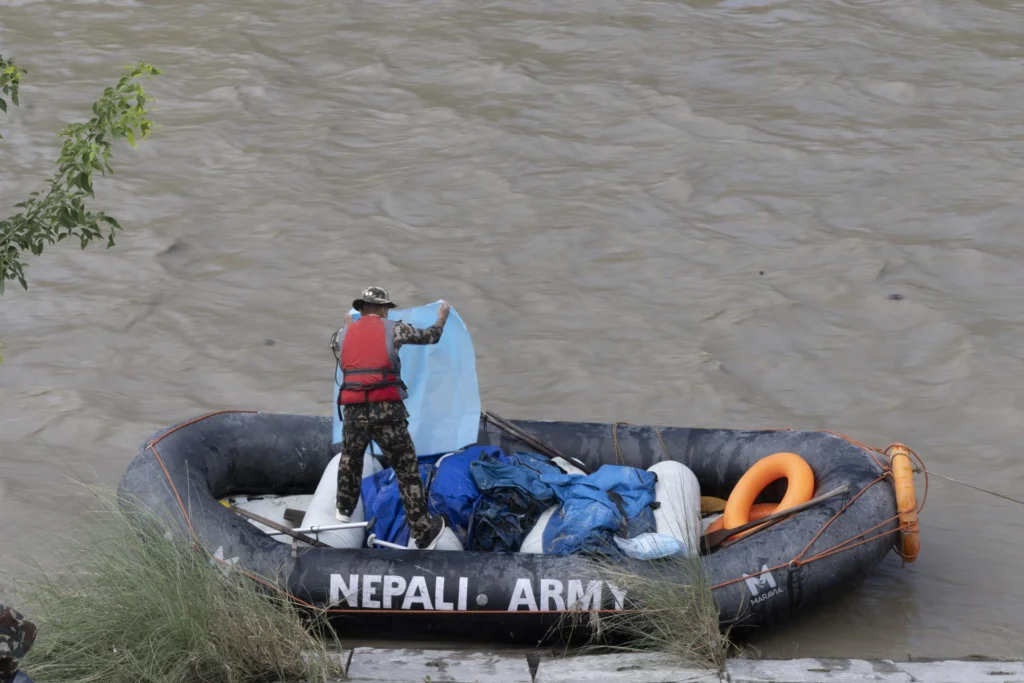
Nepal has reported 903 deaths and China 16, while thousands remain missing and hundreds of foreign nationals are still unaccounted for.
The death toll from devastating floods near the Nepal-China border has reached 919, with Nepal reporting 903 fatalities and China 16 as international rescue teams join operations to locate more than 3,000 people still missing on both sides.
RELATED: Nepal Flood Death Toll Hits 750 As Rescues Are Hampered
Nepalese authorities say more than 2,500 people remain missing in the country, including hundreds of foreign tourists, while China has reported 546 people unaccounted for. The figures have not been reconciled through a unified cross-border system.
International rescue teams are now working alongside Nepalese army and police units, focusing in part on more than 900 people feared trapped inside tunnels at hydroelectric power projects.
Text Reads:  A flash flood in the Nuwakot district of Nepal destroyed a 25-megawatt solar power plant and damaged strategic hydroelectric projects
  .
.
 Nearly 900 megawatts of power capacity were compromised. Hundreds of people remain trapped at the facility, while rescue teams search for survivors after hundreds of deaths and thousands of missing persons.
A total of 591 foreign nationals remained out of contact in Nepal on Sunday, five days after flooding struck several districts, according to the Nepal Tourism Board. Authorities have rescued 289 foreign tourists, including 180 Indian and 89 Chinese citizens.
Those rescued also include four Germans, four Maltese, two Italians, two Russians, two Turks and two Americans, as well as citizens of Bulgaria, Oman, Portugal and Switzerland.
Nepalese authorities said they had established contact with three Spanish citizens. The tourism board did not specify whether they had been evacuated or remained at their locations awaiting rescue, and gave no further information on whether other Spanish nationals were still missing.
Spain’s Foreign Ministry said Saturday that two Spanish citizens remained missing. A report broadcast Sunday by Chinese state broadcaster CCTV listed a Spanish citizen among those missing for the first time.
Nepal’s Foreign Ministry has established an emergency control center to coordinate the search for foreign nationals with the institutions involved and their families.
Rescue and identification efforts
Nepal says it has rescued 8,730 people overall, including 279 who were evacuated by helicopter from hydroelectric projects.
The arrival of international rescue teams comes after relatives of workers missing from the hydroelectric facilities questioned the government’s technical capacity to carry out an operation of such complexity.
India has also sent 18 forensic experts specializing in DNA analysis to help identify recovered bodies. Nepalese authorities said some unidentified bodies, including those in an advanced state of decomposition, have been temporarily buried according to established protocols, including those of the International Committee of the Red Cross.
On the Chinese side of the border, communications near the Gyirong crossing were partially restored Sunday after the floods destroyed roads, power lines and telecommunications networks. The damage had hindered both access to the disaster zone and the transmission of information during the first days of the emergency.
More than 2,100 Chinese personnel, along with hundreds of vehicles and other equipment, remain deployed in Gyirong as searches continue among the remains of the border crossing.
Glacier collapse blamed for disaster
An expert team affiliated with the Chinese Academy of Sciences has attributed the flooding to the collapse of a glacier in Nepal whose stability had been affected by prolonged global warming, according to CCTV. The assessment was based on remote-sensing images, monitoring data and field observations.
The glacier collapsed at about 10:52 a.m. local time Wednesday at an altitude of roughly 5,200 meters. The mass of ice fell rapidly to around 4,000 meters before striking the mountain and generating a torrent of mud, rocks, ice and other debris that swept down the valley toward Gyirong.
Chinese authorities said the flow traveled about 22 kilometers before reaching the border crossing, which sits at roughly 1,800 meters above sea level. The entire journey took about six minutes and seven seconds, according to calculations released by Chinese authorities.
The torrent affected about 0.7 square kilometers around Gyirong and destroyed 27 buildings and associated facilities, including much of the border complex, which was buried under mud and debris.
The Chinese experts described the event as sudden, with a large volume of water and debris, high speed and strong destructive force.
China’s latest national glacier inventory, released in 2025, estimated that the country’s glacier area had declined by 26% since the 1960s, with retreats of up to 40% in some parts of the Himalayas and Transhimalayas.
Flooding of the Bhote Koshi and Trishuli rivers affected the districts of Rasuwa, Nuwakot, Dhading and Gorkha.
The Kathmandu-Mugling highway, one of Nepal’s main road links, remains completely blocked at Krishnabhir in Dhading’s Benighat Rorang rural municipality after river erosion caused part of the road to collapse.
Most of Nepal’s road network remains operational, apart from sections affected by flooding in Rasuwa, Nuwakot, Dhading and Gorkha.
The Nepal Tourism Board has advised travelers to check road conditions and weather forecasts before traveling, particularly toward areas affected by the floods.
From teleSUR English via This RSS Feed.