

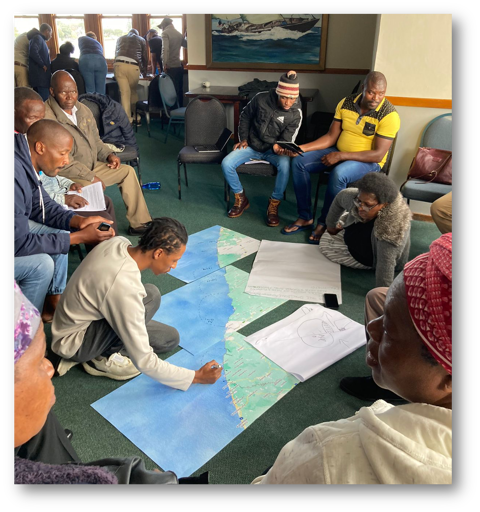
CAPE TOWN — When scientist Loyiso Dunga began mapping the Great African Seaforest in 2016, he decided to go snorkeling. The South African section of the kelp forest stretches around 800 miles or 1,300 kilometers, straddling two coasts and two oceans. Dunga grew up in a coastal community, Nqabara, in South Africa’s Wild Coast. As a member of the Xhosa nation, the ocean was kin or family to Dunga, and a sacred place. But that snorkeling trip was the first time he went into the ocean for fun. “That moment enchanted me,” said Dunga, who lives in Cape Town. Dunga’s research is now focused on evaluating kelp ecosystems. He works in South Africa as the executive director for the Seas of Good Hope program and globally with the International Union for Conservation of Nature (IUCN) and the Kelp Forest Alliance, a group that is dedicated to protecting over 9 million acres (3.6 million hectares) of kelp forests by 2040. But, for this conservation work to succeed, Dunga says that Indigenous wisdom, science and policy must be better connected. Dunga founded Asili Blue Renaissance, a nonprofit, to provide diverse, legitimate ocean conservation measures, including working with Indigenous communities. Dunga is now working on an initiative with the Kelp Forest Alliance to rename global kelp forests by their Indigenous names. Mongabay spoke with Dunga on the phone about his work. The interview has been edited for length and clarity. Loyiso Dunga. Image courtesy of Loyiso Dunga. Mongabay: How did you first become…This article was originally published on Mongabay
From Conservation news via This RSS Feed.