

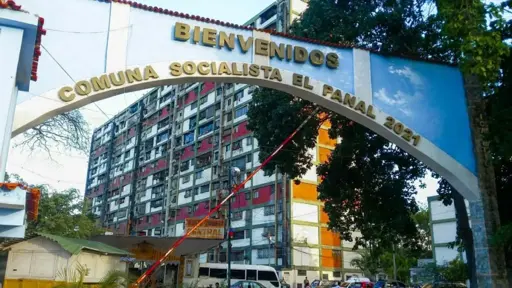
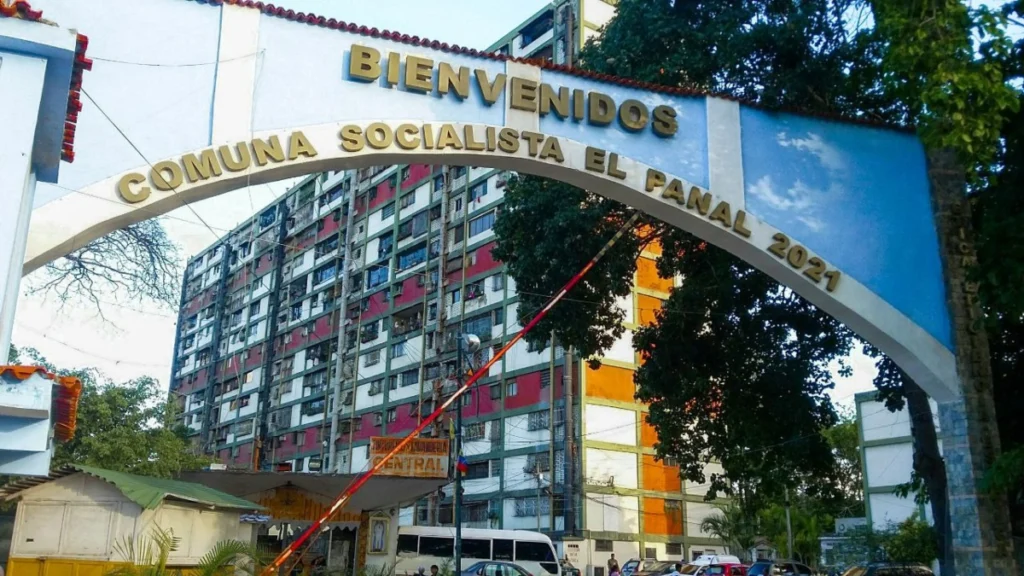
Comuna Panal 21 has developed housing, infrastructure, economic initiatives and community services for more than 10,000 residents.
Nearly two decades of grassroots organization in Caracas’ 23 de Enero parish have transformed Comuna Panal 21 into a community network serving more than 10,000 residents, with projects ranging from housing and basic infrastructure to local economic initiatives, education and recreation.
RELATED: Venezuela’s $209 Billion Energy Agreement With the U.S.
The commune, made up of nine communal councils, has developed through years of community organizing in the historic Caracas neighborhood. Residents say the organization has helped them confront economic difficulties and other crises while building local services and productive activities.
Judith Guerra, a spokesperson for the Santa Rosa community, recalled that residents once felt unable to move freely through their neighborhood or use its public spaces without fear.
Since then, she said, the community has replaced 42 makeshift homes with permanent housing, renewed 600 linear meters of drinking-water and sewage pipes and repaired roofs across the area. It has also promoted family and community-based economic activity.
Text Reads:  The Panal 21 Commune, in the 23 de Enero neighborhood of Caracas, transformed the lives of more than 10,000 residents for nearly two decades. It is comprised of nine community councils.
 This social organization faced economic hardship, military aggression, the kidnapping of President Nicolás Maduro, and the double earthquake of June 24th. Residents recall that before the commune, they lived in fear and without the freedom to move about in public spaces.
A local economy built during the pandemic
One of the community’s most enduring initiatives emerged during the COVID-19 pandemic, when movement restrictions coincided with widespread unemployment.
Unable to leave their homes, residents created a social-media group to identify the skills and services available within the community. They discovered neighbors working as bakers, electricians, blacksmiths, hairdressers, seamstresses, cooks, carpenters and appliance-repair technicians.
The initiative, known as Panalito, helped residents promote those services and connect them with people from other communities passing through the area, Guerra said.
Today, Comuna Panal 21 also has a radio station, recreational spaces, a public library and sports facilities. Residents can take classes in dance, martial arts and robotics.
Interest from Catalan activists
The commune has also become a point of interest for a group of socialist activists from Catalonia who traveled to Venezuela to learn about community organization and the country’s communal model.
Maura Antoni, one of the visitors, said she arrived without knowing what to expect but wanted to learn about Venezuela’s experience of grassroots organization.
She said the visit showed her how communities can build political structures from the ground up through popular organization, assemblies and bottom-up decision-making.
Alex Quintero, a Catalan activist specializing in international relations, said visits to several communes had given the delegation an opportunity to examine participatory processes, including the election of communal councils and the role of community representatives.
He said the group hoped to take what it had learned back to Catalonia.
Beyond local government
Cira Pascual Marquina, a researcher and popular educator with Comuna Panal 21, said communes should not be understood simply as administrative institutions. In her view, they emerge from local experiences of community self-organization.
Pascual said the commune goes beyond addressing practical needs such as sewage, lighting and roads. She described it instead as a center for developing new social relationships.
She identified two foundations for the model: direct, participatory democracy without representation and community control over the means of production. Together, she said, they form what she calls substantive democracy.
Pascual also recalled a period of severe shortages when communal organization took on a particularly important role, including efforts to organize food distribution. She linked that experience to the slogan associated with former President Hugo Chávez: “Commune or nothing.”
She argued that international solidarity is essential to the broader socialist project, saying that struggles in different countries cannot be pursued in isolation.
According to Venezuela’s Ministry of Communes, the country has 3,924 registered communal territories. Of these, 53 are Indigenous, 1,056 are rural, 1,851 are suburban or mixed, and 964 are urban.
Each territory has its own characteristics, Pascual said, while describing communal organization as an ongoing process that continues to develop amid the country’s difficulties.
From teleSUR English via This RSS Feed.