

This article by Lorenzo Meyer originally appeared in the August 27, 2026 edition of SinEmbargo, an independent Mexican digital news outlet.
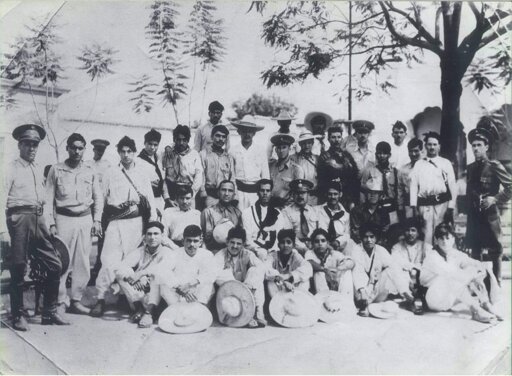
As Carl von Clausewitz aptly observed, war is the continuation of politics by other means. The Prussian soldier’s definition is very much to the point when reflecting on the centennial of one of our most bitter internal wars: the Cristero war, or “cristiada,” which today occupies barely a couple of pages in school textbooks and six in the book published in 1979 by the Ministry of Defense, El ejército mexicano, a voluminous history in which the maps and lists of towns barely left room for a very brief text where what really draws attention, coming from where it does, is a kind of conclusion that accepts that the Cristeros, “Mexicans after all, fought valiantly,” against the established Government.
The emergence, exactly one hundred years ago, of a popular anti-government army in the center of the country invites a deeper reflection, for that struggle (which cost the lives of tens of thousands of Mexicans, though we do not know exactly how many) ultimately did not lead to any substantive political change.
The clash between the Catholic Church and the revolutionary regime turned into war precisely because the parties failed at what Clausewitz emphasized: the period before hostilities, that is, the time of political negotiation. What happened after the violent collision was simply the consolidation of the status quo ante in the relationship between the regime and the Church, which ended up institutionalizing a coexistence quite comfortable for both parties, which leads one to ask whether the war served any purpose at all.
The conventional start of what became a new great civil war, just as the one of the Mexican Revolution had barely ended, is usually dated to July 2, 1926, when the “Calles Law” was published in the Official Gazette, a regulation of Article 130 of the Constitution that hardened and narrowed the space and manner in which churches (the Catholic one, in reality) could carry out their professional activities. Of course, the start could also be dated a few days later, on the 26th of that month, when the Catholic Church announced that, in protest against the regulation imposed on it, it would close its temples and suspend its services (masses, sacraments, etc.). In any case, by the end of August the first armed clashes took place between government forces and groups of Catholic civilians who would end up organizing themselves as the Cristero army.
The confrontation had, by 1927–1928, become a substantial armed clash in which the insurgent side sought, in the name of the defense of the Catholic religion, to put an end to the revolutionary regime that was only just taking shape. However, the root of such a great undertaking can be found much earlier: in the difference and clash of the political projects that emerged shortly after Mexico achieved its Independence. It was the clash of two projects of Nation, the liberal and the conservative, which in the mid-nineteenth century fought each other to the death but which, at the beginning of the following century, seemed to have been definitively overcome as a result of the triumph of liberal arms in 1867.
Nevertheless, the violence that, for religious motives, once again convulsed our country while the aftermath of the Mexican Revolution was still being felt can be better understood if it is seen as the reemergence of that tremendous political and military clash that were the civil wars of the previous century.
That violence we know as the War of the Reform had as its central cause, though not its only one, the effort of the liberal side to radically and definitively separate the structures of the State from those of the Catholic Church. The union of State and Church was one of the main features of the three-century political system in New Spain, and the conservative project was precisely to maintain that symbiosis, holding that in independent Mexico it was the only way to give unity to a Nation built on a highly fragmented social base. For the liberals of the time, on the contrary, freeing the State from the influence of the Church was a sine qua non condition for making the economy of the young country viable, beginning to put an end to the historical fragmentation of its social base, and achieving a national identity beyond religious beliefs.
The defeat of the original conservative project, sealed with the execution by firing squad of Emperor Maximilian, did not mean, as would be seen in the events of the 1920s, the resignation and adaptation of the Catholic hierarchy to the new reality. The influence of the Catholic Church in the everyday life of the country, above all in the worlds of rural and majority Mexico, was dominant. Works such as Pedro Páramo by Juan Rulfo and Al filo del agua by Agustín Yáñez, or microhistories such as Pueblo en vilo by Luis González, are so many windows that allow us to gauge the importance (not only religious but political, cultural, and identity-related) of the Catholic Church in much of central Mexico where, despite the changes introduced by the Revolution or precisely because of them, it turned out to be fertile ground for the resurgence of a violent reaction against a Government that, among other things, remained bent on imposing the values of the secular State in spheres that, in practice, the Church and the Catholic community still considered their own.
The great work (more than a thousand pages) by Jean Meyer, La Cristiada, published in Spanish in three volumes in 1973, shows that in its zone of operations the Cristero army had a solid social base of support, multiclass and highly motivated by the possibility of putting an end, not simply to the anticlerical measures of President Calles’s government, but, in the name of Christ the King and the most holy Virgin of Guadalupe, to a regime they supposed was determined to do away with the religion of the people. It is worth noting that in that juncture, and although a good number of priests took up arms, the Catholic Church as such did not choose to join the rebellion openly. The federal Government, which in that period also had to confront an old uprising with an Indigenous base (that of the Yaquis in Sonora) had an army that was only just being organized and professionalized, but whose command had serious internal divisions that would erupt later. In any case, the head of the Government force, General Joaquín Amaro, concentrated his troops in the states where the Cristero social base was strongest (Jalisco, Michoacán, Guanajuato, Nayarit, Colima, Aguascalientes, Zacatecas, and Durango) and arranged for a force of irregulars made up of agraristas, notably from San Luis Potosí, to operate as auxiliaries of the regular army.
The composition of the contending sides (in a civil war that was particularly brutal on both sides and where practically no prisoners were taken) turned out to be very similar, since the federal soldiers and their agrarista auxiliaries were also mostly Catholic and of peasant origin.
Unlike what occurred during the Revolution, the Cristero war had no great decisive battles like, for example, the great battles of Zacatecas or Celaya a few years earlier. The Cristeros always had difficulty arming themselves and did not have the participation of professional military men, except for the case of General Enrique Gorostieta, killed in action. By 1929 it was evident that the Cristeros were not going to defeat the Government forces, but it was equally clear that the Government could not put an end to its adversaries quickly and decisively. Hence, with the mediation of the Washington Government (which did not want more instability south of the Bravo), interim President Emilio Portes Gil met with two bishops (Leopoldo Ruiz and Pascual Díaz) to finally return to politics and declare, each side on its own, that the Government did not intend to interfere with the religious beliefs of society or to destroy the Catholic Church, and that the Church, in turn, did not intend to disavow the authority of the Government and was making a call to the rebels to lay down their arms.
On June 21, 1929, the church bells rang out to announce the return to normality. But since the Cristero combatants themselves were not taken into account in what were called “the arrangements” of ’29, they did not consider themselves defeated but rather betrayed by the Catholic hierarchy. Most of the rebels laid down their arms, but not all. And to better understand those who continued the fight until the end of the 1930s (in what has been called the “Second Cristiada”) one can turn to a moving autobiographical work: Rescoldo. Los últimos cristeros, by Antonio Estrada.
In 1934, General Lázaro Cárdenas took charge of the new regime; in 1936 the former president and author of the “Calles Law” was expelled from the country by Cárdenas; the Agrarian Reform gained strength and generated a large peasant base of support for the regime of the Mexican Revolution. Nevertheless, the embers of the war, of the “Second Cristiada,” persisted throughout the second half of the 1930s, although from 1940 on “la cristiada” began to become history, part of our history as a nation.
And so, how are we to interpret today a conflict that cost the lives of, by estimates ranging between 90,000 and 200,000 Mexicans? In practice the government prevailed over its adversaries, and militant Catholics no longer questioned the legitimacy or the reversibility of the secular State. The modus vivendi reached in 1929 simply took root and, at the end of the last century, in 1992, it was institutionalized with the government’s recognition of the churches as legitimate organizations with rights and obligations, and with the establishment of diplomatic relations between the Mexican Government and the Vatican.
Could this result have been reached without the political confrontation turning into the war it became? It is very probable, for in the end that painful struggle did not modify in any substantive way the legal framework in which the secularism of the State operated; rather, it reaffirmed it. On the other hand, the Catholicism of the bulk of Mexicans held firm, and if anything changed in this last respect, it was more the product of the passage of time and of social change than the result of specific Government policies.
In short, the Cristero war must be recognized as a tragic part (one among others) of the process of formation of our Nation, and also as an example of the high cost that political struggles between the summits of power can have for society when they act irresponsibly.

Lorenzo Meyer Cossío is a historian and political scientist specializing in international relations and the political processes of Mexico.
He earned his bachelor's and doctoral degrees in International Relations.
-
A Hundred Years After ‘La Cristiada’
August 30, 2026
“The Cristero War stands as an example of the high cost that political struggles among the elites of power can have for society when they act irresponsibly,” concludes Meyer.
-
The Normalization of the Abnormal
August 30, 2026
Palestine’s ambassador to Mexico, Nadya Rasheed, denounces the normalization of genocide in Gaza: more than 73,000 Palestinians killed, homes, schools and hospitals destroyed, water poisoned — and a world that looks away.
-
Peña Nieto Filmed Next to Controversial Israeli Contractor
August 30, 2026August 30, 2026
Former Mexican president Peña Nieto was filmed wearing a kippah at a Jewish wedding in Italy, seated beside Avishai Neriah, the Israeli businessman an outlet accused of channeling $25M to him for Mexican government contracts, including Pegasus.
The post A Hundred Years After ‘La Cristiada’ appeared first on Mexico Solidarity Media.
From Mexico Solidarity Media via This RSS Feed.