

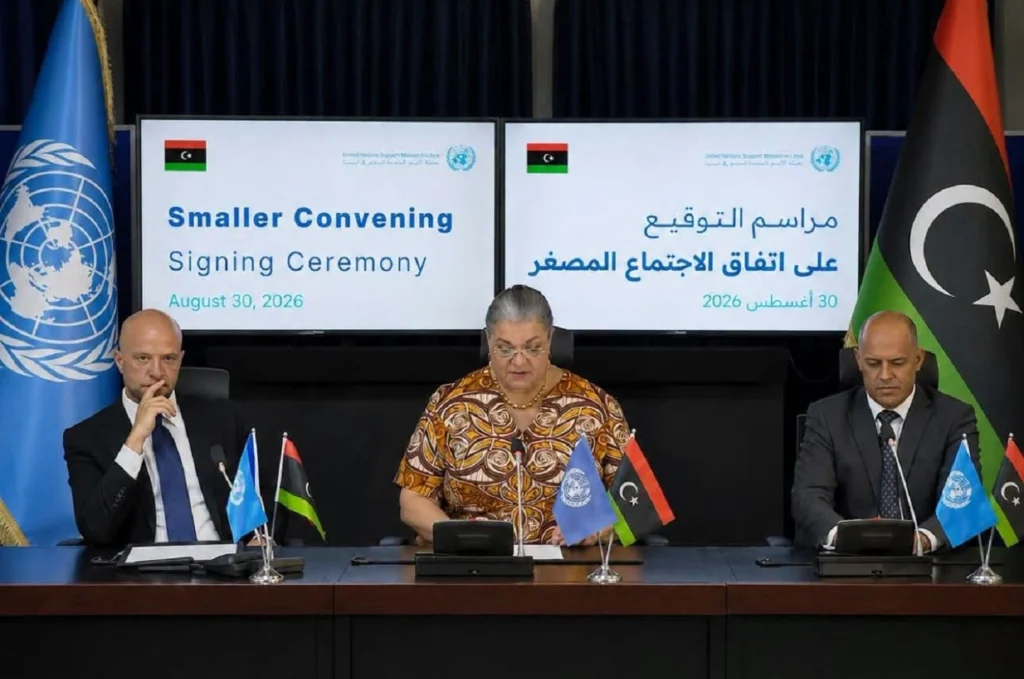
Representatives from eastern and western Libya, a country institutionally divided since 2014, have signed a UN-sponsored agreement. This agreement commits the parties to holding presidential and legislative elections within a maximum of two years with the aim of advancing towards national unification.
[Armed Clashes Erupt Again in Western Libya as Brigade Intervenes to Halt Fighting: West and East Libya Agree To Hold Elections Within Two Years](https://www.telesurenglish.net/west-and-east-libya-agree-to-hold-elections-within-two-years/)
The document, debated by four representatives from each side (4+4 Committee), with the mediation of the UN mission for Libya (UNSMIL), also includes the restructuring of the Electoral Commission and addressing disputes regarding the laws that will govern the elections.
Furthermore, according to the agreement, the elections must be organized by a unified authority and “unique national sovereign” institutions, which requires prior negotiations, as currently, each side has its own entities operating in their respective territories.
They also committed to respecting victory without a second round, should a candidate reach 50% of the votes plus one, an issue that sparked extensive debates in recent years.
UNSMIL welcomes the signing of an agreement on Libya’s electoral framework and next steps towards national elections
TRIPOLI, 30 August 2026 – The United Nations Support Mission in Libya (UNSMIL) today hosted the signing of the agreement of the Smaller Convening, marking an… pic.twitter.com/R4ySgj6ZeF
— UNSMIL (@UNSMILibya) August 30, 2026
The agreement nullifies part of UNSMIL’s roadmap, presented in August 2025 to the Security Council by the organization’s special representative in Libya, Hanna Tetteh, which envisioned holding elections within a maximum of 18 months from the presentation date.
Had the roadmap continued its course, Libya would be half a year away from electing a president and its representatives in Parliament for the entire country, but the new agreement postpones the electoral event to the year 2028.
Tetteh recognized on several occasions the stagnation of the roadmap and blamed the leaders of the warring parties for “delaying the agreed deadlines,” which is why she considered the possibility of making modifications, the first reflected in the 4+4 agreement signed today.
For the head of UNSMIL, “this agreement represents a significant step forward,” so “the priority now is to implement its provisions within the agreed timeframe and maintain momentum to complete the remaining stages of the roadmap.”
After the continuous blockades and delays, she emphasized that “the primary objective is to create the conditions for holding elections within a clear and unchangeable timeframe.”
From teleSUR English via This RSS Feed.