

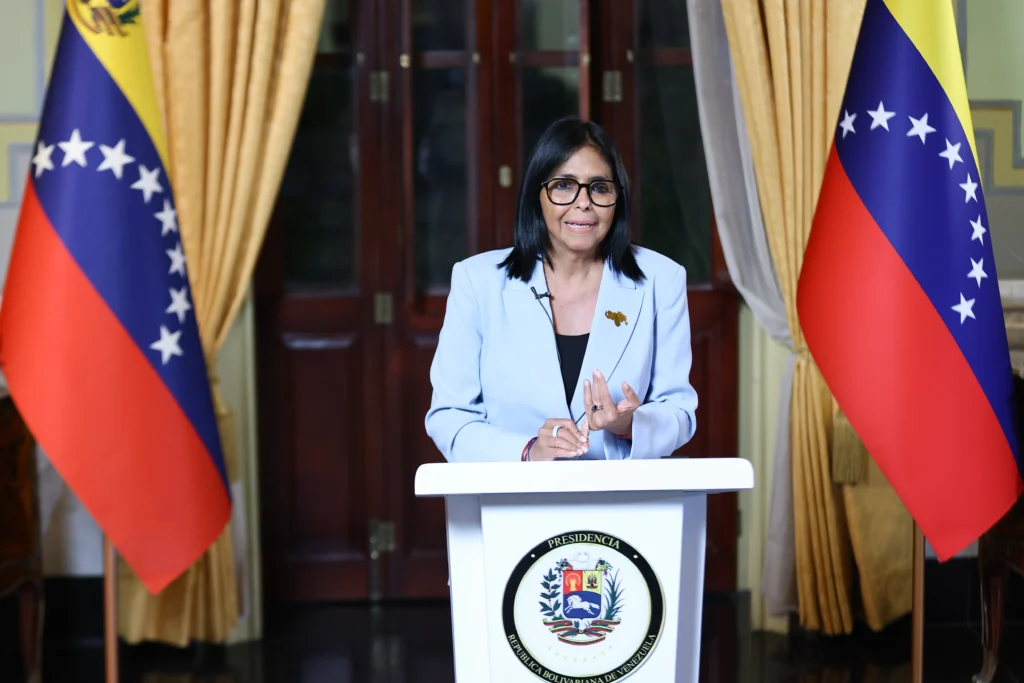
Venezuela’s acting president, Delcy Rodriguez, said a recently reached energy agreement with the United States could bring more than US$200 billion in revenue to the South American country.
Related: Venezuela Oil Output Tops 1.23 Million Barrels Per Day
In a message addressed to the Venezuelan people on Saturday, Rodriguez provided details about the expected financial impact of the agreement, which includes the development of strategic oil fields and potential cooperation with several major international energy companies.
Venezuela’s acting president, Delcy Rodriguez, comments on the oil and energy agreement with the United States finalized on August 28, 2026.#Venezuela #UnitedStates #DelcyRodríguez #oil #teleSUREnglish pic.twitter.com/XTXgu2PtUh
— teleSUR English (@telesurenglish) August 30, 2026
The announcement comes as Venezuela seeks to strengthen its oil industry, attract investment and increase production while emphasizing national control over its natural resources.
Venezuela Expects $209.3 Billion in Revenue
According to Rodriguez, Venezuela is expected to receive approximately US$209.335 billion under the energy agreement with the United States. The estimate is based on an average crude oil price of $65 per barrel.
The Venezuelan leader described the projected benefits as exceptionally significant, saying that the advantages for the country “are beyond measure.” Her comments highlighted the potential scale of the deal at a time when Venezuela continues to face economic challenges and relies heavily on its energy sector.
Oil remains one of Venezuela’s most important economic assets. The country possesses some of the world’s largest crude reserves, but its industry has experienced years of declining production, limited investment and international restrictions. A major agreement with the United States could therefore provide new opportunities for revenue generation and industrial recovery.
The projected income would also give the Venezuelan government greater financial room to address domestic priorities, including infrastructure, public services and economic development. However, the final results will depend on the implementation of the agreement, oil production levels and changes in international crude prices.
Agreement Covers 17 Strategic Oil Fields
The Venezuela energy agreement with the United States reportedly includes the exploitation of 17 strategic fields. These areas are expected to play a central role in efforts to expand oil activity and improve the country’s production capacity.
Rodriguez stressed that the agreement’s objective goes beyond the initial fields. She said Venezuela’s broader strategy includes signing additional agreements with important companies in the global energy industry, including Chevron, Shell and BP.
The participation of these companies could provide access to international expertise, advanced equipment and financing. Their involvement may also help modernize Venezuela’s oil infrastructure, improve operational efficiency and support the rehabilitation of facilities that have suffered from years of underinvestment.
Chevron already has a presence in Venezuela through joint operations with the state oil company PDVSA. Expanding cooperation with Chevron, Shell, BP and other firms could significantly reshape the country’s energy sector, depending on the legal and commercial conditions established by the agreements.
Venezuela Maintains Ownership of Its Resources
One of the main points emphasized by Rodriguez was that Venezuela will retain ownership and sovereignty over its natural resources.
The statement reflects the Venezuelan government’s effort to present the agreement as a partnership rather than a transfer of control. Under this framework, the country would allow foreign participation in the development of its oil fields while maintaining its legal authority over its reserves.
Resource sovereignty has long been a central issue in Venezuela’s energy policy. Government officials have repeatedly argued that international investment must respect the country’s ownership of its oil and gas resources.
The structure of the agreement, including production rules, revenue distribution and oversight mechanisms, will be important in determining how this principle is applied in practice.
Venezuela and the United States Offer Different Strengths
Rodriguez explained that Venezuela and the United States would contribute different capabilities to the agreement.
Venezuela would provide access to its energy resources and its skilled workforce, while the United States would contribute technology and capital. The Venezuelan president described the arrangement as a combination of the strengths of both countries.
Venezuela has a long history of oil production and a workforce with experience in exploration, extraction, refining and related industrial activities. Nevertheless, much of the sector requires updated equipment, technical investment and expanded financing.
The United States, meanwhile, has major energy companies with access to advanced technologies, large-scale capital and international distribution networks. These resources could be used to improve oil recovery, repair infrastructure and increase the reliability of Venezuelan production.
If implemented effectively, the partnership could create jobs, support local suppliers and stimulate activity in sectors connected to the oil industry. It could also generate demand for transportation, engineering, construction and maintenance services.
Potential Economic Impact and Challenges
The expected US$209.335 billion in revenue represents a major opportunity for Venezuela, but several challenges could influence the agreement’s outcome.
Oil markets are highly sensitive to geopolitical tensions, global demand and production decisions by major exporters. An average price of US$65 per barrel may change over time, affecting the final amount of revenue generated for Venezuela.
Production capacity is another important factor. Developing 17 strategic fields requires substantial investment, technical planning and reliable infrastructure. Pipelines, refineries, ports and electricity systems will all be important to ensuring that higher production translates into sustainable income.
The agreement may also face political and regulatory scrutiny in both countries. Its success will depend on clear rules, transparent financial arrangements and compliance with applicable laws and international restrictions.
For Venezuela, the challenge will be to convert oil income into long-term economic benefits. That could include rebuilding public infrastructure, strengthening non-oil industries and creating mechanisms to ensure that revenue reaches the wider population.
A New Chapter for Venezuela’s Energy Sector
The agreement with the United States could mark a new chapter in Venezuela’s efforts to recover its oil industry. By combining Venezuelan resources and labor with American technology and capital, the two countries aim to create a framework for expanding energy cooperation.
Rodríguez’s announcement presents the deal as an opportunity capable of generating more than $200 billion for Venezuela while preserving the country’s ownership of its natural resources. The planned development of 17 strategic fields and the possible participation of companies such as Chevron, Shell and BP could make the agreement one of the most consequential energy initiatives in recent years.
Its ultimate impact, however, will depend on execution. Investment, production, market conditions and transparent management will determine whether the projected benefits become a lasting reality for Venezuela and its people.
From teleSUR English via This RSS Feed.