

This editorial originally appeared in the August 29, 2026 edition of La Jornada, Mexico’s premier left-wing daily newspaper.
The National Institute of Statistics and Geography (Inegi) reported that in the first quarter of the year wages represented 30.8 percent of gross domestic product (GDP), an increase of 4.1 percentage points compared to 2018. In just the 12 months between the January–March 2025 period and the same period this year, wages advanced 1.7 percentage points across the Mexican economy as a whole.
This means that over the past eight years the distribution of wealth has changed in favor of workers, which is also reflected in the figures on labor poverty — the condition in which income from work is lower than the value of the food basket. This indicator stands at 31.9 percent of the employed population, an annual decrease of 3.2 percentage points. While serious lags persist in states such as Chiapas, Oaxaca, and Guerrero (with 59.8, 52.9, and 52.2 percent of workers in labor poverty, respectively), in others there were increases in real labor income of up to 20 percent (the State of México and San Luis Potosí) or 30 percent (Morelos).
More than mere figures, the data cited attest to the transformation of the Mexican economy in the previous six-year term and the current one. The scant weight of wages in GDP is also a measure of inequality and a reflection of political decisions. Thus, it is no coincidence that the countries where workers’ incomes represent a greater proportion of the economy are also those that register the highest Human Development Index and are recognized for their high quality of life.
Nor is it by chance that the implantation of the neoliberal model drove this proportion to its lowest level on record, as a result — among other factors — of the fall in workers’ bargaining power through de-unionization and labor flexibilization.
It is estimated that for every percentage point that the wage share of GDP falls, the Gini Index (the standard metric of inequality) rises by between 0.15 and 0.33 percentage points.
Nothing is isolated. Beginning in the 1980s, the decline of the wage share of national income has its correlate in the surge of dividend and interest payments by non-financial corporations. That is, wealth was diverted from payrolls to shareholders, which proves that neoliberalism is, in essence, a mechanism for extracting capital from the lower and middle classes and transferring it to a minority of the ultra-rich.
In this sense, it is significant that the real improvement in the living conditions of salaried Mexicans is achieved in a period of low GDP growth, which belies the well-worn neoliberal fallacy that the only path to reducing poverty runs through sustained economic growth. Once again it is proven that, in the absence of redistributive policies, the products of growth are hoarded by those at the top of the economic pyramid.
The fact that Mexico today runs counter to the neoliberal machinery of dispossession shows that, with its flaws and shortcomings, the economic model of the Fourth Transformation has turned the prosperity of a few into well-being for the majority.
-
Wages: Reversing the Neoliberal Damage
August 29, 2026
Wages now make up 30.8% of GDP (4.1 points more than in 2018) and labor poverty fell to 31.9%: the Fourth Transformation reversing decades of neoliberal wealth transfer to those at the top.
-
Mexico Recovers $5.8 Million from the Weinberg-García Luna Network; It Will Go to Guerrero Schools
August 29, 2026August 29, 2026
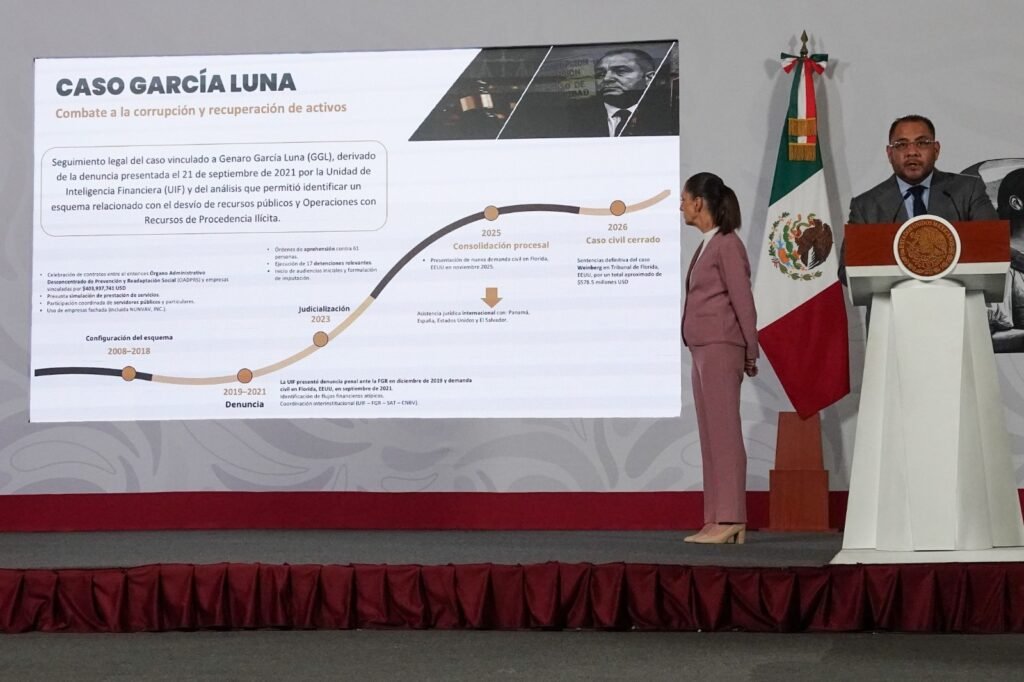
The $5.8 million is a first slice of a $578.5 million U.S. judgment against funds the UIF traced through Barbados shell firms like Nunvav on inflated prison contracts.
-

Wages Accounted for 30.8 Percent of Mexico’s GDP in the First Quarter
August 28, 2026
Employee compensation’s share of GDP has risen 4.1 points since 2018 while corporate profits fell 7.3 points, a real shift in how Mexico’s wealth is distributed.
The post Wages: Reversing the Neoliberal Damage appeared first on Mexico Solidarity Media.
From Mexico Solidarity Media via This RSS Feed.
You must log in or # to comment.