

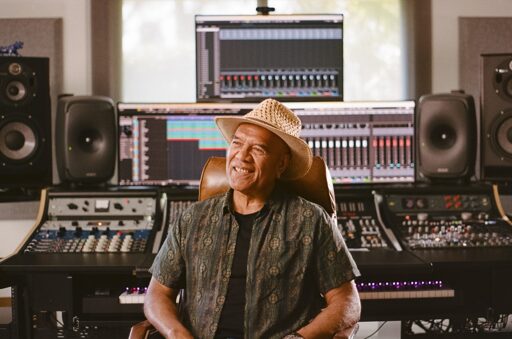

Opetaia Foa’i, composer and musician. Through both Te Vaka, the band he formed in the 1990s, and his work on the Moana films, he’s been motivated by wanting to “serve the ancestors”. (Photo supplied)
Before Disney asked Opetaia Foa‘i to write songs for the original Moana movie, more than a decade ago, he and his band Te Vaka had already toured 40 countries, performing their distinctive style of contemporary Pacific music and spreading the word about the achievements of Pacific navigators.
Here he is talking to Dale about working with Lin-Manuel Miranda, saying no to Disney, and how it feels to have written a song (“We Know the Way”) that’s now been streamed a billion times.
Kia ora, Opetaia. Congratulations, man, you’re a billionaire!
Unfortunately, only on paper, my friend.
Well, it’s been a beautiful musical journey.
Thank you.
It’s a pleasure to have a kōrero with you, brother. I always want to acknowledge our connections, villages, and our old people. Would you be kind enough to speak of the names you carry, how you got to carry them, and your villages and old people?
Yes, it’s always been a very important part of what I do, acknowledging the ancestors.
My father comes from Tokelau, and my mother comes from Tuvalu. I was born in Sāmoa, so I have lineage in all three islands, and I’m very proud of them all.
I was named after my maternal grandfather’s eldest brother. It’s quite fitting that the name Opetaia means “one who serves”.
All my work has been the result of my respect for my elders. My parents first, then my grandparents, and from there back to the ancestors.
I was intrigued that you were born in a Tokelauan village in Sāmoa. How did that come to be?
My mother, Saute Rimoni, was on a scholarship from the island of Tuvalu. She went to the London Missionary Society school in Sāmoa. And my father, Faraile Tavita Foa‘i, went there to find a better life from Tokelau, which is a very small group of islands north of Sāmoa. They met there and settled in a small village called Alamagoto, near Apia.
Several Tokelauan families were living there, and they had all their fale (houses) in a circle. I was born there, and as a child I had many families, many uncles and aunties. I could go to sleep in one fale and end up in another. It was very family orientated.

Opetaia in Atafu, Tokelau, in 2001.

With brother Luavasa (left) in Tokelau. (Supplied)
I was at a Waitangi Day concert in Manukau, and a group of Tokelauan women were singing, and their harmonies were very high-pitched and very beautiful, but quite distinctive. Were you exposed to the richness of the Tokelauan chords and harmony structures, which filtered into your eardrums when you were a young man?
Yes, that was my education. In the middle of all the fale in our village, there was an empty space, and that was where the dances happened. As a child, I just sat there and soaked it all in.
There was Sāmoan traditional song and dance. There was the Tuvalu fatele. And there was Tokelauan fatele, where you had an empty box at the centre to provide the rhythm and the beats.
And then a line of people would be swaying and dancing, and all their actions would express the story that was being told in the song they were singing. This was the music that I was soaking in, and I just loved it. I think it was the basis for all my work afterwards.

In Nukufetau, Tuvalu. (Supplied)
While we’re talking about your whakapapa, can we touch on Tuvalu, because we’re united in feeling a sense of grief that the islands are slowly being taken by the moana. How does this reality sit with you? I know we’re talking music, but we can’t help talking about people.
Yes, exactly. People are the most important. They’re where stories come from. I took my parents to their islands in 2001. We went to Tokelau and Sāmoa, and then to Tuvalu. My father and mother told me that the land was much bigger when they were young than it is now, as the sea is slowly taking over.
I came home and wrote songs about it. A few Tuvaluan people were on my back, saying: “You shouldn’t mention those things in your songs, because if you mention them, they will happen.” But I felt there was a need to say something about it.
You’d be familiar with Herbs and how music can be a force for societal and even political change. It’s a powerful tool that we carry, and it’s such a uniting force. It has the potential to effect change, and I sense that you’ve been conscious of this for a long time in the work that you’ve been doing.
There are things that each island finds very hard to say out loud. And I feel it’s my responsibility as an artist to talk about it, to highlight it, and to make a space for people to feel free to express their thoughts on it.
For example, Tokelau has an island called Olohega that was taken from them. And there were events there that people didn’t want to talk about because families know families, and they didn’t want to get into the bad books. Well, I highlighted it, inviting people on both sides to get together and talk about it, and find a solution.
I’m not into hating or creating disharmony. I like to work towards finding solutions for things.

Opetaia (pictured in his studio in 1996) started Te Vaka in the 1990s, and since then, the band has performed in 40 countries. “At every event, I made sure they understood that the ancestors’ achievements on the sea, their ability to sail and navigate, were the best the world has ever seen. That was my intention. To show them a village and spread the word about the achievements of the ancestors.”
We know that our Pasifika beat, our Pacific languages and traditions have interwoven into contemporary music in a very meaningful way, and you’ve been a strong part of that journey with the establishment of Te Vaka, and certainly with the success of kaupapa like Moana**.**
But that brings me to your first guitar, which to me is always intriguing. Who gave it to you? And what was the first song you learned to play on it?
It was in Sāmoa. I was about six or seven, and I had an uncle named Foa‘i who I watched play guitar and ukulele, and that fascinated me. That was a step up from beating on an empty box.
But it wasn’t until I got to New Zealand that a really kind teacher named Joan Hoffman gave me a classical guitar, and I just started playing things on it. You know, the usual. “Ten Guitars” and that sort of stuff.
I arrived in Auckland in 1965 at the age of nine, and went to Grey Lynn Primary, then Pasadena Intermediate, and that’s where I met Joan Hoffman. She saw that I needed a lot of help with the English language, and she got my parents’ permission to take me to spend weekends with her family in Northcote — her husband Tom and children Anna and Paul. This kindness allowed me to understand more about this new Pālagi culture and language.
At Kelston Boys’, I got more help from the headmaster, Mr Bean. Among other things, he saw that I couldn’t afford shoes for cricket, so he bought a pair for me. I was still struggling with the language at that time, but I did win a prize for sportsman of the year.
I hear you were a bit of a Jimi Hendrix fan as a young man.
Yeah. At Kelston Boys’ High School, somebody sold me a Jimi Hendrix double álbum, Electric Ladyland, for $1. I went home and put it on our secondhand radiogram, and I couldn’t believe what I was hearing. From then on, my life changed. I couldn’t believe the power that was coming out of that guy’s guitar.

Opetaia performing at the Toata Stadium in Tahiti, 2005.
What are you making of the rise of Pasifika sound, the confidence that we’re seeing in our young people? You’ve been at the vanguard of merging English and Pacific reo, and it’s very common now, but it didn’t used to be. We’re seeing so many young artists weaving aspects of te reo Māori or Sāmoan, or, in your case, Tokelau and Tuvalu, into their music. How encouraging is it for you, as an older guy, to see this development?
I think what people are doing now is fantastic. All Te Vaka material was in Pacific languages — no English. At the time, the only people who could relate to that were in Europe.
There are two audiences this music is aimed at. There’s the local audience, and then there’s the international audience, and they are not the same. Locally, it’s very, very popular now to do reggae and hip hop in a Pacific language. It’s very popular with our people here in the Pacific. But from my experience, the international market is different — the music, melodies and language have to go together.
You’ve maintained your commitment to our Pasifika languages, and this is what makes you different, perhaps unique on the world music stage. Audiences at international festivals want the energy and the cultural honesty, and are perhaps less fazed by the Pacific lyrics if they can feel the intent. How would you describe the way Te Vaka’s music has been received on the world music stages?
In the beginning, all I wanted to do was provide the experience of the village in Alamagoto. You’ve got the percussion, you’ve got people dancing, you’ve got people singing in the Pacific languages. I wanted to take that village and present it on the stage in Europe, and that’s why we took 12 to 16 people every time we went on tour. And some of these tours were five months long.
The Europeans really appreciated that. Seeing what a Pacific Island village looked like was something new for them. Of course, they didn’t understand the language, but they could feel the rhythms and the beats.
I tried my best to explain the stories to them. At every event, I made sure they understood that the ancestors’ achievements on the sea, their ability to sail and navigate, were the best the world has ever seen. That was my intention. To show them a village and spread the word about the achievements of the ancestors.

“A person had to have their culture firmly in their heart to be in Te Vaka,” says Opetaia Foa‘i. Pictured: Te Vaka, opening for Ringo and the Allstars in Surrey, England, in 1998. (Photo supplied)
I love that you do that, because we should feel immense pride in their abilities and sophisticated celestial navigational techniques — and this is celebrated in your attitude and in your music. Plus, brother, you’re able to tour with your whānau. That’s a pretty special opportunity as well, eh?
When you’re spending three to five months away, it’s quite a big undertaking. We had certain criteria and rules. A person had to have their culture firmly in their heart to be in Te Vaka. Plus, we’re completely drug-free. No drinking alcohol the night before a performance.
We’ve lasted over 30 years by having these simple things in place, so we can do the job of showing off our beautiful culture to the world.
Let**’s talk about recording. Do you have a feel for how an album’s going to roll out, so you take the listener on a journey — or do you record the waiata independently and then piece them together once they’re recorded?**
I prefer to write very quickly. But I’m just doing my first solo album now, and I’ve been writing it for four or five years, because each time I’ve started something, my mother would not be well, so I’d fly across and spend some time with her in New Zealand. And, bless her, she passed away in 2022. And then my father was unwell, and I would stop writing and fly over and spend some time with him. He passed away last year.
The process of writing can be itsy bitsy, because you have to deal with life, and then those songs become hard to reconnect with, so they’re thrown away. I prefer to write an entire album from an inspired moment in time and then record it in one or two weeks. This is what I’m doing now.

Saute (Mum) and Faraile (Dad) at the premiere of the first Moana movie, in Auckland, 2016. (Supplied)
When you were approached by Disney to be part of creating the original Moana soundtrack and writing the waiata, were you hesitant at all or just proud to be able to share what’s a very unifying story for Pacific peoples?
At that time, I’d toured 40 countries telling the story of the Pacific — of all the fantastic achievements of the ancestors. So when the calls came in from Disney, to me it was just an extension of what I was doing. It was just like: “Wow, instead of me going around performing and telling these stories, we can do it in a big way.”
I was buzzed because of that, but it didn’t really sink in until I met with a lawyer in LA by the fancy name of Rebel Roy Steiner Junior Esquire. He took us out to lunch, and he said: “You know, this is very unique.” And I said: “You mean unique for the Pacific?” He said: “No, unique anywhere.” And he started telling me: “You know Phil Collins, they called him in for Tarzan, and Elton John, they called him for Lion King. Well, they’re calling you in for this.”
It wasn’t until that moment that I realised the huge responsibility. It wasn’t just me serving my ancestors by promoting their achievements. It was bigger than that, and I had to come up with good songs because it was going to be worldwide.
It was massive. And, of course, a spinoff was the version of Moana in te reo M****āori, which just sat so beautifully with our kids. I’ve been in a theatre with Māori kura kaupapa kids when they watched it, and they were just delighted. So you’ve done a great service. You are our Pasifika Elton John.
No, no, no, I didn’t mean it that way. I just meant I didn’t realise the responsibility. I would’ve loved to have experienced that in the theatre, but I prefer watching Moana in te reo, anyway. The Tokelau language is similar to te reo Māori, so I can understand parts of it and refer to my dictionary when I need to.
I speak the languages of Sāmoa, Tokelau and Tuvalu, which is why I use them in my songs. It would be amazing to have Moana versions in those languages too, but for now I love hearing Moana in te reo.
Touch on the relationship you had with Lin-Manuel Miranda, the songwriter you worked with.
Initially, when I talked with Disney in 2013, I let them know that I wasn’t keen on writing in English, or even singing in English. I was just interested in writing and singing in the Pacific language. It was then that they decided to bring in Lin-Manuel Miranda.
Our work began in Auckland. We were in a hotel there, and I was keen to start, and he says: “Listen to this, listen to that.” And I said: “What are you doing?” And he said: “Oh, I’m working on this thing called Hamilton. And I’ve got 60 songs. What do you think of this one?” He was so enthusiastic. Later on, I got to see that fantastic musical that he made.
He was great to work with. He was very fast in the studio, as I am.
I wrote “We Know the Way” on the flight back from the US in 2013. And I think about six months later, when they decided to keep the song in the movie, is when Lin wrote the English lyrics that went with it, and I thought he did a very, very good job on that.
It’s been celebrated and sung across the world — it**’s had over a billion streams!**
Yeah, that’s so awesome. I just love it because the verse is in Sāmoan and the chorus is in Tokelauan. To have a Pacific-orientated track with that many streams is fantastic.
So what else do you do, mate?
Music is all I do. It seems like I’m trapped in the world of music.
In a good way, I hope!
Oh yes, yes, yes.

Opetaia with his daughter Olivia and son Matatia to his immediate left, along with other Te Vaka band members at the world premiere of the first Moana in 2016. (Photo supplied)
Can I ask what’s ahead?
My daughter Olivia is in Auckland right now, working with editors on a project that she’s been doing for nine years, which is the documentary on Te Vaka. And she’s got everything, like every show we’ve done in those 40 countries has been captured on film, and so she’s over there putting in the finishing touches. It’s to be released later this year.
We also have a percussion album that my son Matatia is releasing soon. And as I mentioned, I’ve got my first solo album that I’m working on right now, which will follow a new Te Vaka album to be released next year.
Can you explain a percussion album?
A percussion album is using wooden log drums, skin drums and chants. Matatia is the composer and master percussionist. This is his fourth album. And they’re very, very good.

Opetaia and Julie Foa’i in Los Angeles last month for the world premiere of the live-action Moana, the third movie in the franchise. Opetaia worked on all three Moana movies. (Photo by Rodin Eckenroth/Getty Images for Disney)
Is there anyone you’d like to mention?
My wife Julie is our fearless manager and my navigator who books all our tours and looks after all the businesses. One of the smartest things I ever did when I signed the Moana contract in 2013 was to say in the contract that wherever I go, Julie has to come, too.
And, you know, it was a very lucky thing that I did, because, being green to this world of Hollywood, I could’ve been eaten up and spat out. It’s a very competitive world, and I go in there very innocently thinking we’re all doing something for love, but there’s another side which I discovered later.
I’ve got to give thanks to John Musker, Ron Clements, Osnat Shurer and John Lasseter for being amazing during my time in that first movie. I spent a lot of time with them, and they were very respectful and listened to what I had to say. And I said “no” so many times. I really felt like I was going to be sacked right from the beginning.
The movie makers wanted to do certain things, and I would say: “No, that doesn’t work for my culture.” And luckily, they decided to keep me, so I’ve got to give my thanks to those guys.
And, of course, I have to give my thanks to my amazing Te Vaka team. My cousin Sulata Foa’i-Amiatu, my son and daughter Matatia and Olivia, Melodee Panapa, Neil Forrest, Joe To’omata, Douglas Bernard, and Talaga Sale. We’ve been in this game together a long time, and every time I have an idea, they immediately know where I’m going and then just add their voices.
Believe it or not, those things that you hear in the score in all the Moana movies were done like that. I would make it up on the spot, they captured it, we recorded it, and it went straight into the movie. So I’m very grateful to have these amazing people around me.

Opetaia, 70, in his studio in Sydney, where he now lives. “All I was interested in was doing something that paid respect to the culture and the ancestors.”
Good on you, Opetaia. To maintain the integrity, you weren’t just fighting for yourself, you were fighting for us.
I told them right from the start that I’m serving my ancestors, so anything that I feel offends the ancestors, I’m not going to do it.
I got the feeling that they’d never had anybody so crazy come into their midst who would say that, because I didn’t care if they fired me. All I was interested in was doing something that paid respect to the culture and the ancestors.
(This interview has been edited for length and clarity.)
The post Opetaia Foa‘i: Serving the ancestors appeared first on E-Tangata.
From E-Tangata via This RSS Feed.