

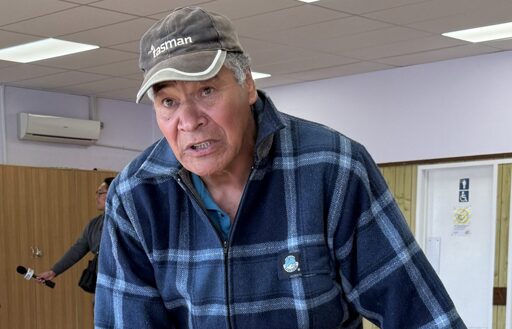

Jack Hahika, a sawmill worker who lost some of his leg due to PCP exposure. (Photo: Te Aniwaniwa Paterson, Te Ao Māori News)
Sawmill workers poisoned by PCP exposure have had welcome new light shone on their plight this month, as Catherine Delahunty explains.
For many people, PCP is an unfamiliar set of letters. But for sawmill workers from the 1950s until the late 1980s, PCP or pentachlorophenol, was the ubiquitous chemical used to treat timber on the “green chain”.
Workers would routinely dip freshly sawn pine into baths of PCP without safety clothing. PCP is readily absorbed through the lungs, skin and gastrointestinal tract. Workers who were involved in green chain treatment, or who handled freshly treated timber, had significant PCP exposure.
The dioxins and furans in PCP are highly toxic to humans at a millionth of a millionth of a gram per kilogram of body weight. Dioxins are known to cause cancers and other diseases. A better-known product containing dioxin is Agent Orange, which was dumped on the Vietnamese people and their forests by the US military during the Vietnam War, poisoning generations of Vietnamese families, as well as soldiers from Aotearoa who were sent there.
Dioxin poisoning is a terrible experience, but what has been harder for the sawmilling whānau is the toxic legacy their exposure left for mokopuna. The chemicals disrupt the body’s biological systems and can result in heart disease, many types of cancer, bone disease, fertility issues and reproductive organ illnesses in subsequent generations.
The effects on human skin are known as chloracne. We’ve witnessed wasting and spontaneous bleeding in workers’ limbs decades after exposure, and their worst fears have come true — whānau members in subsequent generations suffering from a range of related illnesses and effects.
My partner Gordon Jackman, in his role at Greenpeace, wrote the first exposé of PCP in 1992, in a booklet called The Deadly Legacy.
I was with him one day in the 1990s when he explained to more than 100 sawmill workers why they and their whānau were suffering from a wide range of terrible illnesses. It was bad news to bear, but at least someone had finally told them the truth about PCP. You’d think health support and compensation would have flowed from this moment. But not so far.

Gordon Jackman, the science adviser to SWAP. (Photo: Te Aniwaniwa Paterson, Te Ao Māori News)
This month, on August 18, we went to Whakatāne and met with the poisoned sawmill workers once more. We were there to hear Te Kāhui Tika Tangata Human Rights Commission release its new report, The Legacy of PCP and its Dioxins in Aotearoa — an overview of human rights concerns.
It was 33 years since we’d first met SWAP, the Sawmill Workers Against Poisons group. We looked around the room and realised just how many people were no longer alive. So many years of effort and so many lives affected, and there was still no justice.
Nevertheless, we appreciated the human rights experts being there. They had worked hard to listen to SWAP, and were launching their report in the heart of the dioxin contamination zone, Whakatāne. It felt like a significant moment.
The report calls for a national inquiry into PCP contamination, a clean-up plan for the contaminated sites, and support and compensation for workers and their whānau. Led by Dayle Takitimu and Oliver Christellar, it recognises workers’ basic rights to safe and healthy working conditions, to effective remedy for the harm caused to them, and much more.
Te Tiriti o Waitangi rights are also recognised. Many of the sawmill workers and their whānau are tangata whenua. The limited recognition and redress for Māori sawmill workers is a failure to uphold equity under Article 3 of Te Tiriti.
In my opinion, poisoning people and land in order to make a profit is an ongoing colonial strategy, as is ignoring the continuing effects of the poisoning on the whakapapa of the tangata whenua.
We cannot give up.
In the early 2000s, after years of lobbying and struggling, SWAP did get some help from Labour’s Parekura Horomia. He helped fund a local support service and one free GP visit per worker per year. This hardly addressed the many specialist medical problems experienced by the poisoned men and their whānau, but it was, at least, an acknowledgment that what they suffered was real.
Despite various plans and promising trials, there has been no national clean-up of contaminated PCP sites.

Tracey Godfery, whose father was a chemical mixer at Tasman Lumber and became too sick to work.
In 2022, SWAP was approached by MBIE to participate in a review of the ACC regulations. The review recognised that the criteria and risk assessment of chemicals such as PCP were out of date. It was a moment of hope for the men that their health conditions would at last be investigated, understood, and recognised.
We sent the review team international evidence on how dioxin-related poisoning leaves a legacy of complex health conditions.
We hoped for a new approach, but it never came. Instead, the present coalition government completed the review, added two work-related diseases to the ACC Act list, but explicitly refused to change the general approach to poisoned sawmill workers on the grounds that it was “too long ago” and there was “insufficient causal evidence”.
Only people suffering from two illnesses associated with dioxin can get ACC right now. Those recognised conditions are chloracne and non-Hodgkin’s lymphoma.
Last week at the launch, we heard from the mokopuna of a sawmill worker. She spoke about moving home after the loss of both her father and her grandfather. She wants to fight for this community and the unfinished kaupapa of contamination.
A sawmill worker who’d never spoken out before got up to talk. He spoke about his mokopuna who has reproductive disorders associated with dioxin.
The hurt was deep and palpable. When the whānau asked who they could turn to for proper medical help, we had no answers.
These men were poisoned at work, and rather than properly investigate the issues, successive governments appear to be waiting for them to die. It’s cheaper that way.

Kereama Akuhata, co-chair of SWAP.
We left Whakatāne and drove through the Mataatua lands where dioxin-contaminated soils have been dumped, knowing that there are many other old sawmill sites and dump sites across Aotearoa, unrecognised and in need of remediation.
The land and the people suffer, while the profits have been made by the owners of an industry that couldn’t have cared less.
The Kāhui Tika Tangata Human Rights Commission was honest with the sawmill workers — but they are not the government, and they have limited powers.
But they do have moral authority. They’ve been brave enough to recognise the effects on both the sawmill workers and their whānau. They’ve made robust recommendations.
Together, we’ll keep fighting to heal whenua and whānau. If those poisoned men can keep standing up for their people and lands while sick and tired, the rest of us can stand with them.
Catherine Delahunty is a Pākehā activist in environmental, social justice, and Te Tiriti o Waitangi issues. She is a writer and a tutor on social change issues, and a grandmother. Catherine was a Green MP for nine years and lives in Hauraki.
The post Still poisoned, still standing appeared first on E-Tangata.
From E-Tangata via This RSS Feed.