


Artist Lindah Lepou: “We have this horrific historical record of putting human beings in these enclosures — and yet, here I am, putting myself in an enclosure, a digital enclosure, and selling myself.” (Photo: Lisa Fa*‘*alafi)
Artist Lindah Lepou’s latest exhibition was inspired by the Sāmoans who were taken to Germany to be displayed in “human zoos” at the turn of the 20th century. She talks to Atakohu Middleton.
Lindah Lepou was a teenager when she read about “human zoos”, and was fascinated and repelled at the same time.
“That kind of blew my mind, because it was so gross. Just the thought of somebody taking you from your land, your environment and your family, and placing you in this foreign environment where you’re now on display.”
Human zoos, also known as ethnological expositions, human dioramas or ethnic shows, were popular and lucrative in the colonial era, with many thousands of Indigenous peoples from Africa, Asia and the Americas shipped back to Europe, some willingly, some under false pretences, some abducted, to feed public demand for the exotic. Many of the entrepreneurs of these shows were also wild animal merchants who supplied zoos.
Influenced by circuses and world fairs, these human exhibitions were held in a range of venues, from circus tents and what was then called “freak shows” to entire mock villages within zoos. People were expected to demonstrate activities deemed typical of their culture, often alongside animals from their homelands.
These displays played a powerful role in normalising racism and creating a lasting European perception of foreign cultures as inferior. During Germany’s colonial rule of Sāmoa, German entrepreneurs took groups of Sāmoans to Europe.
In her new exhibition Mata‘AITU (Voyeur), running at Porirua’s Pātaka Art+Museum until November 8, Lindah shines a spotlight on the exhibits in which Sāmoans performed more than a century ago, and asks whether, in the digital age, we’re putting ourselves in another kind of voyeuristic enclosure to be watched, consumed, fetishised, and surveilled.
As a Sāmoan fa*‘*afafine and celebrated multidisciplinary artist whose work spans music, theatre, film and fashion, Lindah has always been acutely aware of the gaze of others.
In recent years, her interest in exploring the idea of the colonial human zoo intensified as she watched reality TV and social media create digital zoos, with people willingly building online enclosures and inviting all and sundry to watch.
“My curiosity was, are we evolving or have we de-evolved? And if it is a de-evolution, is it moral de-evolution?” she says. “I could see these parallels in terms of the digital space: reality TV, social media, and watching others’ private lives.”
She’s also aware that she isn’t immune to the contagion of social media and the digital world: “We have this horrific historical record of putting human beings in these enclosures — and yet, here I am, putting myself in an enclosure, a digital enclosure, and selling myself.”
Delving further into human zoos, Lindah came across the work of Hilke Thode-Arora, a German anthropologist working at the Museum Fünf Kontinente (Five Continents) in Munich.
Hilke explored the experiences of three groups of Sāmoans who travelled to Europe to appear in völkerschauen (people shows) over the 16 years from 1895, and later published this in her 2014 book From Samoa with Love? Samoan Travellers in Germany, 1895–1911.
In Sāmoa, Hilke interviewed descendants of the travellers and pored over the records there, finding that the groups went overseas with contracts in place, and that some of the travellers were of rank.
“Although most ethnic shows took place in a colonial setting of structural inequality,” she writes, “indigenous agency in the sense of capacity to act and negotiate was definitely an important factor in many of them.”
Some Sāmoan leaders saw the trips to Europe as opportunities to establish political ties with the German administration. Says Lindah: “Sāmoans knew they were being overpowered. They knew where they sat in this dynamic, but they still maintained a sense of strategy and control and power over themselves.”
She was particularly interested in the role of German merchant Carl Hagenbeck, who supplied wild animals to zoos and later organised human exhibitions as well. He became famous for pioneering the modern zoo, with open animal enclosures that were closer to animals’ natural habitats.
That was a path that the human zoos followed as well, moving from a loose sequence of activities on a stage to open-air enclosures where inhabitants could live “naturally”.

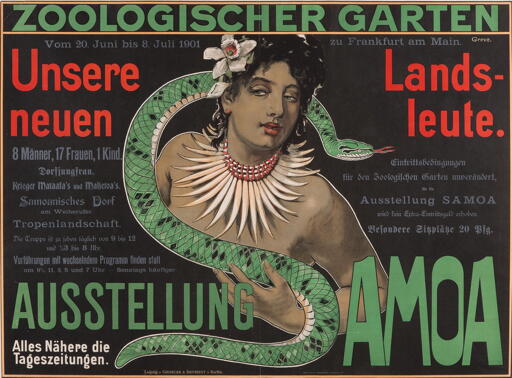
A poster for the ‘Sāmoa Show’ that took place in 1900-1901. (Photo: Historisches Museum Frankfurt a. M.)
The programme for the “Samoa Show” of 1900 and 1901 gives you an idea of what visitors saw: Sāmoans singing, dancing, climbing a coconut palm to bring down coconuts, carrying out a kava ceremony, and engaging in combat.
In summer, the women bathed in the ponds of zoological gardens as part of “swimming festivals”, and pigs were cooked in umu, with the audience given samples of the meat.
Sometimes, natural features of Sāmoa were recreated. Lindah, who has ties to the villages of Se‘ese‘e, near Upolu’s famous sliding rocks, found that these were recreated in wood for a Hamburg exhibition around 1910.

Sāmoa’s Papase’ea Sliding Rocks were recreated in wood for a 1910 exhibition in Germany. (Photo: Museum für Völkerkunde Hamburg Inv.-Nr. Ikano 186 a)
In February this year, thinking she was near the end of her preparation for the exhibition, Lindah went to Germany, where she stayed with Hilke and searched through documentation dating from the German occupation of Sāmoa.
One day, reading through lists of those who had come from Sāmoa to perform, she saw the name Tolio Lepou. A relative! Then she saw, in brackets, an age: 10. Tolio is the small boy in the picture below.

A 10-year-old Sāmoan boy, Tolio (centre bottom), was among a group that went to Europe to become part of a “human zoo”. (Photo: MARKK Museum Archives, Hamburg)
Lindah was stunned. She often weaves her own Sāmoan and Pākehā gafa (genealogies) into her work, but never expected to find something like this. She learned that Tolio was related through her grandfather and had gone to Europe without his parents — though presumably he was in the care of the adults with him.
Tolio returned home safely, and his experiences form part of Lindah’s ongoing research.

Inside the exhibition, showing an example of Lindah’s ‘Pacific couture’ — one-off pieces made with natural fibres. (Photo: Mark Tantrum)
Pātaka Māori and Pacific curator, Jacki Leota-Mua, says many visitors to the museum have no idea about human zoos until they step into Mata‘AITU (Voyeur).
She says she’s seen visitors left in awe by the techniques in Lindah’s Pacific couture and toile outfits, and challenged by the way social media, by constantly putting people on display, mirrors the human zoos of the past.
Jacki says she’s also seen some discomfort among visitors, “as the exhibition is doing exactly what the artist intended. We haven’t left the human-zoo era behind us. We’ve just digitised it!”
Lindah sees a direct line connecting colonial human zoos, early ethnographic cinema, and today’s algorithmic surveillance, but adds that the exhibition draws no conclusions and doesn’t push a message.
“The intention is not to provide a conclusion,” she says. “It’s really just to provide an opportunity for people to reflect.”
She sees more opportunity than oppression in the digital world, particularly for Indigenous people.
“It’s an incredible new level playing field, this digital space. Things that we didn’t have access to in the past, because we had to get permission or were blocked, we can now control,” she says.
“I can now control my narrative on my own website, on my own platform. This is such an exciting thing.”
Mata‘AITU (Voyeur) by Lindah Lepou is at Porirua’s Pātaka Art+Museum until November 8. Curatorial and design team: Andy Cummins, Nikki Parlane, Lotte Kellaway, Georgie Keyse and Marlene Siu, with Jacki Leota-Mua. Supported by Goethe Institut New Zealand and Pātaka Foundation.
You can also see artefacts from the exhibition on Lindah’s website here.
The post Human zoos in the digital age appeared first on E-Tangata.
From E-Tangata via This RSS Feed.