

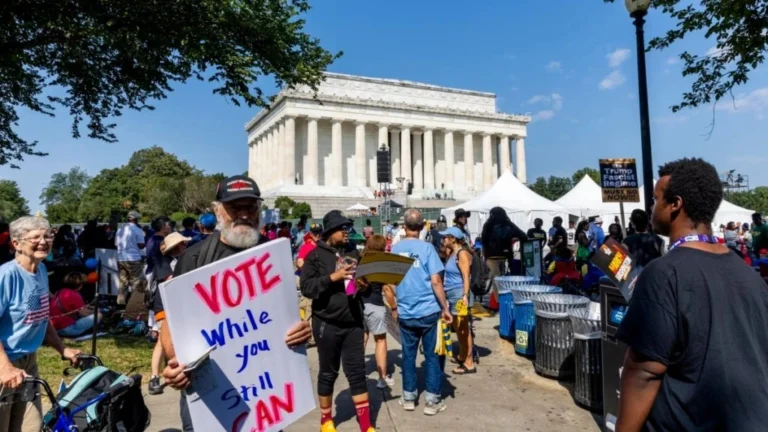
Washington march voting rights rally: Thousands gather at Lincoln Memorial for 63rd MLK anniversary. Explore AOC, Sanders, Jeffries speeches and midterm election stakes.
Related: 7 Alarming Facts on US Military Budget Iran War Funding Crisis
Washington March Voting Rights: Thousands Rally at Lincoln Memorial for 63rd MLK Anniversary
The Washington march voting rights rally drew thousands of activists to the Lincoln Memorial on Friday, August 28, 2026, commemorating the 63rd anniversary of Martin Luther King Jr.’s historic 1963 March on Washington while demanding urgent legislative action to protect voting rights and civil liberties ahead of the November 2026 midterm elections. Organized by Rev. Al Sharpton’s National Action Network and Martin Luther King III’s Drum Major Institute, alongside more than 90 partner organizations including the NAACP and National Urban League, the event centered its institutional demands on preserving the right to vote and restoring social guarantees eroded by recent Supreme Court rulings and state-level restrictions.[newsfromthestates][aljazeera][reuters][eciks]
During the peaceful demonstration, Congresswoman Alexandria Ocasio-Cortez (D-N.Y.) emphasized to the crowd that true civil freedom necessarily requires economic stability and security, affirming that access to dignified work, housing, and public education constitute fundamental pillars for community development. Senator Bernie Sanders (I-Vt.) urged the consolidation of social unity among diverse ethnic sectors comprising the U.S. population, while House Minority Leader Hakeem Jeffries (D-N.Y.) questioned the White House’s management and warned of the socioeconomic deterioration affecting minorities. The march evoked the massive concentration held on August 28, 1963, when King delivered his emblematic “I Have a Dream” speech, with speakers from the Congressional Black Caucus agreeing that the gathering represented an active day of citizen mobilization, not merely a commemorative act.[newsfromthestates][reuters][thehill][reuters]
Washington March Voting Rights: Supreme Court Rulings, Legislative Reforms, and Midterm Stakes
The Washington march voting rights rally unfolded just four months after the U.S. Supreme Court’s April 2026 decision in Louisiana v. Callais, which significantly weakened Section 2 of the Voting Rights Act of 1965 by reinterpreting key provisions concerning race-conscious congressional redistricting. The ruling has triggered redistricting changes across Republican-led states, eroding equal representation in Black communities and fueling concerns among civil rights groups about racial gerrymandering and Black voting power. Organizers focused the anniversary march around a “Defend the Vote” message, warning that voting rights and other freedoms King fought and died for are once again under threat.[newsfromthestates][eciks][twincities][youtube]
For Reuters’ coverage of the march, see: Thousands March in Washington as Leaders Warn of Voting and Civil Rights Rollbacks
Social leaders at the rally noted that historical debts persist regarding the ideal of social justice and racial equality exposed in the mid-20th century, highlighting the need to advance urgent legislative reforms to curb voter suppression in upcoming national elections. The original 1963 march propelled the promulgation of the historic Civil Rights Act under the federal administration in July 1964, and civil rights organizations reaffirmed their commitment to maintaining community mobilizations to defend democratic advances across U.S. territory. The 2026 “Defend the Vote” March on Washington drew several thousand people to the National Mall, including union members, students, members of Black Greek-letter organizations, and attendees of all ages who traveled from across the country.[newsfromthestates][aljazeera][reuters][eciks]
For AP News’ analysis of voting rights challenges, see: Civil Rights Groups Make Urgent Plea for Voting Rights in DC
The program began at 9 a.m. ET with confirmed speakers including Senator Bernie Sanders, Representative Alexandria Ocasio-Cortez, and House Minority Leader Hakeem Jeffries, alongside Virginia Governor Abigail Spanberger (D-Va.), Democratic National Committee Chair Ken Martin, and National Urban League President Marc Morial. Speakers invoked the same demands King made from the Lincoln Memorial steps two and a half generations ago: that the fight for equality remains unfinished, and that voting rights, economic justice, and civil liberties must be defended against unprecedented rollbacks of electoral access. The Supreme Court’s Louisiana v. Callais decision has allowed Southern states to redraw congressional maps in ways that dilute Black voting power, prompting civil rights groups to call for federal legislative intervention to restore Voting Rights Act protections.[newsfromthestates][eciks][thehill][reuters]
Rev. Al Sharpton, who co-chaired the event with Martin Luther King III and Arndrea Waters King, declared: “This is the first year we are marching that the voting rights bill has been nullified by the Supreme Court.” The National Action Network and Drum Major Institute coordinated logistics with over 90 community partner organizations, ensuring broad representation from labor unions, faith groups, student organizations, and civil rights coalitions. The march concluded with a procession through the National Mall, symbolizing the continuity of struggle from 1963 to 2026, and a call to action for voters to participate in the November midterms as a means of defending democracy.[wpxi][abcnews][nbcwashington][journalrecord]
Ciudadanos marcharon en Washington hacia el Monumento Lincoln bajo la consigna “Defendamos el voto”, en el aniversario del discurso de Martin Luther King. Exigen respeto a los derechos electorales y equidad en las urnas.
Comparte esta información. #EEUU #teleSUR #28Ago pic.twitter.com/LxZgjsGuFl
— teleSUR TV (@teleSURtv) August 28, 2026
Geopolitical Context: Democratic Backsliding, Global Civil Rights Movements, and U.S. Credibility
The Washington march voting rights rally unfolds against a backdrop of global democratic backsliding, where voting restrictions, gerrymandering, and voter suppression have become increasingly common tactics to consolidate political power in established and emerging democracies alike. The U.S. Supreme Court’s Louisiana v. Callais decision mirrors similar rulings in India, Brazil, and Hungary, where judicial reinterpretations of electoral laws have weakened protections for marginalized communities and enabled partisan map-drawing. The timing of the march—just two months before midterm elections—underscores the high stakes for voting rights advocates, who fear that further rollbacks could entrench minority rule and undermine faith in democratic institutions.[newsfromthestates][eciks][twincities][youtube]
Regionally, the Washington march voting rights rally reflects broader tensions in U.S. race relations and economic inequality, where systemic disparities in wealth, education, and criminal justice continue to disproportionately affect Black and Latino communities. The emphasis on economic justice in speeches by Ocasio-Cortez and Sanders highlights the intersectionality of voting rights and economic rights, framing ballot access as inseparable from dignified work, housing, and healthcare. This holistic approach resonates with global civil rights movements, from South Africa’s #PutSouthAfricaFirst to Chile’s 2019-2020 protests, where economic grievances and democratic demands converge in mass mobilizations.[newsfromthestates][reuters][thehill][youtube]
Globally, the Washington march voting rights rally carries implications for U.S. credibility as a champion of democracy abroad, particularly as the State Department promotes voting rights in authoritarian contexts while facing criticism for domestic rollbacks. The Supreme Court’s weakening of the Voting Rights Act has drawn condemnation from UN human rights bodies and international NGOs, who warn that U.S. democratic erosion undermines its moral authority to advocate for free and fair elections globally. The march’s timing, coinciding with midterm elections, also raises questions about partisan motivations, as Democrats seek to mobilize minority voters while Republicans defend state-level restrictions as anti-fraud measures.[aljazeera][reuters][eciks][twincities]
The legacy of Martin Luther King Jr. looms large over the 2026 rally, with speakers invoking his unfinished dream to frame contemporary struggles as continuations of the 1960s civil rights movement. However, the political landscape has shifted dramatically since King’s era, with voter suppression tactics now employing sophisticated legal and technological tools rather than overt segregation laws. The Louisiana v. Callais decision exemplifies this evolution, using judicial reasoning to undermine race-conscious redistricting while claiming colorblind neutrality. Civil rights groups counter that formal equality without substantive protections perpetuates structural racism, necessitating legislative remedies like the John Lewis Voting Rights Advancement Act, which remains stalled in Congress.[newsfromthestates][eciks][twincities][youtube]
Furthermore, the Washington march voting rights rally highlights the growing role of youth and intersectional movements in shaping civil rights agendas, with students, LGBTQ+ activists, and climate justice organizers joining traditional voting rights coalitions. The presence of Yolanda Renee King, King’s granddaughter and a prominent youth activist, symbolizes the intergenerational continuity of the struggle, while the inclusion of labor unions and economic justice groups reflects a broadened coalition that links ballot access to workplace rights, healthcare, and environmental protection. This expanded framework positions voting rights not as an isolated issue but as a gateway to broader social transformation, echoing King’s original vision of a Beloved Community grounded in economic and racial justice.[newsfromthestates][thehill][youtube][youtube]
— teleSUR TV (@teleSURtv) August 28, 2026
From teleSUR English via This RSS Feed.