

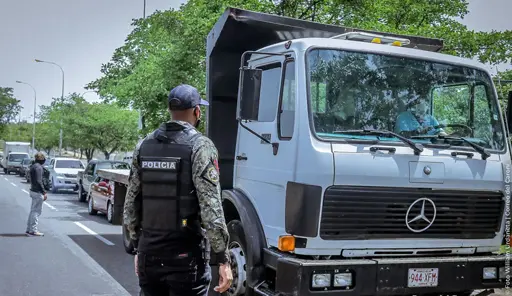
On Monday, August 23, Venezuelan Acting President Delcy Rodríguez announced that police checkpoints in cities will be eliminated and replaced by a “reinforced patrol mechanism, designed to guarantee comprehensive, professional security that fully respects human rights.” She reaffirmed her commitment to consolidating a model of citizen security that is closer and more efficient for Venezuelan families, ensuring peace and free movement.
However, she did not specify whether the measure will cover highway checkpoints, which many experts, travelers, and producers view as a persistent hurdle. Police checkpoints are widely criticized for infringing on freedom of movement, while their effectiveness in reducing crime remains heavily questioned.
According to mototaxi driver Rodrigo Daniel Nevado, Rodríguez’s announcement was a wise and timely decision. “It is a measure that should be welcomed. We all know what really happens at those checkpoints and how some officials behave with citizens when they stop them to check their documents,” he said.
At Bolívar Avenue, Caracas, he told Diario VEA that he is against any type of restrictions when stopping at a checkpoint. “There, you can have a bad time, and most likely you will have to hand over some amount of money,” he criticized.
In his opinion, the checkpoints should have been eliminated a long time ago. However, “if carried out transparently and ethically, it would put an end to the extortion and even the theft by officials, who have turned the checkpoints into a real business,” he added.
“The measure will also prevent the criminals from disguising themselves as police or other authorities, committing abuses, and robbing both drivers and passengers. I definitely agree with this announcement,” Nevado said.
Gradual elimination preferred
Near La Hoyada market, Diario VEA spoke with Freddy Espinoza. He happily welcomed the announcement of the elimination of police checkpoints on public roads. He added that they should be eliminated gradually while better controls for citizens’ safety are implemented or adjusted.
“I think its elimination is very good, but some roads or areas where the crime rate is a bit high cannot be left unprotected. Some processes should be adjusted so that the elimination of the checkpoints does not come at the expense of the very people who have been victims of the extortion carried out by police officials,” said Espinoza.
Hope for implementation
Jhonny González, an informal trader, sells food near the Nuevo Circo passenger terminal. He stated that even if the checkpoints are eliminated, “I have serious doubts that extortion will disappear in Venezuela.” In his experience, “the police forces have made extortion a culture, and I hope that the decision made by President Delcy Rodríguez is fully implemented. However, I reiterate, I have my doubts about it.”
González added that as a Venezuelan, one of the things he aspires to is “for every public official to perform their duty with seriousness and transparency. The checkpoints can exist to provide more security for the people, but they must be monitored and operated by honest people committed to the good of the country. I want that decision to be fulfilled and trust to be restored in those who are supposed to combat crime.”
A necessary evil
In David Serrada’s opinion, “the checkpoints are a necessary evil. Like it or not, they are necessary to combat criminal activity to a certain extent. However, they are like a kind of double-edged sword. Let me explain: if an official wants, they can easily ask you for money or at least tell you to give them something for breakfast or lunch, depending on the time of the day you pass through the checkpoint.”
Serrada asked Diario VEA not to take his photograph. He mentioned that he has had very bad experiences with police personnel stationed at checkpoints. “No one is safe when you fall into the hands of those who should be safeguarding our security,” he said. “They come at you like vultures to tell you that in order for them to let you go, you must collaborate with something. Such practices are very sad and regrettable.”
He clarified and specified that not all officials are the same. “Some officials have helped me and supported me in some circumstances, but there are others who do not deserve to wear a uniform,” he asserted.
Extortion
“When one hears the word checkpoint, the first thing that comes to mind is that they are going to extort or hit you,” remarked Ronald Mendoza. He added that what is really needed is to eradicate corrupt officials and to double the supervision at each checkpoint.
When asked if he had been a victim of extortion by the police, Mendoza responded, “On more than one occasion. Any official, when stopping a driver, is actually hoping the person has an expired document or is not carrying it with them. It is a practically normal situation that has proliferated. So, that police officer or guard, instead of calling attention to the lack of updated documentation, engages in criminality, asking for a small ‘contribution’ in cash.”
On the question of whether the elimination of checkpoints would increase insecurity, he said, “I do not believe it. When the measure was announced, it was stated that once eliminated, the checkpoints would be replaced by a reinforced patrol mechanism. With a higher number of patrols, there should be more security. I think that if the personnel at the checkpoints handle those control points seriously and as the law mandates, no one would have a negative perception of the officials. A rotten apple tends to spoil the others. If a single police officer is corrupt, people end up thinking that all of them are corrupt. There must be a thorough cleansing, and those who harm the institution must be removed.”
On this matter, Venezuela’s Attorney General Larry Devoe asserted that the elimination of checkpoints in urban areas constitutes a wise decision. He pointed out that there is evidence that this mechanism has limited effectiveness in combating crime and instead creates a negative impact on the legitimacy of police forces.
“An intelligent patrolling policy, based on data analysis, demonstrates a much superior effect in reducing criminal incidence and strengthening the bonds of trust and cooperation between the police and the community,” he commented.
(Diario VEA) by Carlos Batatin
Translation: Orinoco Tribune
OT/SC/SF
From Orinoco Tribune via This RSS Feed.