

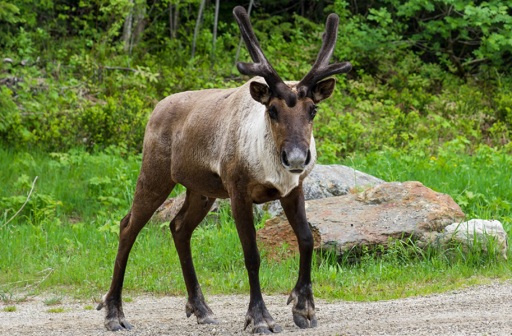
“Under our Syilx Okanagan law, everything is sacred to us. We believe that Mother Earth is alive, all of kʷuləncutn, the creator’s creation, that it’s all alive,” Chief Dan Wilson of the Okanagan Indian Band, a Syilx Okanagan Nation, told Mongabay in a phone call. “That’s why the caribou are so important to us … they reflect on the job we’re doing for preserving kʷuləncutn as a creation for the next generation.” Southern mountain caribou are a type of woodland caribou (Rangifer tarandus caribou) found in mountainous regions of Western Canada, and until recently, parts of the U.S. They live in mature forests, and depend on lichen as a winter food. Three caribou herds — all imperiled — remain within Syilx-Okanagan territory in southern British Columbia. The Columbia North herd is the strongest with 185 individuals. The Central Selkirk herd has just 27 individuals, and the Frisby-Boulder herd, with eight individuals, is considered too small to remain viable. A fourth herd, the Columbia South, was extirpated from Syilx-Okanagan territory in 2023. The situation is mirrored across the southern mountain caribou’s range, where logging has chipped away at their mature forest habitat. In the past 20 years, 15 out of 40 herds once found in British Columbia and Alberta have disappeared or are too small to stand a chance, with numbers falling from nearly 10,000 in 1991 to just over 4,700 in 2023. In British Columbia alone, 11 of the province’s 32 herds have either vanished completely or become so small…This article was originally published on Mongabay
From Conservation news via This RSS Feed.