

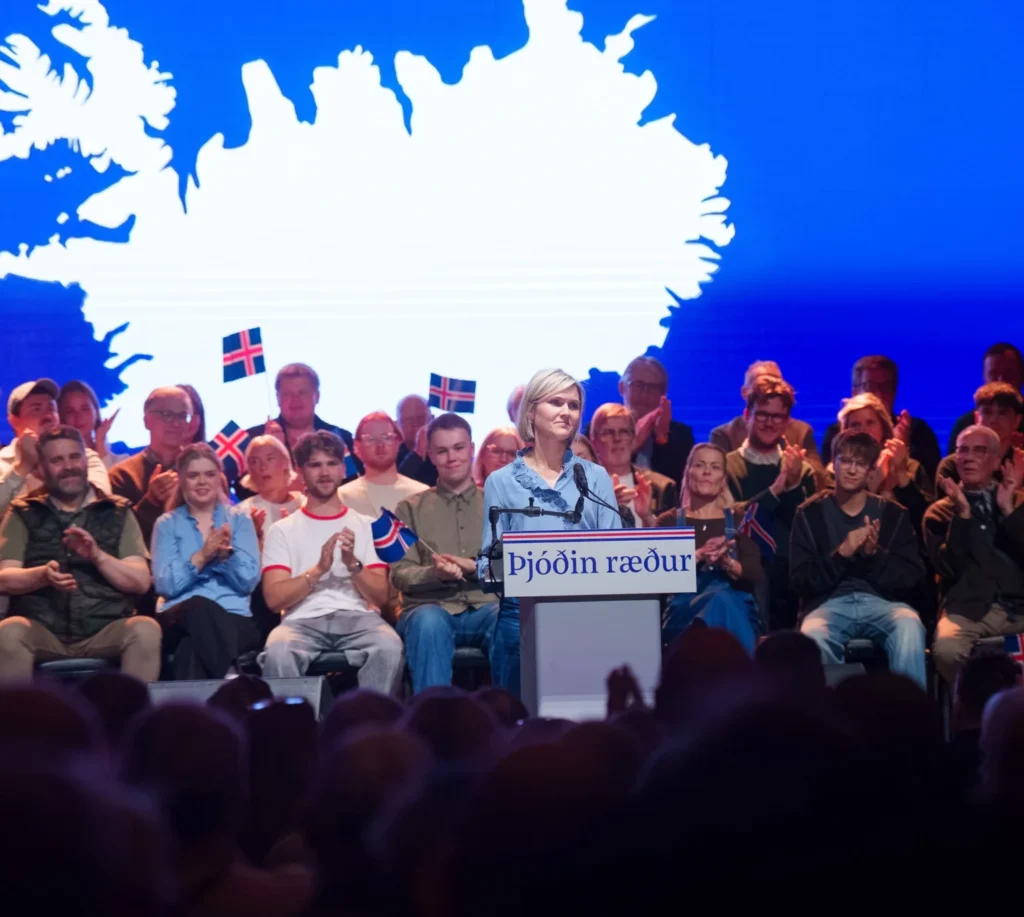
Nearly 400,000 Icelanders go to the polls Saturday in a historic referendum on whether to resume European Union accession negotiations frozen since 2013.
The vote closes a debate that has split the island nation for more than a decade.
Iceland first opened talks with Brussels in 2009, under Social Democrat Jóhanna Sigurðardóttir, after the 2008 collapse of its banking sector. Four years later the process stalled over the Icesave compensation dispute and the refusal to hand over fishing quotas.
A conservative government formally notified the cancellation of the bid in 2015, yet the European Commission kept the candidacy open. That status forms the backdrop for Saturday’s consultation, the first time Icelanders will settle the European Union question directly at the ballot box.
Recent surveys show an exceptionally tight race. A Maskina poll gives the yes side 51.3% against 48.7% for no, while earlier Gallup readings recorded a technical tie. The figures illustrate a deeply polarized public opinion. Both sides enter the final stretch aware that the outcome rests with the electorate.
The current coalition, formed in 2024 under Prime Minister Kristrún Frostadóttir, agreed to hold the referendum on the grounds that citizens were never directly consulted when the dialogue was suspended. The government argued that a decision of this magnitude could not be taken without a direct mandate from the electorate.
Tomorrow is the day.
Europe is ready to welcome Iceland home. pic.twitter.com/gEM0pzK16X— Other Europe
(@other_europe) August 28, 2026

Self-determination Decides
Frostadóttir called for mass turnout under the motto “The nation decides,” stressing that popular self-determination should set the island’s strategic course. She warned against allowing external actors or minority sectors to decide the country’s future.
In her message, the Prime Minister described the preceding public debate as a collective construction. She said she understood both those who see economic opportunities in European integration and those who express reservations about sovereignty and fishing resources.
Fishing quotas and the management of marine resources sit at the center of the campaign, alongside the question of how much sovereignty Reykjavik would keep inside the bloc.
The run-up has also included complaints of external interference, echoing the prime minister’s insistence that no outside actor should decide the island’s future.
Frostadóttir declared that the result would be binding on the state administration and promised that the fears expressed by citizens would be addressed if the vote delivers an affirmative mandate to negotiate with Brussels.
The Prime Minister placed the consultation in a longer arc of Icelandic foreign policy, recalling the country’s entry into NATO, its integration into the European Free Trade Association, the resolution of the Cod Wars and the signing of the European Economic Area agreement.
She argued that major multilateral decisions had required boldness in different historical eras and that national sovereignty should operate as a dynamic force to defend the people’s interests amid global transformations.
Tomorrow, the people of Iceland decide.
We wish you the very best.
Let’s build a stronger Europe together.pic.twitter.com/ALSV4YaqkK
— PES
Polling stations Will open across Iceland on Saturday, August 29. The ballot asks voters to approve or reject the resumption of accession talks, and the government has committed to treating the result as binding, a pledge that will define Reykjavik’s next steps toward Brussels.
From teleSUR English via This RSS Feed.