

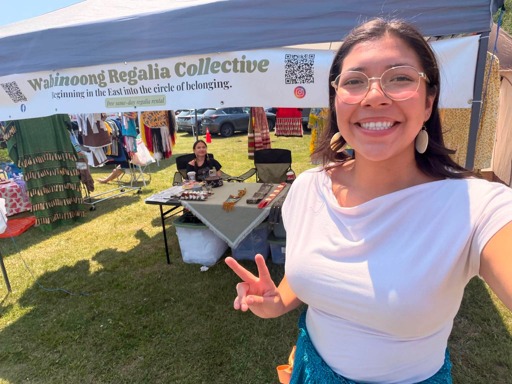

Tisha Duncan with the Wabinoong Regalia Collective booth set-up behind her. Photo by Tisha Duncan
Tisha Duncan was 19 years old when she had the idea to start a lending library of powwow regalia in Anishinaabe Aki.
She wanted to give free access to regalia for those who wanted to dance at powwows but might be facing barriers — such as young people dancing for the first time, and older people returning to the circle.
So the Wabinoong Regalia Collective began with the goal in mind to reduce financial and social barriers to participation and cultural healing for Indigenous people across northern Ontario.
“So, I had just gotten my driver’s license, I just got in my car, I made it work,” said Duncan, who is now 21.
The member of Bearskin Lake First Nation, an Anishininiw (Oji-Cree) community, was born in Sioux Lookout and grew up in Thunder Bay.
She said her vision for Wabinoong Regalia Collective was inspired by the work of the Siletz Regalia Closet, a lending library for Indigenous powwow regalia operating out of “Salem, Oregon.”
Duncan said she had Indigenous Youth in particular in mind — as they are the fastest growing population in “Canada” and facing a crisis of high suicide rates.
“Dancing is like really healing,” Duncan said, adding that “feel good” chemicals get released when moving to the drum beat.
“I think it’s really important to allow Youth to experience that kind of healing.”
‘Just go do it’
Eternity Neekan, a 22-year-old from Mishkeegogamang Ojibway Nation, works for the Wabinoong Regalia Collective.
Neekan initially met and became friends with Duncan through while they were both doing mentorship work with the Regional Multicultural Youth Council in Thunder Bay.
When she first heard her talk about her idea to start a regalia collective, she recalled urging Duncan to “Just go do it.”
Soon after, Duncan made a call-out for regalia donations. And, in the summer of 2025, she showed up at Whitesand First Nation’s powwow by herself with only a handful of outfits to share, and no booth.
Now, in their second summer of operations this year, Wabinoong has a team who travels together with a full vendor set-up which includes a changeroom, full-length mirror, a rack full of regalia, and a banner which bears their name, Wabinoong Regalia Collective.

Members of the Wabinoong Regalia Collective at a powwow in northern Ontario. Photo by the Wabinoong Regalia Collective
The group has been able to get powwow committees to waive vendor fees once a committee understands their purpose.
This has helped them to stretch their limited budget even further.
The Wabinoong Regalia Collective has been able to operate through various grants and donations.
Duncan estimated that they’ve supported more than 200 rentals in their first year of operations alone. They have also occasionally gifted regalia to those in great need.
As part of their work, they take Youth to powwows, and hire them to work the Wabinoong Regalia Collective booth — paying wages through Canada Summer Jobs grants, which gives them work experience.
The experience has given Youth opportunities to grow confidence and connect with a wide range of people beyond their community at home.
“It’s really fun, like taking Youth to powwows as well, and it’s just a great thing to be involved with. And it makes me feel good. It makes … everyone who rents feel good,” Neekan said.
“We do that work so we can provide these Youth with their opportunity to engage with their culture.”
One Youth who has been with Wabinoong since the first summer, Neveah Yellowhead, from Nibinamik First Nation, said that working and volunteering with the collective has been one of her favourite things to do each year.
“I get confident in my social skills by how interactive it gets and how much people come to ask questions and give praise,” she wrote.
“Overall, this collective has made me into someone I’ve dreamt to be, and has shown me experiences in such situations as helping others to pursue their love for dancing.”
A jingle dress donation
Much of the collective’s regalia collection has grown thanks to community generosity. Since 2025, they’ve amassed more than 40 outfits.
Jingle dresses are the most abundant within their collection because they tend to be easier to source.
“Our biggest donation was 28 jingle dresses,” said Duncan, who mentioned that a woman named Karen Perry was the donor who had gathered the dresses over many years.
Perry is from Fort William First Nation, near Thunder Bay.
“My sister and I have been dancing for over 40 years, I love jingle dresses, and now it’s time for me to share some of my dresses,” said Perry in a Facebook reel shared by Wabinoong.
“I hope everybody enjoys them, and it brings joy to their heart.”

A look at some of the jingle dresses available in Waabinoong’s collection. Graphic by the Wabinoong Regalia Collective
Perry added in a statement to IndigiNews that jingle dresses have gotten more expensive to purchase. She wanted to share the joy and healing that comes from dancing — and jingle dresses.
“I make them for myself, I buy them and they have been given to me,” she shared. “I have always danced even before I could afford to make or buy a jingle dress. I see a lot of people watching at powwows and I decided to share the joy of dancing in a regalia.”
While the collective now has a good selection of women’s regalia, they have had difficulty acquiring donations of regalia for male dancers, such as head roaches, bustles, and bells.
When IndigiNews spoke with Duncan, it was while she was on break from a head roach making workshop where she was learning how to make one for the first time as a part of the collective’s wardrobe.
Honouring the regalia
The collective has based its agreement for signing out regalia on an honour system that acknowledges the Seven Grandfather Teachings.
Duncan explained that part of the agreement that borrowers sign off on says: “I agree to honor and respect this regalia and wear it with pride and make sure that future people can also wear it with pride.”
She said that Wabinoong has never had any regalia go missing or stolen, it always gets returned. Duncan maintains the regalia by making small repairs with her sewing machine.

Tisha Duncan learns how to string together a head roach — often made with deer mule and porcupine guard hairs — at a workshop on Aug. 18. Photo submitted by Duncan
After returning from a powwow weekend, Duncan, Neekan and others work together to make sure each outfit that was worn is carefully handwashed and hung-dried in the sun.
“There’s another kind of teaching of, like, regalia is really personal to the person wearing it,” Duncan said.
She explained that there is a transfer of energy from each person who wears the borrowed garments, which is why it’s important for them to wash and smudge the worn items with sacred medicines.
Duncan told IndigiNews that at one powwow they arrived at, a spiritual advisor turned Wabinoong away because they felt so strongly about energy transfer from persons to objects.
They respected their decision and turned around, going to a different event that weekend.
Wabinoong also honours the regalia each season with a feast, four times a year, in the same way that people with spiritual bundles will feast their sacred bundles made of items like pipes, feathers, shakers, drums, etc.
Due to having a tight budget, the group only hosts one public feast in the spring. For the other three seasons, Duncan said she quietly does a feast for the regalia and leaves a plate of food offerings and tobacco at the foot of a tree.
“I had always envisioned it helping people with financial barriers, but I think the summer has made me realize, ‘oh, it can be more than that,’” said Duncan, who saw their work expand to include the fire evacuees who came to Thunder Bay this summer.
She said that Wabinoong has lent out regalia at local drum socials where the evacuees have attended.
They have been there for “people who didn’t have time to take their regalia with them, or didn’t have enough room to take their regalia with them, or who might have lost it,” she explained.
Duncan said that when powwow goers return regalia to Wabinoong’s booth they will often share about how it has given them healing in the short time they’ve danced in it.
“I find it the most rewarding part for me,” she said.
“When I noticed that this regalia means a lot to this person, and they might need it more than I do… If I could spare one, then I’m like, ‘yeah, they can keep it,’” Duncan said.
She recalled gifting to “a little girl that had really been attracted to this one jingle dress.”
As the Wabinoong Regalia Collective has grown, they have a goal to buy a truck or a van and a storage space for their collection. And, to grow their male regalia selection.
“I just really hope that I’m able to continue doing this for the next year,” Duncan said.
The post ‘Really healing’: Powwow regalia lending library supports dancers in Anishinaabe Aki appeared first on Indiginews.
From Indiginews via This RSS Feed.