

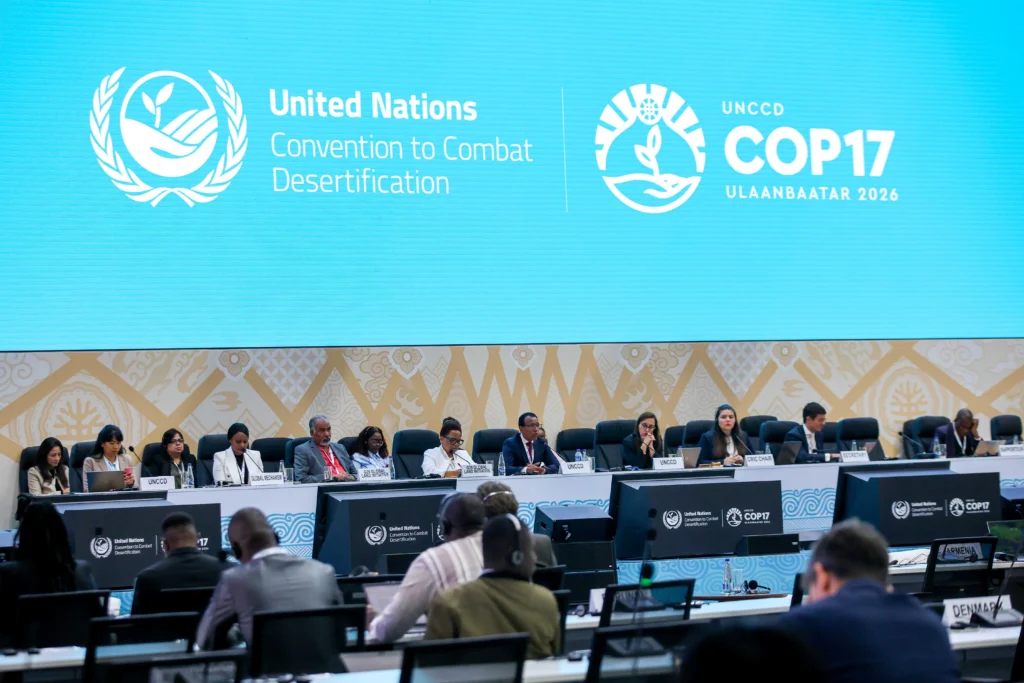
The 17th Conference of the Parties to the UN Convention to Combat Desertification (COP17) closed this Friday in Ulaanbaatar, Mongolia, without a global framework agreement to fight drought, despite mobilizing funds for land restoration.
After two weeks of negotiations among the convention’s 197 signatories, COP17 delegates postponed the adoption of a proactive drought management strategy to COP18.
The move extends a political impasse that has lingered since the previous session in Riyadh, Saudi Arabia, in 2024, where the same question failed to reach consensus.
RELATED: Climate Change Adds Month of Dangerous Heat For 560 Million Children
The summit secured up to $1.3 billion earmarked for land restoration and drought resilience in 23 nations, a result that organizers presented as evidence that financial cooperation can advance even when normative agreement lags.
COP17-DAY 11 | AFTER VIDEO
НҮБ-ын Цөлжилттэй тэмцэх тухай конвенцын Талуудын 17 дугаар бага хурал буюу “COP17”-ийн 11 дах өдөр өндөрлөлөө.
TenGer TV 12 өдрийн турш “COP 17” талуудын бага хурлыг шууд дамжуулна.#TenGerTV #COP17Mongolia pic.twitter.com/GI9RpQe7D9
— TenGer TV (@TenGerTV) August 27, 2026
Billions for Degraded Lands
Most of the resources will be channeled through the Grasslands Flagship Initiative, a program that runs alongside the International Year of Rangelands promoted by the Mongolian government. The initiative targets pastoral ecosystems, where overgrazing, water stress and expanding degradation have put traditional livelihoods under pressure.
The conference also introduced new technical instruments: the Drought Resilience Investment Fund (DRIF)seeks to attract $400 million in private capital, while the International Drought Resilience Observatory (IDRO) entered its second phase. IDRO helps nations evaluate their vulnerability to land degradation, a phenomenon that already covers 40% of the planet’s land surface and threatens to consume an additional 11%by 2050.
UNESCO pushed a parallel agenda focused on the human and social side of the environmental crisis. Combining open science, cultural preservation and public policy, the agency promoted the protection of water resources and traditional pastoral knowledge as tools to defend livelihoods, food security and the cultural identity of communities most exposed to environmental decay.
Degraded land does not stop at borders. Across dry zones in Africa, Asia and Latin America, shrinking pastures put harvests, livelihoods and cultural identity at risk, which is why negotiators keep returning to the table even when they leave without a binding text.
NEWS from #COP17Mongolia: Egypt has officially been selected to host the 18th session of the Conference of the Parties to the United Nations Convention to Combat Desertification (UNCCD COP18), which will take place in Sharm El-Sheikh in 2028 pic.twitter.com/grhPg82xhN
— UNDP Planet (@UNDPplanet) August 28, 2026
Egypt at Next
COP18, scheduled to be hosted by Cairo, will give delegations another chance to set binding commitments on drought and tackle related issues. The financial baseline makes the challenge explicit, roughly $355 billion per year is needed to combat desertification and drought effectively worldwide, against the $77 billion mobilized today.
The funds already committed, the new observatory and the investment fund give the convention something to build on, but without a shared framework for proactive drought management, each new summit risks repeating the same script.
From teleSUR English via This RSS Feed.