

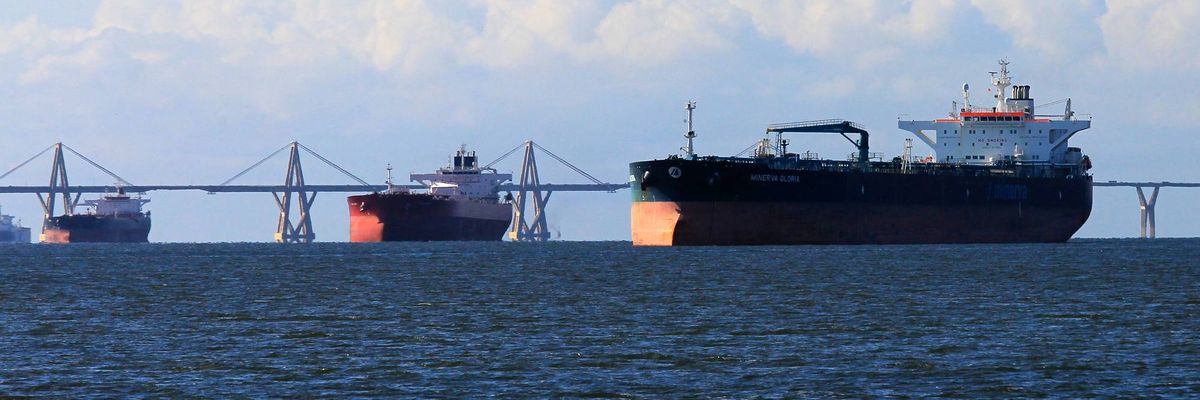
Trump administration officials are claiming that talks between US Secretary of State Marco Rubio and the Venezuelan government regarding control of the country’s oil fields will ultimately secure “America’s energy future for generations to come”—but analysts on Friday called on lawmakers to halt President Donald Trump’s “colonial” push to take over the reserves.
As Axios reported, officials including Rubio and Deputy White House Chief of Staff Stephen Miller have been involved in talks with Venezuelan acting President Delcy Rodriguez about taking an ownership stake in more than a dozen oil fields in the Orinoco Belt and Lake Maracaibo regions, which have about 90 billion barrels of oil reserves. In all, Venezuela’s vast reserves—the world’s largest—contain about 300 billion barrels.
The deal would double US oil reserves at a time when Americans have seen gas prices skyrocket and oil firms reap profits as a result of Trump’s war on Iran and the closure of the Strait of Hormuz—events to which countries that have expanded renewable energy sources have proven far more resilient, according to data from JP Morgan Commodities research.
Despite that resilience, the Trump administration has reportedly approached the talks as a way to lock the US into generations of continued reliance on planet-heating oil extraction. According to Bloomberg, one deal under consideration is a 100-year lease on the oil fields.
Axios reported that in return for giving the US an ownership stake—something Trump began privately discussing before US forces invaded Venezuela and abducted President Nicolás Maduro in January—Venezuela “would benefit from private companies, including American firms, developing the fields and returning more oil revenue” to the South American country.
Tyler Slocum, director of Public Citizen’s energy program, said that if the deal is finalized, “Trump will likely transfer operational control to US oil companies,” which donated heavily to his campaign.
The proposed deal would open “the door to Trump’s typical bilateral transactional corruption” and bestow “lucrative opportunities for the oil companies he chooses to reward,” said Slocum.
“In the nearly eight months since Trump’s illegal January 2026 Venezuelan invasion, the Trump administration has managed a $13 billion slush fund gleaned from its control over Venezuelan oil sales, with zero transparency, and little to no public oversight or accounting," Slocum continued. “The president has no authority to negotiate a deal where the federal government takes control over foreign oil production facilities, and Congress must intervene and put an end to Trump’s oil-fueled imperialism.”
One opposition leader in Venezuela, where Energy Secretary Chris Wright is expected to travel next week to discuss increasing oil production by US companies, said the deals currently being discussed amount to “a land grab—a massive land grab.”
Francisco Rodríguez, a senior research fellow at the Center for Economic and Policy Research and author of The Collapse of Venezuela, said the country’s National Assembly “should deny authorization for this predatory deal.”
Following Trump’s invasion of Venezuela in January, energy historian and Eurasia Group analyst Gregory Brew told The Guardian, “US dominance over Venezuelan oil reserves allows the US to regard Venezuelan reserves as its own reserves: a source of oil from which the United States can draw and that nobody else has access to.”
"I think that’s how the administration is conceiving of this—excluding China, excluding Russia, but I think also excluding other potential customers for Venezuelan oil,” Brew said. “It sounds colonial, because it is.”
The president’s “effort to establish a South American kleptocracy is an outrage,” said Slocum. "There’s been no improvement in human rights in Venezuela, so Trump’s move is further evidence that his illegal actions in Venezuela are all about controlling oil with no public accounting, transparency, or oversight. This is yet another Trump gift for Big Oil.”
From Common Dreams via This RSS Feed.