

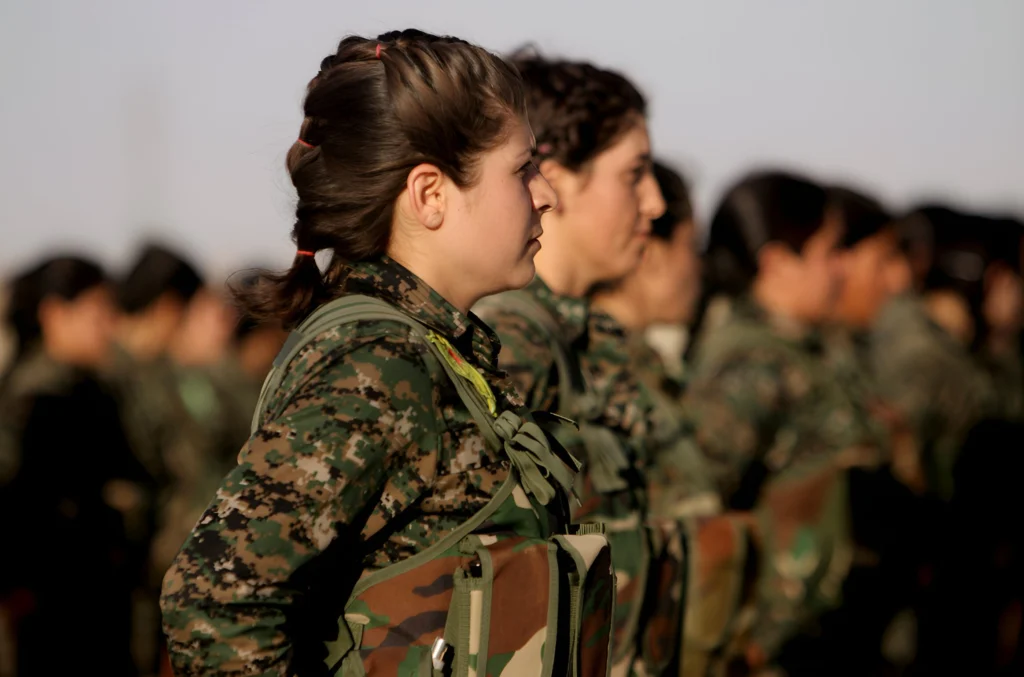
The transition of SDF into regular state institutions ended a decade of autonomy.
The Syrian Democratic Forces (SDF) served as a central military alliance in the Syrian conflict for over a decade. Formed as a multiethnic coalition operating primarily in North and East Syria, the alliance was led by Kurds and incorporated Arab, Turkmen, Syriac-Assyrian, and Armenian units.
RELATED:
Syrian Democratic Forces Obstruct Humanitarian Corridor in Deir Hafir
The SDF functioned as the primary defensive instrument of the Autonomous Administration of North and East Syria, an entity that managed local governance across large portions of the country.
During the fight against the Islamic State of Iraq and the Levant, the coalition operated as the main ground component supported by the International Coalition led by the United States.
Operating between U.S. tactical air support, military operations by neighboring Turkey, and negotiations with the central authority in Damascus, the group managed defense policy across the region. In
In August 2026, the organization officially ended its independent military role and became fully integrated into the Syrian state’s structure.
Kurdish forces to dissolve 14-year autonomous rule; Syrian Druze remain defiant
Syria’s Kurdish-led Syrian Democratic Forces agreed this week to dissolve their northeastern autonomous region and integrate into the central military. Oil-rich territory will return to Damascus… pic.twitter.com/eCKs3zc05G
— NewsTongue (@NewsTongueX) August 28, 2026
Why and For What Was the SDF Created?
The Kurdish-led Syrian Democratic Forces (SDF) were established on October 10, 2015, in al-Hasakah. The group emerged amid the security vacuum created by the Islamic State’s rapid expansion across Syria and Iraq.
Following the defense of Kobanî in early 2015, local military groups identified the critical need for a unified defensive and offensive structure capable of conducting broad operations against extremist forces.
The SDF brought together several existing armed groups under a single integrated command. The People’s Protection Units formed the initial core combat structure and operational leadership, while the Women’s Protection Units served as an autonomous female force dedicated to combat and regional security.
This foundation was expanded to include local Arab tribal units, such as the Sanadid Forces from the Shammar tribe, Arab elements from Liwa Thuwar al-Raqqa, and Christian defense forces represented by the Syriac Military Council.
The SDF’s main goal at its founding was to secure the ground, defeating extremist factions across northern Syria, protecting the region’s diverse communities, and securing critical border territories.
Beyond immediate territorial defense, the organization was built to safeguard the administrative framework of Democratic Confederalism.
This governance model prioritized decentralized administration, direct community participation, ethnic pluralism, and institutionalized gender parity within regional councils.
To achieve these operational goals, the SDF entered a tactical partnership with foreign military forces. The United States Department of Defense provided vital air support, military intelligence, and equipment under the framework of Operation Inherent Resolve.
This international military coordination enabled the coalition to reclaim major urban centers from extremist control while maintaining a distinct political and administrative system independent of the central government in Damascus.
Syrian Democratic Forces Commander Mazloum Abdi formally announced the dissolution of the SDF as an independent military force.#Syria #SDF #MiddleEastNews #Geopolitics #SyrianConflict #KurdishNews #InternationalRelations #CheckmateMedia pic.twitter.com/syPchlw42d
— Checkmate Media (@CheckMate1_) August 28, 2026
Historical Milestones and Operational Evolution
The operational trajectory of the Syrian Democratic Forces traces back to the early defensive resistance organized by Kurdish self-defense units during the onset of the Syrian civil war.
The People’s Protection Units (YPG) and Women’s Protection Units (YPJ) established local defense structures based on the political theories of Abdullah Öcalan, the imprisoned leader of the Kurdistan Workers’ Party (PKK).
Following its official establishment in late 2015, the SDF launched a series of major offensive campaigns to dismantle the territorial enclave of the Islamic State.
In October 2017, after months of intense urban combat supported by international airstrikes, the coalition captured Raqqa, which had served as the de facto administrative capital of the extremist movement.
The territorial defeat of the Islamic State culminated in March 2019 at the Battle of Baghuz Fawqani. Coalition combatants secured the last remaining pocket of territory held by the group near the Iraqi border, ending its territorial control in the region.
Following this victory, the coalition assumed responsibility for securing thousands of captured foreign and domestic fighters alongside tens of thousands of displaced family members in facilities such as the al-Hol detention camp.
The organization’s operational focus was repeatedly altered by external military interventions, most notably from neighboring Turkey. The Turkish government, identifying the Kurdish leadership of the alliance as an extension of the PKK, initiated major military operations into northern Syria.
Operation Olive Branch, launched by the Turkish Armed Forces, in early 2018 led to the displacement of local populations from Afrin Canton, while Operation Peace Spring in October 2019 established a Turkish-controlled border zone between Tel Abyad and Ras al-Ayn.
Structural and Ideological Characteristics of the SDF
The internal organization of the Syrian Democratic Forces reflects the framework of Democratic Confederalism, an anti-statist political model that advocates for local autonomy, environmental sustainability, and radical municipal democracy.
Rather than operating under a traditional centralized military hierarchy, the alliance utilizes regional military councils that correspond to local administrative cantons.
This structure grants local commanders considerable decision-making autonomy while maintaining a unified strategic command under General Commander Mazloum Abdi.
Gender parity is a core requirement across all branches of the organization. Grounded in the concept of Jineology, defined by its proponents as the science of women’s liberation, the alliance mandates dual leadership across all administrative and military bodies. Under this system, every command council features one male and one female co-commander.
The Women’s Protection Units (YPJ) operate both independently as an all-female army and as an integrated component of the broader military command, ensuring that women retain complete autonomy over security decisions affecting their communities.
While Kurdish commanders retained prominent positions in overall strategic planning, regional defense councils in predominantly Arab areas, such as Deir ez-Zor, Raqqa, and Manbij- were composed primarily of local Arab combatants and tribal leaders.
Similarly, Christian communities maintained direct command over the Syriac Military Council to ensure localized defense. This structural framework aimed to replace centralized state control with localized, multi-ethnic defense councils linked by a shared political agreement.
YPJ discusses integration into Syria’s Interior Ministry
——
The Syrian Kurdish Women’s Protection Units (YPJ) said on Thursday that it had held talks with the Interior Ministry over integrating its fighters into government forces.The announcement came two days after Mazloum… pic.twitter.com/GLlPqGsX7q
— The Cradle (@TheCradleMedia) August 27, 2026
Current Status (2026) — Integration and Dissolution
The political and operational status of the Syrian Democratic Forces underwent a fundamental transformation following the collapse of the Assad regime in late 2024 and the establishment of a transitional government in Damascus under President Ahmad al-Sharaa.
As foreign policy priorities shifted in Washington and regional normalization accelerated, the strategic buffer that sustained Kurdish autonomy gradually eroded.
In January 2026, central government forces launched a major military offensive into northeastern Syria, leading to the transfer of key provinces including Raqqa and Deir ez-Zor back to state control.
Faced with an altered strategic environment, the leadership of the coalition negotiated a comprehensive political and security integration framework with Damascus. During ceasefire talks, President al-Sharaa issued Decree No. 13 of 2026, which formally recognized Kurdish cultural and civil rights.
The decree established Kurdish as a national state language alongside Arabic, declared Nowruz a national holiday (March 21), and restored Syrian citizenship to tens of thousands of Kurds in Hasakah province who had been stripped of their status during the 1962 census.
On August 25, 2026, General Commander Mazloum Abdi officially announced the conclusion of the mission of the Syrian Democratic Forces and its complete dissolution as an independent military organization during a joint press conference at the presidential palace in Damascus.
Under the final terms of the agreement, individual personnel from the alliance were incorporated directly into the regular Syrian Armed Forces, while regional security apparatuses merged into the Ministry of Interior.
The all-female combat units of the YPJ were designated to transition into specialized counter-terrorism divisions. State institutions subsequently assumed control over critical infrastructure, border crossings, and key petroleum fields east of the Euphrates.
Geopolitical Assessment
The historic trajectory of the Syrian Democratic Forces represents a significant non-state military and political development in the modern Middle East.
Born out of the existential threat posed by the Islamic State in 2015, the coalition successfully liberated vast territories, provided localized governance through radical municipal institutions, and established unprecedented standards for gender inclusion and pluralism in regional security.
Ultimately, the trajectory of the coalition highlights the persistent structural challenges faced by non-state political experiments operating within complex international security systems.
While its independent military structure has dissolved into the Syrian state, the legacy of the coalition endures through the permanent legal recognition of Kurdish civil rights, institutionalized gender frameworks, and a redefined model for regional administration within a re-unified Syria.
Sources: teleSUR – Al Jazeera – Al Mayadeen – Press Tv – TASS – Reuters – EBSCO – BBC – Arab News – France 24
From teleSUR English via This RSS Feed.