

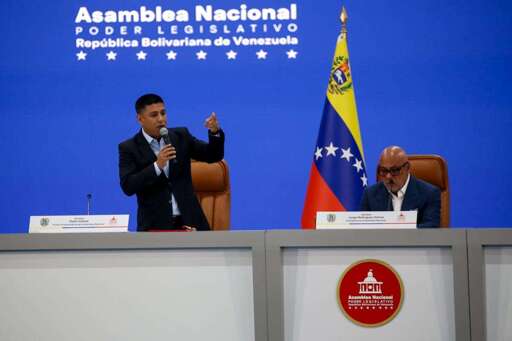
The partial reform bill for the Organic Law of the Supreme Court of Justice has been unanimously approved in its first discussion during an ordinary session of the Venezuelan National Assembly.
The first vice president of the National Assembly, Pedro Infante, presented the partial reform bill to the plenary this Thursday, August 27. The legislation seeks to modify the structure of the Judicial Nominations Committee and restart the process of appointing magistrates.
Infante explained that the proposal is based in the Constitution, referring to the “aspects that establish the context and the reasons that motivate us to present this reform bill,” specifically noting Article 264 and Article 270 of the Constitution. He explained that these constitutional provisions govern the selection procedure and the composition of the body responsible for evaluating candidates.
This would be the second reform of the Supreme Court law this year, after parliament approved a reform in May that increased the number of magistrates in the country’s highest court from 20 to 32. The Supreme Court is currently headed by Justice Caryslia Rodríguez.
Infante explained that the central change of this latest reform concerns the composition of the Judicial Nominations Committee.
“The specific proposal is to increase the Judicial Nominations Committee to 23 members,” he explained, “with a very important substantive difference: we would retain 11 deputies while increasing the representation of the different sectors of civil society, or Venezuelan society, to 12 members.”
The committee currently consists of 21 members: 11 parliamentarians and ten representatives of civil society.
Infante recalled that this agenda was reactivated after the interruption of the previous selection process, initiated in April, which increased the number of magistrates from 20 to 32. The process was suspended following the devastating earthquake of June 24, and the subsequent negotiations with former deputies of the defunct and fictive far-right “2015 National Assembly.”
The parliamentarian linked the initiative to talks between the Venezuelan government delegation and a sector of the far-right opposition.
“As a result of that dialogue, an agreement was signed on August 12 of this year,” Infante reported. “In that regard, one of the agreements proposes initiating a process that contributes to the transformation of the justice system and reforming the Organic Law of the Supreme Court of Justice, specifically Article 65.”
Assessment of the justice system
During his remarks, Infante framed the proposal as part of a broader judicial restructuring process promoted since the beginning of the year by the Venezuelan government and the National Assembly. He highlighted the renewal of the authorities of the Citizen Power and the progress made through the Amnesty Law.
He further reported that more than 15,037 requests had been registered under the Amnesty Law, and that so far, 314 release measures and 8,429 full releases had been granted.
In requesting parliament’s support for approving the bill in its first discussion, Infante emphasized that the legislature is directly responsible for guaranteeing a “transparent, orderly, and inclusive” process for appointing the magistrates of the country’s highest court.
Parliament’s authority
National Assembly President Jorge Rodríguez explained the details of the negotiations to the plenary, emphasizing that the Venezuelan government has consistently sought constructive dialogue.
Rodríguez noted that the current talks include all political factions and are being conducted without international mediation, despite widespread recognition that the far-right opposition negotiators remain under the firm control of the US empire.
“It is positive that this is one of the few recent occasions on which a dialogue process has been convened exclusively among Venezuelans,” he said, “without the facilitation of foreign organizations, countries, or personalities.”
Rodríguez strongly criticized previous foreign mediation efforts, arguing that they had proven ineffective, and emphasized the legislature’s exclusive authority over institutional decisions.
“Decisions that, according to the Constitution, correspond to the National Assembly of the Bolivarian Republic of Venezuela,” Rodríguez stated, “will only be discussed, decided, and debated in accordance with the internal rules and procedures, which are sovereign law.”
Delcy Rodríguez Praises Agreements With Opposition to Recover Venezuelan Gold in England
Next steps
Following the bill’s approval in its first discussion, the Internal Policy Commission must now prepare a report for a second and final debate. Beforehand, the commission must open the proposal to public consultation, as mandated by the Venezuelan Constitution.
On August 12, Chavista politicians and members of the far-right opposition agreed to reform the law and renew all the magistrates who make up the Supreme Court of Justice as part of the first agreements reached at the negotiating table.
Following the abduction of President Nicolás Maduro and his wife, Deputy Cilia Flores, by the US empire during the brutal January 3 US bombing of Venezuela, the government of Acting President Delcy Rodríguez initiated a process of institutional reform that includes the judicial branch.
(Últimas Noticias) with Orinoco Tribune content
Translation: Orinoco Tribune
OT/JRE/AU
From Orinoco Tribune via This RSS Feed.