

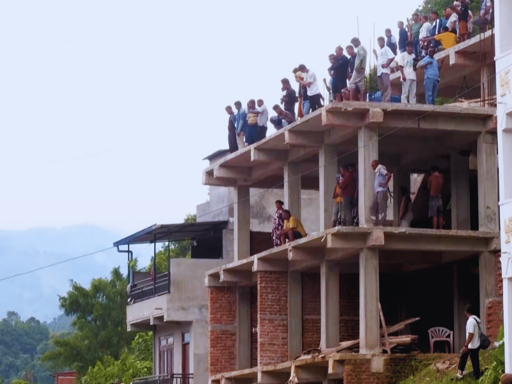

Nepal’s deadly glacial flood is a catastrophe boosted by climate change, according to experts. The crisis is both a humanitarian disaster and a warning that must be heeded in an overheated world, Greenpeace added.
Reuters reported that
“While experts caution against describing climate change as the sole, immediate trigger for Wednesday’s collapse, they say that rising temperatures and melting glaciers probably played a role in the disaster.”
Greenpeace noted that while it’s too early to link this specific event to global warming, the broader trend is clear — a warming planet is raising the risk of such disasters.
Global heating, mostly driven by fossil fuel emissions from just 32 companies, is rapidly transforming the Himalayas. Even if warming can be limited to 1.5C as a global average, more than a third of the ice volume of glaciers within the extended Hindu Kush Himalayan region is projected to be lost this century.
A torrent of water, mud and debris swept away entire communities in Nepal on 26 August 2026, killing hundreds, with hundreds more missing. According to UNICEF, the lives of at least 17,000 children in Nepal have been irreparably impacted as a result of the flash floods.
Least responsible affected
Zack Polanski said the Nepal floods are terrible and noted that climate crisis impacts often fall on those least responsible.
This is so horrendous and upsetting.
The consequences of the climate crisis being felt often by those who have done the least to cause it.
Thinking tonight of all those affected and what we’re doing to the world. https://t.co/ePaI3Lajs8
— Zack Polanski (@ZackPolanski) August 26, 2026
Former UK MP, Claudia Webbe, said that Nepal produces just 0.1% of global emissions yet was ranked the 6th most climate-affected country in 2024, adding, “We did this.”
Nepal produces one tenth of one per cent of the world’s emissions and was ranked the 6th most climate-affected country on Earth in 2024.
We did this. pic.twitter.com/dwU21QfV2q
— Claudia Webbe (@ClaudiaWebbe) August 27, 2026
Savio Carvalho, head of campaigns and networks for 350.org was quoted in Common Dreams saying:
“This moment of grief has a clear message for world leaders: Delay is deadly. Rich countries must finally deliver the finance and protection they owe frontline communities. Without a rapid transition away from fossil fuels, the planet will continue to heat up and lives can be lost in a flash.”
UK knows the Himalayan risk
Feyzi Ismail noted in Counterfire that the Nepal flood exposes a broader failure, that is, world leaders have the means to stop the climate crisis but lack the will.
Ismail points out that the UK, for instance, gathered data highlighting the likelihood of a collapse in the Himalayas by 2030. But instead of preparing and contingency planning, Westminster has been ramping up defence spending, making things worse.
She said:
The UK government, for example, in its much-delayed and abridged Joint Intelligence Committee report on biodiversity loss and national security released earlier this year, identified the Himalayas as having a realistic possibility of collapse beginning in 2030. But rather than concentrating resources on mitigating ecosystem collapse and adapting to its immediate effects, national security concerns are driving the frenzy towards defence expenditure. This expenditure will only exacerbate the crisis.
Nepal left high and dry
Your Party was the leading voice in the UK calling for an emergency relief and construction fund, to ease the burden of growing debt for Nepal.
They said:
Britain must fund emergency relief and reconstruction – not impose more debt.
The fossil-fuel profiteers caused this crisis. Make them pay.
Your Party stands with Nepal as families mourn, search for loved ones and confront the destruction of homes and livelihoods.
Britain must fund emergency relief and reconstruction – not impose more debt.
The fossil-fuel profiteers caused this crisis. Make them pay.
— Your Party (@thisisyourparty) August 27, 2026
Families in Nepal lost loved ones, homes and livelihoods within minutes.
This isn’t a natural disaster.
Nepal didn’t burn the fuel, didn’t take the profit – it only bore the cost. pic.twitter.com/4DdOwWRpTI
— Your Party (@thisisyourparty) August 27, 2026
This comes as research from Oxfam and the CARE Climate Justice Centre shows that rich countries are profiting from the climate crisis.
Nearly 70% of climate finance for the Global South is disbursed as loans rather than grants, and developing countries are now paying more to wealthy nations than they receive.
France ranks as the worst offender, with 92% of its climate finance delivered as loans, followed by Japan, Italy, Spain and Germany.
While it does not rank among the worst offenders for loan-based finance, it has used “creative” accounting to inflate its contributions, reclassifying £1.7bn for humanitarian work to appear as climate finance. This comes alongside deep UK aid cuts, slashing Official Development Assistance (ODA) spending from 0.7% to 0.3% of GNI, the lowest since 1999.
Featured image via the Canary
By Nandita Lal
From Canary via This RSS Feed.