

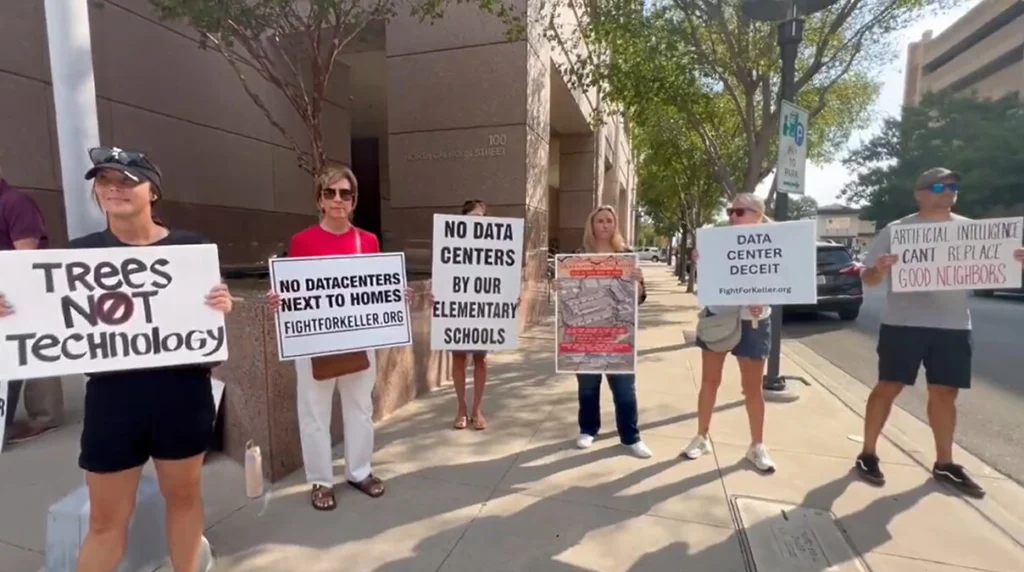
Growing opposition to data center projects is crossing party lines as Americans weigh their energy and water costs.
Data centers, the facilities that support the growing infrastructure of artificial intelligence and connect us to the internet, have become the new battleground in U.S. politics, just over two months before the midterm elections.
RELATED:
U.S. Midterm Elections To Reshape Trump’s Power Aspirations
While opposition initially was part of the Democratic Party’s policies, Republicans have joined the strategy of calling for limitations or moratoriums on the construction of these centers. As a result, the issue has taken on a bipartisan dimension in the campaign for November’s legislative and state elections, in contrast to President Donald Trump’s defense of these facilities.
1. The Rise of Data Centers
These enormous facilities, which house thousands of servers to process, store and distribute large volumes of information for cloud services, have seen their activity surge due to the growth of artificial intelligence (AI), which consumes increasingly vast amounts of energy and requires constant cooling.
The five technology giants — Amazon, Microsoft, Google, Meta and Oracle — are expected to invest more than US$750 billion in them in 2026, according to the companies’ own spending projections. That represents the largest increase in capital investment in a single sector since the railroad boom in the 19th century or the dot-com bubble.
This represents a 67% increase in technology companies’ investment compared with last year, with the vast majority destined for the development of artificial intelligence. There are about 4,000 data centers in the United States, and at least 75 more planned facilities have been affected in the first quarter of 2026 by local restrictions or moratoriums.
Check it out.
AI data centers could end up tilting the midterms.
Voters are paying attention. Some have already switched political parties over this issue, and more are asking who’s putting Big Tech ahead of their communities.
Candidates ignore this at their own risk. pic.twitter.com/sKRY72Onmd
— Christopher Webb (@cwebbonline) June 25, 2026
2. The Problem of Where to Build Them
Data centers require large tracts of land for their buildings and powerful infrastructure for cooling and electricity systems. They demand enormous amounts of water and electricity. With the cost of living the top concern for Americans, many citizens blame them for higher utility bills, while in some cases they also generate emissions if they require their own generators.
Alejandra Castillo, who served as undersecretary of Commerce during President Joe Biden’s administration (2021-2025), told EFE that they represent “such a high energy cost for the area where they are going to be built that if they wanted to build a hospital, they couldn’t.”
Although the incentive of job creation could encourage residents to accept a data center, Castillo explains that they only generate jobs “when they are being built,” and “not in the long term,” so the economic argument loses weight.
3. Citizen Opposition
Residents’ opposition to having data centers built near their homes is growing. More than 70% of Americans oppose the construction of these facilities in their towns or cities, a higher percentage than those who oppose a nuclear power plant, according to a Gallup poll conducted in May.
On July 18, 2026, more than 142 protests were held in 42 states during a national day of action coordinated by Humans First, an organization that argues that the expansion of AI should be carried out by prioritizing citizens over large corporations.
Republicans have given data centers a blank check to raise our utility bills, poison our air, and drain our water.
Now voters are making them pay for it. https://t.co/CUeW1p4OIR
— Climate Power (@ClimatePower) August 26, 2026
4. The Political Response
In an election such as the Nov. 3 vote, in which all 435 seats in the House of Representatives, one-third of the 100 Senate seats and numerous local and regional offices are up for election, politicians make decisions closely aligned with voters’ opinions and needs.
Democratic politicians have opposed the construction of these centers in their territories, including Abdul El-Sayed, the Democratic candidate for the U.S. Senate from Michigan, and New York Gov. Kathy Hochul, who has banned their construction for one year.
Other Democrats, such as Pennsylvania Gov. Josh Shapiro, have changed their positions, going from touting the fact that they had secured a huge data center to imposing strict requirements. In this context, and with election polls increasingly unfavorable to Republicans, many candidates have reconsidered their decisions.
Texas Gov. Greg Abbott, a Republican, went from promoting his state as a center for artificial intelligence development to ordering a pause earlier this month on new projects until their effects on the power grid and water consumption are reviewed.
5. The International Race for AI
The White House continues its policy of promoting the construction of these data centers as part of the technological race with China, and President Donald Trump has opposed Republicans’ change in position.
Thus, data centers have become a subject of public debate in the United States, and their electoral consequences, although they cannot yet be measured, will affect the results of the Nov. 3 election.
teleSUR/ JF
Source: EFE
From teleSUR English via This RSS Feed.