

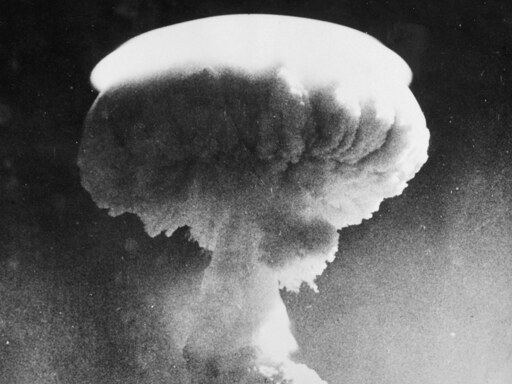

President Trump’s threatened restart of explosive nuclear weapons testing would be “absolutely catastrophic”, and the UK Government must stand against it, campaigners have said on the UN’s International Day against Nuclear Testing (29 August).
UN secretary-general António Guterres said:
This year marks 30 years since the Comprehensive Nuclear-Test-Ban Treaty opened for signature and 35 years since the closure of the Semipalatinsk nuclear test site. Such milestones remind us that humanity can and must choose restraint over ruin.
Nuclear tests do not prove strength. They shatter trust, invite reciprocal tests, fuel a nuclear arms race and betray every community still living with the legacy of past nuclear tests.
The world must never witness another nuclear explosion. I call on all States possessing nuclear weapons to maintain existing moratoria and act to bring the Comprehensive Nuclear-Test-Ban Treaty into force without delay.
Let’s remember why this Day exists. Let’s re-commit to ending nuclear testing.
UK nuclear weapons tests
The UK has a long legacy of conducting its own nuclear weapons tests in the 1950s and 1960s. With a new nuclear arms race underway, the US is now threatening to restart its own explosive nuclear weapons testing programme.
In October 2025, Reuters reported that Trump had:
ordered the U.S. military to immediately restart the process for testing nuclear weapons after a halt of 33 years, a move that appeared to be a message to rival nuclear powers China and Russia.
In the House of Lords on 20 November 2025, former First Sea Lord and former Security Minister Lord West of Spithead asked what assessment the government had made of the news about Trump’s order.
Responding, Ministry of Defence (MOD) minister of state Lord Coaker said:
The United Kingdom has ratified the Comprehensive Nuclear Test-Ban Treaty and continues to press for its entry into force. We remain committed to our voluntary moratorium on nuclear test explosions, having ceased nuclear testing in 1991.
The nuclear testing policy of the United States is a matter for the US Government, and it would therefore be inappropriate to comment further.
The MOD was approached for comment about International Day against Nuclear Testing.
UK should not support creation of ‘new generation of nuclear test veterans’
Reflecting on the UN day, LABRATS (Legacy of the Atomic Bomb, Atomic Test Survivors) founder Alan Owen told the Canary:
The UK should not support the resumption of nuclear testing by the USA, there should not be a new generation of nuclear test veterans, the world has seen the devastation caused by these weapons, the damage done to the planet and the innocent people who died because of the testing program.
In fact, the UK should go further and send an observer to the TPNW (Treaty on the Prohibition of Nuclear Weapons) Review Conference being held at the UN in New York at the end of November with a view to signing the treaty.
It should engage with the communities affected by the UK testing program and provide support under Articles 6 and 7.
A Campaign for Nuclear Disarmament spokesperson told the Canary:
A return to explosive nuclear testing by the US would be absolutely catastrophic. It would very likely lead to a rush by other nuclear weapons states to restart their own testing programmes.
This would hugely increase the risks of a nuclear confrontation. And, of course, it would be disastrous for the environment as well as the whole of humanity. It must be vigorously opposed.
University of Oxford research associate Fiona Bowler completed her PhD on Britain’s atmospheric nuclear testing programme and the impact it had on the veterans who served in the military during the tests.
Bowler told the Canary:
The legacy of British nuclear testing is one that continues to affect families across Britain. The United Kingdom must stand against the resumption of nuclear testing, particularly if Andy Burnham is to fulfil his promise to deliver justice to the veterans who witnessed atmospheric nuclear tests during the 1950s and 1960s.
The UN is clear about the dangers of nuclear testing. All of us live with the consequences of intensive Cold War testing, and in my work as a historian I have had the privilege of working with communities who have fought for justice.
It is vital that we listen to, support, and work with these communities to redress the impact of testing and ensure it does not resume.
It is unclear whether Trump will follow through with his threat to restart explosive nuclear weapons testing. If he did, it would likely mark a dangerous new escalation in the new nuclear arms race.
Featured image via Wikimedia

By Tom Pashby
From Canary via This RSS Feed.