

By Jhay de Jesus, Asia Organizer, World BEYOND War, August 28, 2026
In many places, U.S. military bases pose significant threats and risks to local communities and sectors. Regular base operations and military exercises have led to environmental destruction, the displacement of Indigenous communities from their ancestral lands, and an increase in human rights violations, particularly gender-based violence.
It must end now!
U.S. military installations account for 70% to 85% of all foreign military bases worldwide, spanning over 800 bases across 95 countries and territories.
In our latest report, World BEYOND War found that Europe hosts the highest proportion of U.S. bases at 38%, followed by East Asia and the Pacific at 28.2%.
U.S. Bases and Agreements in East and Southeast Asia
A quick search shows that U.S. military bases and other facilities currently total 245 sites in the region, including those classified as major bases, unclassified permanent installations, or smaller facilities such as communication outposts and shared host-nation sites.
Japan hosts the largest number of U.S. bases in Asia and ranks second globally, with more than 100 sites and 55,000 personnel. South Korea ranks second in Asia and third globally, with over 70 bases and 29,000 personnel. The Philippines is third in the region, with a total of 13 military sites. Other countries hosting smaller U.S. military presences include Thailand, Singapore, Cambodia, and Taiwan.
These bases result from various bilateral military agreements that the U.S. maintains to secure its interests and protect its regional hegemony. Several key agreements remain in place, including the Military Assistance Agreement with Thailand (1950), the Mutual Defense Treaty with the Philippines (1951), the Mutual Defense Treaty with South Korea (1953), and the Treaty of Mutual Cooperation and Security with Japan (1960). Furthermore, the Taiwan Relations Act of 1979 serves as a U.S. domestic law requiring Washington to provide Taiwan with weapons.
Japan’s 100-plus U.S. military sites feature several major hubs, with a heavy concentration in Okinawa Prefecture. These primary hubs include Kadena Air Base (for Air Force power projection), Marine Corps Air Station Futenma, and U.S. Army Garrison Okinawa (Torii Station). Across Honshu, facilities include Yokota Air Base—home to United States Forces Japan (USFJ) and the Fifth Air Force—Yokosuka Naval Base (home port of the U.S. 7th Fleet), Camp Zama (U.S. Army Japan), and Misawa Air Base in Aomori Prefecture. Additionally, Marine Corps Air Station Iwakuni and Sasebo Naval Base are located in Yamaguchi and Nagasaki Prefectures, respectively. These bases are positioned to provide rapid-response capabilities across the Western Pacific, the Taiwan Strait, and the South China Sea.
In the Philippines, the Mutual Defense Treaty paved the way for subsequent agreements that allowed the U.S. to expand its military footprint. The Visiting Forces Agreement (VFA) governs the entry, status, and criminal jurisdiction regarding U.S. military personnel staying temporarily in the country. This agreement was ratified solely by the Philippine Senate, without reciprocal legislative approval in the U.S. The Enhanced Defense Cooperation Agreement (EDCA) serves as an operational and logistical framework allowing U.S. troops to rotate through designated “agreed locations,” preposition supplies, and construct joint-use infrastructure. These agreements have increased troop rotations and led to instances of crimes committed by U.S. personnel with limited accountability under Philippine law. High-profile cases, such as the Subic rape case and the murder of transgender woman Jennifer Laude, resulted in the perpetrators being transferred back to U.S. custody rather than serving their sentences in a local Philippine jail.
In South Korea, the Mutual Defense Treaty led to the creation of the Status of Forces Agreement (SOFA) and the Special Measures Agreement (SMA). In 2024, both nations signed the 12th SMA, covering the 2026–2030 period. Under this agreement, South Korea helps fund the cost of stationing U.S. Forces Korea. The agreement supports the joint defense posture and the presence of roughly 28,500 U.S. troops by covering non-personnel operational expenses outside the standard SOFA framework. South Korea’s contribution for 2026 is set at 1.52 trillion won (approximately $1.13 billion), an 8.3% increase from 2025.
First Island Chain
The First Island Chain is an archipelago in the Western Pacific Ocean stretching from Japan through Taiwan to the island of Luzon in the Philippines. It is geographically vital as it serves as a maritime boundary separating China’s coastline from the open Pacific. The primary territories along this chain are close allies or key partners of the United States, hosting several foreign military installations under different bilateral security agreements.
Taiwan sits at the center of this chain, playing a crucial role in both the economic and military significance of the region. Any conflict or disruption involving Taiwan would trigger cascading effects across global manufacturing, international telecommunications, and military technology supply chains.
Passages such as the Taiwan Strait and Luzon Strait are critical choke points for economic trade routes, maritime transit, surveillance, and regional military exercises. These straits sit adjacent to major industrial and export hub areas, including Shanghai, Ningbo Zhoushan, and Shenzhen. For China, the chain represents a strategic buffer zone.
The U.S. sees the chain as a line for containment and maritime monitoring. Its sole purpose for the U.S. is to restrict potential naval and submarine movement from its rivals and mobilize support from allied countries and territories.
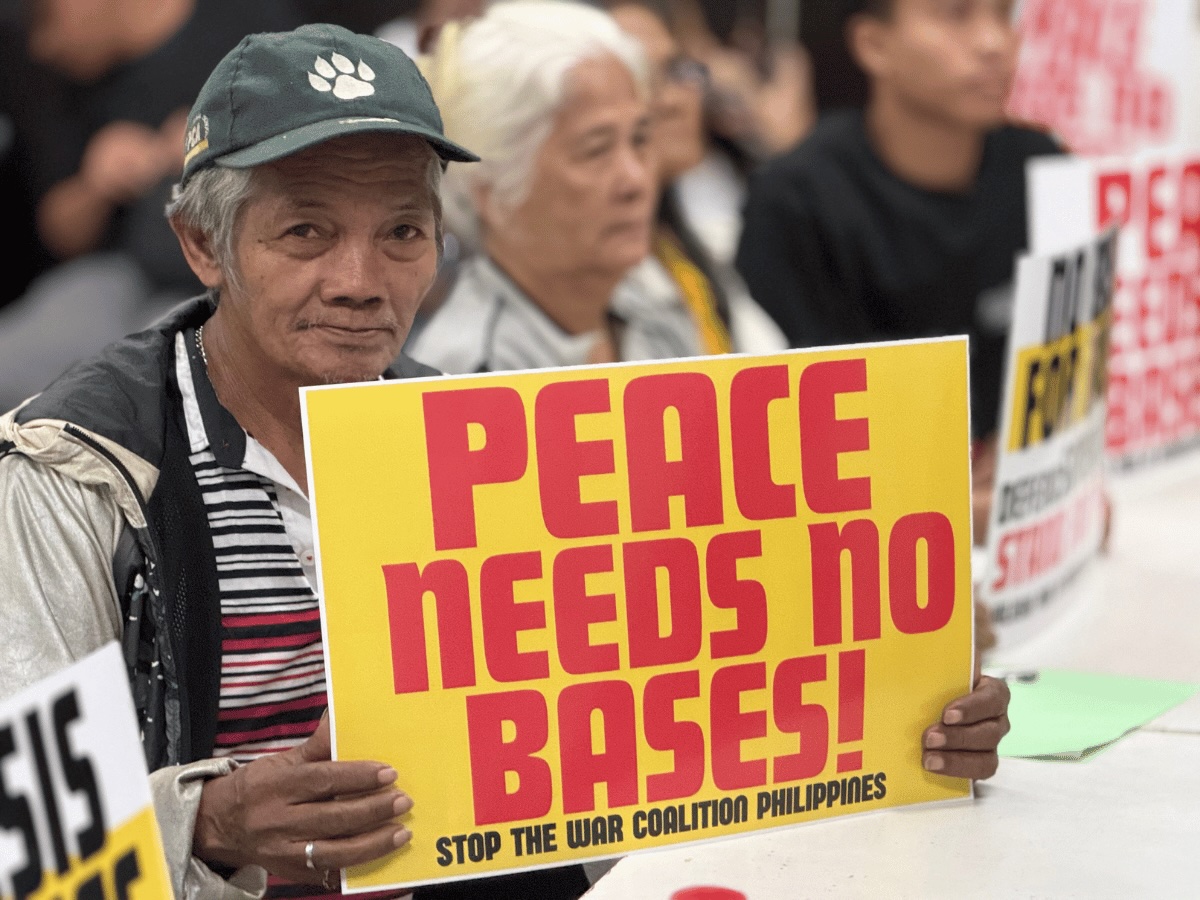
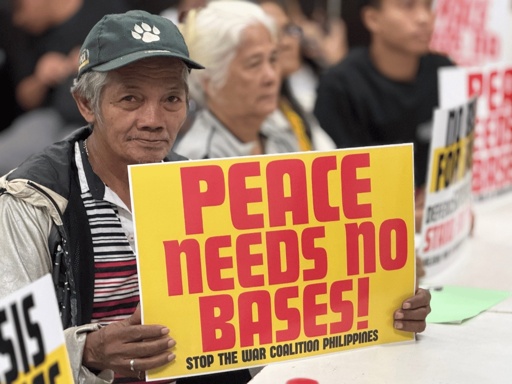
KILUSAN, Stop the War Coalition Philippines, and World BEYOND War organized a hybrid forum during the 2026 Global Day of Action to Close Bases in February at the Commission on Human Rights in the Philippines (photo: WBW)
The People’s Response to Military Bases
The Philippines has a long history of rejecting foreign military presence. On September 16, 1991, the Philippine Senate voted to reject the treaty that would have extended the lease on Subic Naval Base for another 10 years. Its counterpart, Clark Air Base in Pampanga, had already been rendered inoperable earlier that year following the cataclysmic eruption of Mt. Pinatubo. For decades, the Filipino people have organized against foreign military bases. Although current legal frameworks and bilateral agreements have since allowed a rotational military presence, this pivotal chapter in history proves that a nation viewed as a U.S. neocolony can take a decisive stand against hegemony.
Japan’s “Anpo Protests” (Anpo Tōshō) represent another significant milestone in regional opposition to foreign military bases. In 1960, the passage of the revised Treaty of Mutual Cooperation and Security sparked massive, widespread demonstrations across the country. Hundreds of thousands of Japanese citizens took to the streets, ultimately forcing the cancellation of a planned visit by U.S. President Dwight D. Eisenhower and leading to the resignation of Prime Minister Nobusuke Kishi. A decade later, in 1970, another wave of major protests erupted around the treaty’s scheduled renewal date, uniting university students, community organizations, and anti-Vietnam War activists. In Okinawa, where U.S. military bases are concentrated, local residents continue to oppose military presence stating that having military bases makes the communities vulnerable to attacks from rival countries. In a teleSUR interview in January 2026, a local leader said that the root of all problems in Okinawa stems from the U.S. military bases.
Taiwan has also witnessed intense public outrage over atrocities and jurisdictional immunity granted to U.S. military forces. On May 24, 1957, the widow of Liu Ziran, a civilian employee murdered by a U.S. Army officer, protested outside the U.S. Embassy in Taipei alongside her daughter following a U.S. Military Court-Martial’s acquittal of U.S. Military officer Sgt. Robert G. Reynolds. The incident triggered widespread riots across Taipei. The event highlighted deep concerns that foreign military presence can result in violence and a lack of accountability when personnel are shielded by military courts on foreign soil.
South Koreans have similarly voiced strong opposition to U.S. military bases and jurisdiction. A notable peak occurred in 2002 following massive nationwide outrage when two middle school students, Shim Mi-seon and Shin Hyo-sun, were struck and killed by a U.S. military armored vehicle in Yangju. Although the South Korean government requested jurisdiction over the trial, the U.S.–South Korea Status of Forces Agreement (SOFA) allowed the U.S. military to retain custody. The two U.S. servicemen were charged with negligent homicide but were subsequently acquitted by a U.S. Military Court-Martial, triggering widespread anti-base movements. Residents on Jeju Island have been protesting continuously against the naval base built next to a UNESCO biosphere reserve. In 2011, construction was halted several times by protesters concerned about the base’s environmental impact and who saw it as a U.S.-driven project directed at China, but the South Korea Supreme Court legally upheld the construction in 2012. Though the base eventually opened in 2016, citizens continue to demand the removal of the military base from their island.
These historical milestones reflect enduring regional opposition to foreign military installations. To this day, local communities continue to experience the impacts of foreign military presence alongside ongoing demands for justice.
These shared sentiments across the region, for accountability and for the removal of foreign military bases, can help strengthen coordinated advocacy campaigns throughout Asia.
Call to Close the Bases
U.S. foreign military bases around the world continue to impact communities’ lives and livelihood. The long history of U.S.-led wars and occupation has resulted in human rights violations from community displacements, sexual abuses, and killings. We must amplify our voices and escalate our demands to CLOSE THE BASES.
Furthermore, we call for the end of military agreements with the U.S. These unequal agreements have no value to our countries and further endanger our lives and communities.
U.S. out of Asia!
Close the Bases! Pull-out U.S. Troops in Asia!
End all Military Agreements! End all Military Exercises!
The post End Global Militarization. CLOSE ALL BASES. U.S. Troops Out of Asia NOW! appeared first on World BEYOND War.
From World BEYOND War via This RSS Feed.