

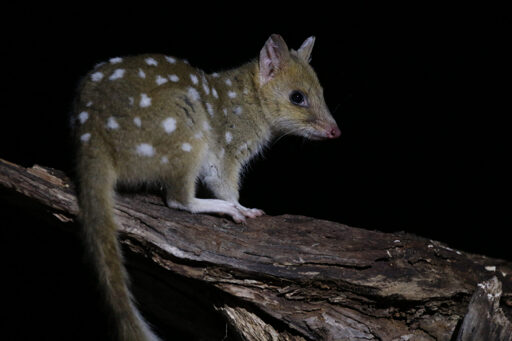
SYDNEY — The endangered eastern quoll, one of Australia’s species of quoll, is a nocturnal carnivorous marsupial that is small in stature with a ferret-like pointed face and a bushy tail. The mammal has two primary color variants: Light fawn and blackish-brown, with white spots on the body. Once so widespread along the eastern coastal fringe of Australia, the eastern quoll (Dasyurus viverrinus) was described as being in “plague abundance” and was occasionally kept as a pet and prized by farmers for its skills in hunting rodents. It was even called a native cat in the 1800s due to its resemblance in both size and hunting behavior to the domestic feline, brought by settlers from Europe. Despite its onetime abundance on the Australian mainland, by the 1960s the last known remaining eastern quoll population was lost. Disease, habitat loss, car strikes and predation by cats, dogs and invasive foxes led to the demise of the species. However, a taxidermied specimen of an eastern quoll emerged in 2016, purportedly originally picked up as roadkill in the Barrington Tops, northwest of Sydney, in 1989 and handed over to the National Parks and Wildlife Service nearly three decades later. This could mean that the species survived for decades longer than official records suggest. Although now considered extinct in the wild on the mainland, the eastern quoll has not been lost entirely. The southern Australian island of Tasmania, free of the predatory invasive foxes, is home to a number of wild populations of eastern…This article was originally published on Mongabay
From Conservation news via This RSS Feed.