

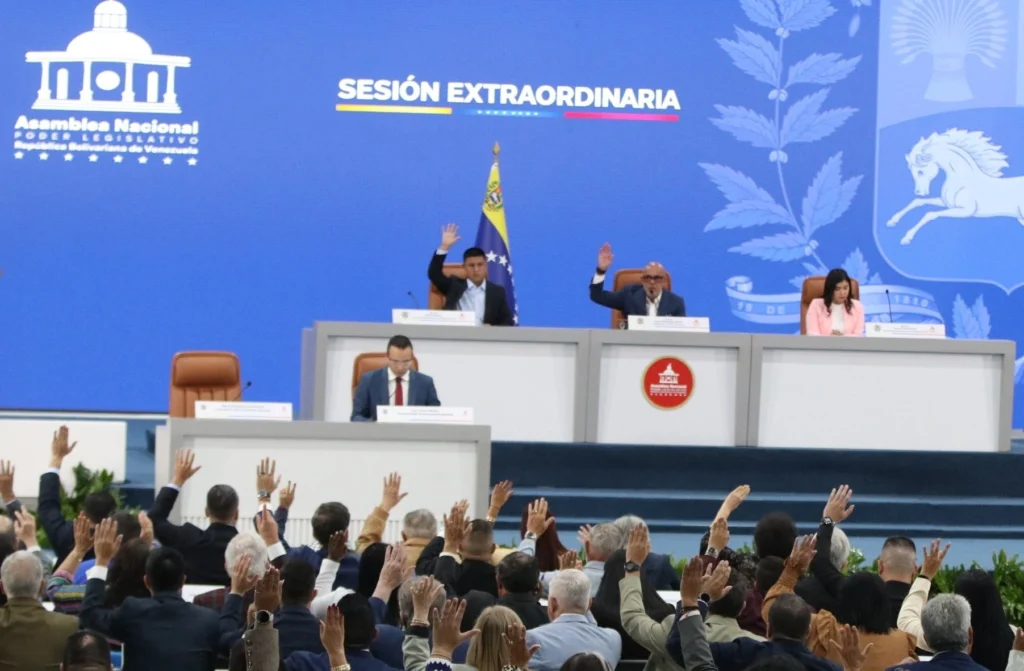
Venezuela’s National Assembly unanimously approved in first discussion this Thursday a partial reform of the Supreme Court of Justice to reshape judicial appointments and reactivate the renewal of magistrates.
The National Assembly of Venezuela gave its unanimous backing on Thursday to a bill that partially reforms the Supreme Court of Justice (TSJ, in Spanish). The vote took place in first discussion, the initial stage of a legislative process that still requires further debate.
The initiative seeks to adjust the structure of the Judicial Applications Committee, the body in charge of evaluating candidates for the highest Court, and to reactivate the renewal of magistrates in the country.
RELATED: Venezuelan Acting President Enacts Housing Construction Law After Earthquakes
The proposal was presented by Pedro Infante, first Vice-president of the Venezuelan Assembly. Infante said the project is grounded in the Constitution and aims to combat procedural delay and strengthen institutional consolidation.
“The concrete proposal is to move to 23 members of the Applications Committee, with a very important substantive difference, leaving 11 the number of deputies and moving to 12 members from the different sectors of civil society or of Venezuelan society,” he explained.
He added that the reform emerged from dialogue with opposition sectors. “As a result of that dialogue there was an agreement signed on August 12 of this year… and in that sense, one of the agreements proposes initiating a process that contributes to the transformation of the justice system and proposes the reform of the Organic Law of the Supreme Court of Justice, specifically article 65,” Infante said.
The lawmaker placed the reform within a broader plan that includes the renewal of the authorities of the Citizen Power and progress of the Amnesty Law, which registers more than 15,037 requests and has granted 314 freedoms, including 8,429 absolute freedoms.
En Sesión Extraordinaria de la Asamblea Nacional aprobamos:
• 1ra discusión de la Reforma Parcial de la Ley Orgánica del TSJ.
• 2da discusión del Acuerdo de la Alianza Internacional de Grandes Felinos.
• Designación del Embajador ante la República Árabe de Egipto. pic.twitter.com/v364wnfiDR
— Jorge Rodríguez (@jorgerpsuv) August 27, 2026
Text reads: “In an Extraordinary Session of the National Assembly we approved: Appointment of the Ambassador to the Arab Republic of Egypt and other states, 1st discussion of the Partial Reform of the Supreme Court of Justice (TSJ) Organic Law, 2nd discussion of the International Big Cat Alliance Agreement.”
The President of the National Assembly, Jorge Rodríguez, called for a structural change in the Judiciary to eradicate the commodification of the administration of justice and eliminate distortions in the review of precautionary measures. Rodríguez said the appointment of the 32 magistrates will be the responsibility of the sitting parliamentarians, with strict adherence to constitutional parameters.
The selection process had been interrupted after the double earthquake of June 24. The previous stages began in April, when the number of magistrates on the Court was raised from 20 to 32.
The Applications Committee currently operates with 21 members, 11 parliamentarians and 10 from civil society. Under the proposed reform, the body would grow to 23 members, keeping the same number of lawmakers and adding two more seats for civil society, which would hand civil society a narrow majority in the evaluation of candidacies.
Giving civil society a more direct role in the committee shifts the balance of the selection mechanism, the bill now continues its parliamentary course. The unanimous first discussion marks a step forward for an agreement signed on August 12, and the next move belongs to the legislative calendar.
From teleSUR English via This RSS Feed.