

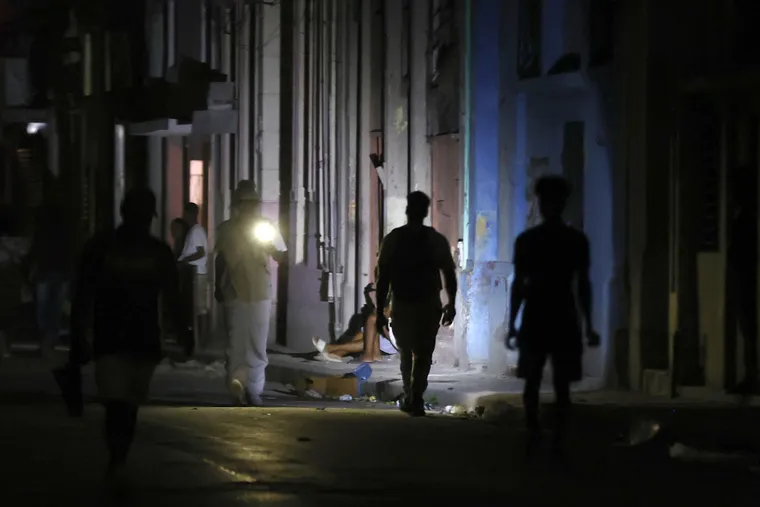
A partial disconnection of Cuba’s national electric system cut power to 3.4 million people across the eastern region this Thursday, the second outage of its kind this month.
The National Load Dispatch, an office of the Electric Union under the Ministry of Energy and Mines, reported that an oscillation in high-voltage transmission lines took three thermal generation units offline on August 27.
The affected plants were unit 6 at the “Antonio Maceo” thermoelectric station, unit 1 at the “Lidio Ramón Pérez” plant -known as Felton-, and unit 6 at the Diez de Octubre station. The failure left eastern provinces from Holguín to Guantánamo without supply.
RELATED: Cuba Rejects Trump’s Decision to Extend the U.S. Blockade
It follows a partial blackout on August 1 that affected seven provinces. In recent weeks the system also suffered two total collapses, bringing the number of outages in 2026 to seven.
#AHORA || Debido a una oscilación en las líneas de transmisión salen de servicio, Felton 1, Nuevitas 6, Este Habana 2 y Renté 6
Debido a esto quedan desconectadas del SEN las provincias de la región oriental, desde Holguín hasta Guantánamo.
Continuaremos informando. pic.twitter.com/RZgWM3yCwY
— Unión Eléctrica de Cuba (@OSDE_UNE) August 27, 2026
Text reads: “Due to an oscillation in the transmission lines, Felton 1, Nuevitas 6, Habana East 2 and Renté 6 are out of service. Because of this, the provinces in the eastern region, from Holguín to Guantánamo, are disconnected from the National Electric System (SEN). We will continue to inform.”
Blockade Fuels Crisis
The energy emergency has a direct external cause. The oil blockade decreed by the Trump administration in January continues to prevent crude from reaching the Caribbean country. Only one vessel, the Russian tanker Anatoly Kolodkin, has entered a Cuban port so far in 2026, carrying 100,000 tons.
Thermoelectric generation accounts for about 40% of Cuba’s energy matrix, and the blockade has aggravated the difficulties in that segment. Distributed generation, which represents another 40%, depends on imported diesel and fuel oil that no longer enters the country because of the U.S. siege.
The White House has added dozens of rounds of unilateral coercive measures in 2026, deepening an economic war that has nearly paralyzed the Cuban economy. The shortage of energy hits the productive sector and transportation, but also education, water supply, food distribution and conservation, and the health system, including the operation of the hospital network.
Gas and renewable sources, mainly solar photovoltaic fields, cover about 20%of the matrix. That share, however, is not enough to offset the petroleum deficit.
The repeated failures expose the fragility of a generation system designed around large thermal plants and fuel imports, both now under direct pressure from Washington’s policy. For the eastern provinces, the return of service depends on restoring the three units and stabilizing a transmission network that has shown signs of strain under the current load.
The reconnection depends largely on factors outside the grid itself. As long as the oil blockade remains in force, fuel deliveries will stay scarce and the risk of new disconnections will persist.
From teleSUR English via This RSS Feed.